
You Can Feel It Before You Can Prove It
When the dashboard says Green but your gut says Red


This article is a collaboration with PMP "Я" US - a publication that provides practical project management tips that actually work for managing teams, side hustles, and life projects.
The project shows green on the dashboard. Milestones are technically on track. But something shifted in last Tuesday’s status meeting. Your project manager gave a vague answer about coordination with a partner team. The sponsor nodded along but didn’t ask follow-ups. And when you pressed on the delay, everyone suddenly had somewhere else to be.
Projects don’t collapse overnight. They deteriorate through small misalignments and questions nobody wants to ask.
I’ve seen it dozens of times. A project that looked solid on paper, with an experienced team, clear scope and executive support starts showing cracks. Not in the work itself, but in how people talk about the work.
📑 Updates get vaguer.
⌛️ Meetings get shorter.
⚠️ Risk discussions disappear from the agenda.
Other signals worth watching:
People stop volunteering information and only answer direct questions.
The language becomes more formal and less conversational.
Humour disappears from team interactions.
Side conversations happen after meetings instead of during them.
Key decisions get deferred repeatedly without clear reasons.
These are trust indicators: when trust erodes, information flow changes first. And this is when leaders matter most. Yes, this is also exactly when many of them stop asking questions. Why do capable leaders go silent when uncertainty hits? And what does that silence cost?
The Psychology of Avoidance
Uncertainty makes people protect themselves and, naturally, leaders feel it too. When a project starts wobbling, the leader who’s been collaborative and curious suddenly shifts. They stop asking “What are we learning?” and start declaring “Here’s what we’re doing.” Open discussions become status reports. Listening becomes directing.
I watched this happen with a VP running an organisational change programme. For months, they’d been great: asking hard questions, acknowledging gaps, creating space for the team to surface problems. Then a key milestone was missed. The next meeting, they walked in with a new plan and started assigning tasks: no questions and no discussion, just control. The team obviously went quiet… not because they agreed, but because the door had closed!
The behavioral shift happens fast. Leaders worry that asking questions makes them look uninformed or indecisive. They fear losing control at the exact moment they need to maintain it. So they flip from curiosity to command: asking questions feels uncertain, whereas giving answers feels powerful.
Watch how language changes:
🎯 “What are we missing?” becomes “Here’s what we need to do.”
💭 “Help me understand the delay” becomes “Get this back on track by Friday.”
😬 “What’s your biggest concern?” disappears entirely.
The tone shifts too. Conversations get more transactional, and the mood shifts from listening to talking. This is a serious problem: the more uncertain things get, the more leaders need to ask questions. Yet the less likely they are to actually do it.
The shift from curiosity to control can rapidly lead to a stagnant information environment:
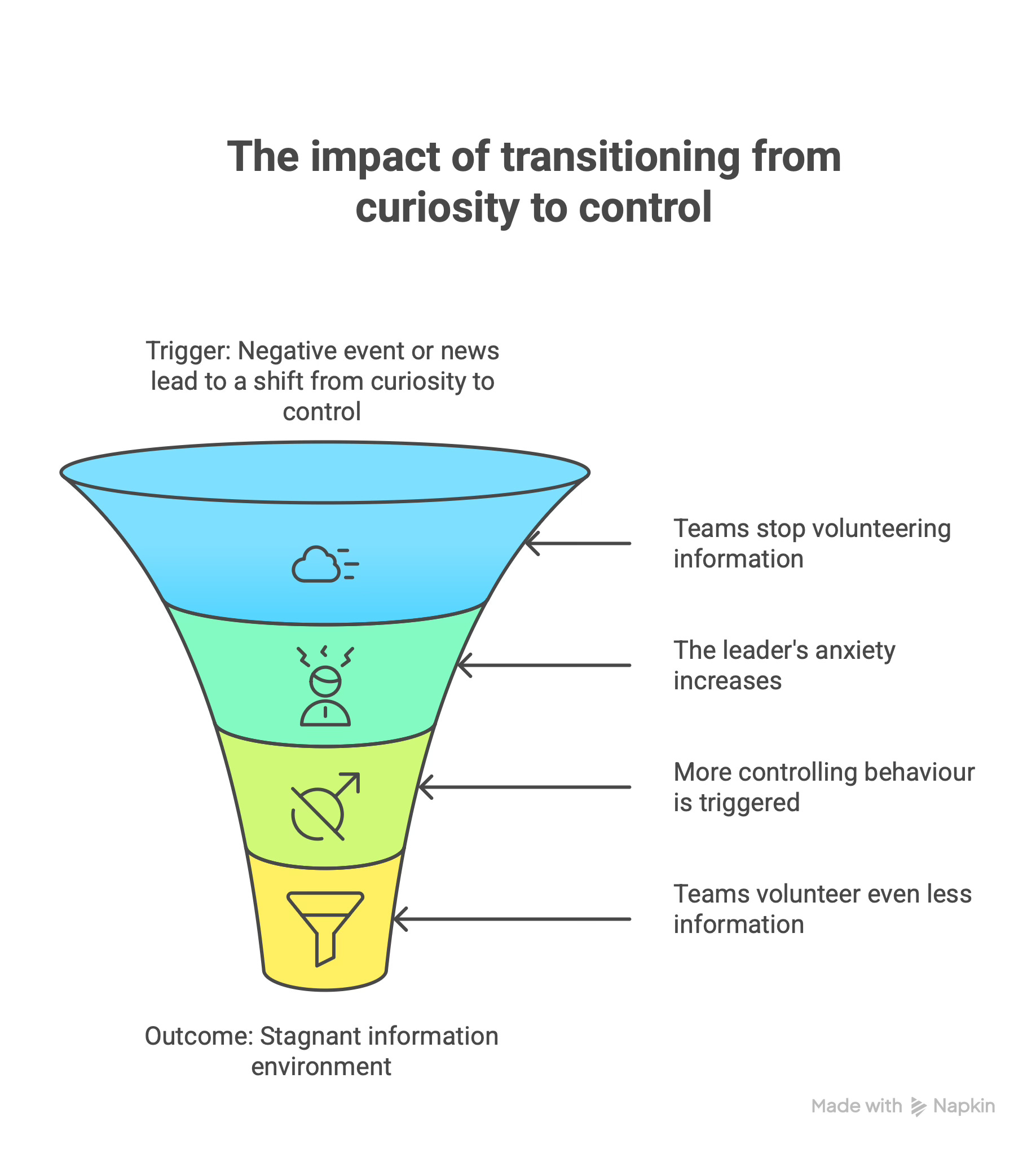
Once that shift happens, teams stop telling you what’s really going on. And that’s when projects go from wobbling to failing. Breaking this loop requires conscious intervention. The leader has to notice the shift happening and actively choose a different response. This means building self-awareness about your stress signals and having a plan for what to do when you feel them.
The Power of Asking Early
In our experience, there are two types of leaders when projects start going sideways. The first waits for certainty; the second looks for truth. The first manages the dashboard; the second manages the conversation.
The difference is quite simple: it’s all about practice. And the good news is we’re here to share some tips. Early questions sound different than crisis questions: in that they are not accusatory and take a genuine interest in understanding what is true. There’s no pointing fingers.
Here are some examples of questions that surface reality:
What feels riskier than it looks on paper?
What’s one assumption we’re making that could be wrong?
If you were explaining this project to someone outside the team, what would make you hesitate?
What are we not talking about that we should be?
These questions work because they acknowledge uncertainty without assigning blame (they are also great for coaching!). And, as Argyris & Schön remind us, reflecting on assumptions enables organisations to catch mis-alignments early, rather than simply fix symptoms.
I started using “What feels riskier than it looks?” in my own projects after watching too many teams hide problems until they became disasters. The question does two things. First, it gives people permission to voice concerns without hard evidence. Second, it separates the public narrative (what’s in the status report) from the private reality (what people actually think). The first time I asked it in a project review, the room went quiet. The project manager said, “Our associate keeps promising the materials are ready, but every update feels off.” Turned out the associate was two months behind. We would have found out eventually, but only when it would be too late to pivot!
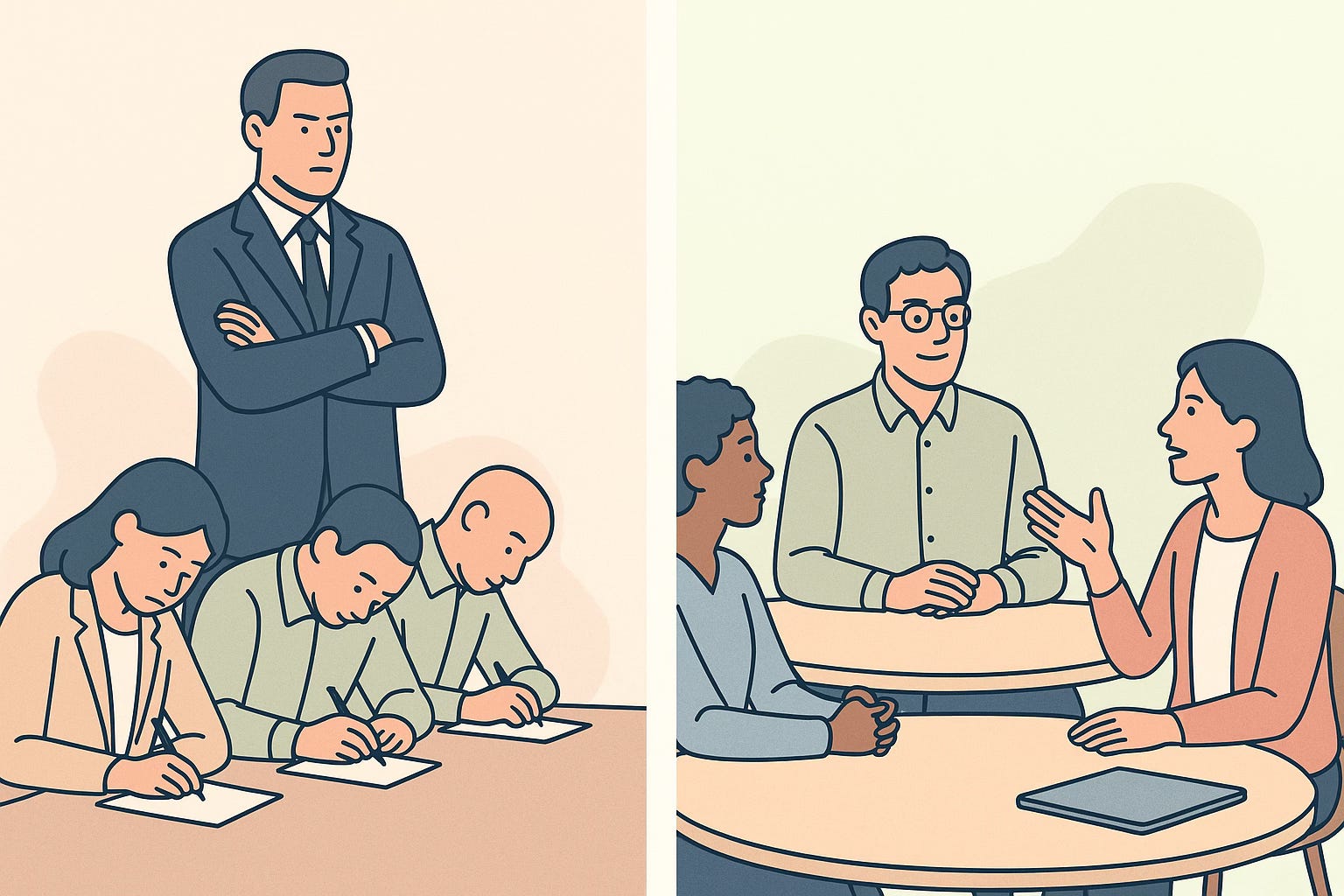
Asking early also serves to stabilise trust: when leaders demonstrate they want to hear the truth before small issues spiral into crises, teams stop waiting for permission to speak up. This is exactly where psychological safety is built.
Building a Positive Habit
Knowing what questions to ask is one thing. Actually asking them consistently is another. Here are practical ways to build the habit:
➡️ Create predictability: Reserve the last 10 minutes of every status meeting for one of these questions, and make it predictable. When teams know the question is coming, they prepare for it. When it never comes, they assume you don’t want to know.
➡️ Ask in writing first: Some people need time to think before they speak. Send difficult questions a day before the meeting. Give people space to formulate their answer without the pressure of a real-time response under the spotlight.
➡️ Separate question time from decision time: Make it clear you’re not looking for solutions yet. You’re just trying to understand what’s happening. This removes the pressure to have answers and makes it safer to voice concerns.
➡️ Ask the same person twice: If someone gives a surface answer, wait a beat and ask again with genuine curiosity. “Tell me more about that” or “What makes you say that?” The second answer is often better.
➡️ Track the pattern, not just the content: Notice who speaks up and who doesn’t. Notice which topics generate energy and which generate silence. The pattern will tells you where the concerns are hiding.
Restoring Safety and Direction
What if you miss your window to ask early? What if avoidance has set in and your team is already retreating into silence? You can’t force psychological safety back into existence, but you can reintroduce curiosity. In fact, research identified “leader humility as a preventative antecedent to team silence.”
Here is a framework that works in our experience: Name → Normalise → Nudge. Let’s take a look:
Name the uncertainty. Don’t pretend everything’s fine and don’t soften it. Just state what’s true.
“We’re three weeks behind on the testing phase, and we’re not clear why.”
“The integration isn’t going the way we expected.”
“We assumed vendor coordination would be straightforward. It’s not.”
Naming problems breaks the silence and signals that what is happening is up for discussion.
Normalise the discomfort. Remind people that uncertainty is part of how projects work, not a sign of failure.
“Projects at this stage always test our assumptions.”
“We’re in the messy middle. This is when we figure out what we got wrong in planning.”
“Every project I’ve led has had a moment like this. It’s not unusual, it’s just uncomfortable.”
Normalisation reduces the shame that keeps people quiet and reframes uncertainty as expected rather than catastrophic.
Nudge inquiry. Open the door for questions without demanding answers.
“What do we need to understand better right now?”
“What would help us make smarter decisions this week?”
“If we could have one honest conversation, what should it be about?”
These aren’t rhetorical questions, so you have to really mean them. And you have to wait for answers, even if the silence feels awkward. Silence after a question is information. It tells that people might be:
Thinking (productive silence)
Deciding if it’s safe to speak (cautious silence)
Doubting your intentions and whether you really want to know (cynical silence)
Your job is to hold the space and not fill it. The first person who speaks after that silence will often say something impactful that can unlock the conversation.
I used this approach on a failing product launch. We’d missed two deadlines and the team was barely talking in meetings. I opened the next stand-up with: “We’re behind and I don’t fully understand why. That’s on me. What do we need to talk about that we’re not talking about?” Nobody spoke for what felt like five minutes, then the design lead said, “We keep getting requirements changes that contradict each other, but nobody wants to push back on the stakeholders.” That opened the floodgates, and within twenty minutes we’d surfaced several different problems the team had been sitting on.
When someone surfaces a difficult truth, you should aim to respond in a way that proves their honesty was safe and worthwhile. Start by acknowledging it promptly: you can say something like “Thank you for saying that” or “I’m glad you brought this up” to signal that speaking up carries value. Then, ask clarifying rather than defensive questions, inviting them to expand (“Help me understand more about that”). Then, make the next step visible so they know their courage led somewhere, even if it’s simply, “I don’t know what to do yet, but I’ll figure it out by Friday.” And finally, follow up publicly in the next meeting, referencing what was raised and what you did about it. This builds a track record that honesty leads to action, reinforcing a culture where challenges are safe to share.
Lean In And Start Asking
Great leadership is defined by the quality of attention and inquiry in moments of ambiguity.
When projects go wrong, people look for certainty. They would like to have someone tell them that everything will be fine or to show them a clear path forward. But certainty is a fantasy: projects are complex, dynamic and deeply human. So all we can do is decide how we respond.
Indeed, the best leaders offer clarity about what matters right now rather than about what is going to happen. And this creates confidence: not the fake confidence that comes from pretending everything’s under control, but the real kind that comes from knowing your leader sees reality and won’t hide from it.
So audit your own questioning habits: Next time a project starts to wobble, notice your instinct. Do you clamp down and start directing? Or do you lean in and start asking?
The questions you avoid tell you everything about the leader you’re becoming.
Enjoyed this post? Paid members receive exclusive access to my practical guides, templates, the Value Proposition workbook, my Report QA Editor, and a new series on surveys, interviews and group exercises.
I’m Andrea, a management consultant with over a decade of experience across industry and academia. I work with commercial, non-profit, academic and government organisations worldwide, helping them capture meaningful insights through mixed methods research.
I write about practical frameworks to help you discover what others miss. My main goal is to translate complex concepts into techniques that readers can use immediately.
 | A guest post by
|
"When trust erodes, information flow changes first." Oh, have I seen this play out. Things get very dangerous very quickly. It's a great example of how, when feedback loops collapse, problems inevitably emerge.
Great post. The early signals you describe are the ones most leaders miss, and you captured them clearly. Projects rarely fail due to a single big event. When I saw them fail, it was through shifts in tone, language, and interaction long before the dashboard shows anything. The way you laid out those subtle indicators makes them visible in a way people can actually use. Thank you for the post.