


In this conversation, I’m joined by Jason L Zimmerman of 3Fold Outcomes to work through a scenario that most strategy discussions leave abstract: what happens in a boardroom when the worst arrives.
In our (real) story, it’s a Wednesday. A US healthcare provider with eleven sites and roughly a thousand employees has payroll due Friday and about a million dollars missing. Panic ensues, as you would expect.
The CEO’s initial diagnosis is that referrals have dropped because of a business development restructure. Once Jason and his team start interviewing employees and patients across the sites, however, a different picture emerges: long-standing patients are leaving, and staff who have been there since the founding are walking out. This is a cultural and operational problem manifesting as a financial one.
In our talk, we covered what high-reliability organisations like wildfire crews, NASA or deep-water drilling do differently to keep this kind of situation from developing in the first place. And Jason shared a brilliant quote from a fire chief that I keep returning to:
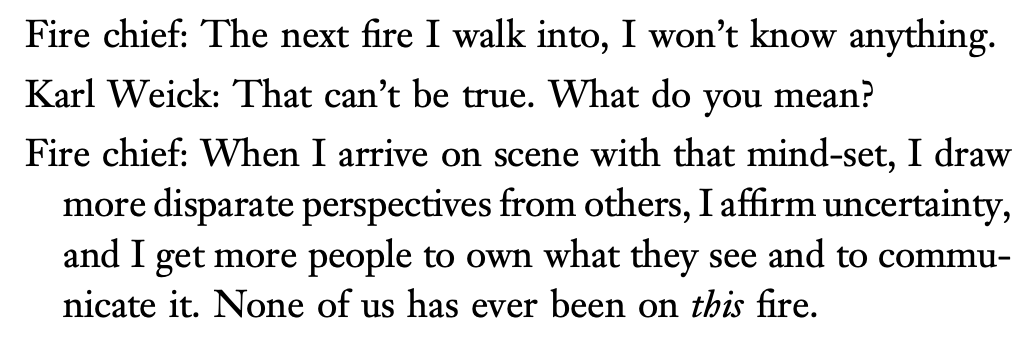
Indeed, the part I’d point people to is our discussion on lookouts in wildfires. A fire chief directing a wildfire response stands close enough to the flames to direct the work, which means their field of vision is almost useless for judging where the fire is going. So the crew establishes lookouts: junior people on a ridge, or others back at the station watching weather patterns, who can be consulted on a regular cadence and will also proactively raise a hand the moment something concerning happens.
What makes this uncomfortable is that it inverts the usual direction of authority, as junior colleagues can significantly steer the fate of an operation. Under pressure, most organisations do the opposite: decision-making pulls upward, and the people with the clearest view of what is happening find they have the least standing to intervene. Jason’s framing is that the leader’s job in a crisis shifts from giving sense to making sense, which sounds like a small distinction until you watch a board try to do it.
The company we discussed in the video is still trading, incidentally. Not out of the woods, but also no longer sliding. What turned it was not the million dollars the founder put in (that only bought two or three weeks) but a board that eventually started asking where its information was coming from.
If you enjoyed the video, Jason and I wrote up the underlying arguments in The Certainty Trap:
The Certainty Trap

You can feel it the moment you walk into a boardroom that’s about to break. Not long ago, Jason L Zimmerman sat with a Board of Directors that had less than 48 hours to secure a massive cash injection to cover payroll. Without it, hundreds of employee wages would bounce, institutional creditors would call in debts, and an enterprise that had spent thirty years building …
Enjoyed this piece? Become a paid member and get my Consulting with AI prompt library, the full Asking Questions Like a Pro course ($199 standalone), practical templates from a decade of fieldwork, and discounts on many other resources. 🔗 See everything included in the paid tier.


