
5 Questions to Stop Continued Success from Turning into Complacency
Is your success keeping you sharp or making you blind?

If Medium is your go-to reading spot, you can catch this post there too! Just click here.
When everything seems calm - steady profits, satisfied customers, stable teams - leadership can drift into autopilot.
Meetings get shorter. Dashboards look greener. The pulse feels strong. But under that reassuring surface, a subtle danger starts to grow: complacency.
Not the dramatic kind. Not hubris or scandal. The quiet kind. The kind that feels like confidence but acts like erosion.
This post is about that moment: when success doesn’t collapse under pressure, but slowly dulls your edge. When leaders stop noticing the world changing around them because what used to work still kind of does. Until it doesn’t!
Welcome to the ‘slope of complacency’. It's where strategic drift begins, and where some of the costliest mistakes in business are born.
Let’s look at how to spot this drift early, and what sharp, consistent questions can do to keep your organisation on course.
Don’t Fly Too Close To The Sun
Success doesn’t always collapse under the weight of arrogance. Sometimes, it erodes quietly, masked by routine and protected by just enough evidence that things still work.
Jim Collins’ How the Mighty Fall explores how ambition curdles into overreach and denial. The Icarus Paradox warns us that strength, taken too far, becomes weakness. These are useful ways of looking at organisations that overreach or scale recklessly, but they don’t explain what happens when vigilance fades without drama.
We’re talking about cases in which leaders stop asking, listening and adapting. Sometimes it’s inertia, or merely fatigue. Other times it’s fear - of breaking what works, of looking out of step or of facing hard truths that might upend today’s calm. It’s human to want to protect what’s working. But, left unchecked, that instinct can blunt the edge that made things work in the first place.
If you’re familiar with business jargon, you have likely heard about the idea of strategic drift to explain the above: this phenomenon happens when an organisation slowly falls out of sync with its environment because its habits no longer match the world it operates in.
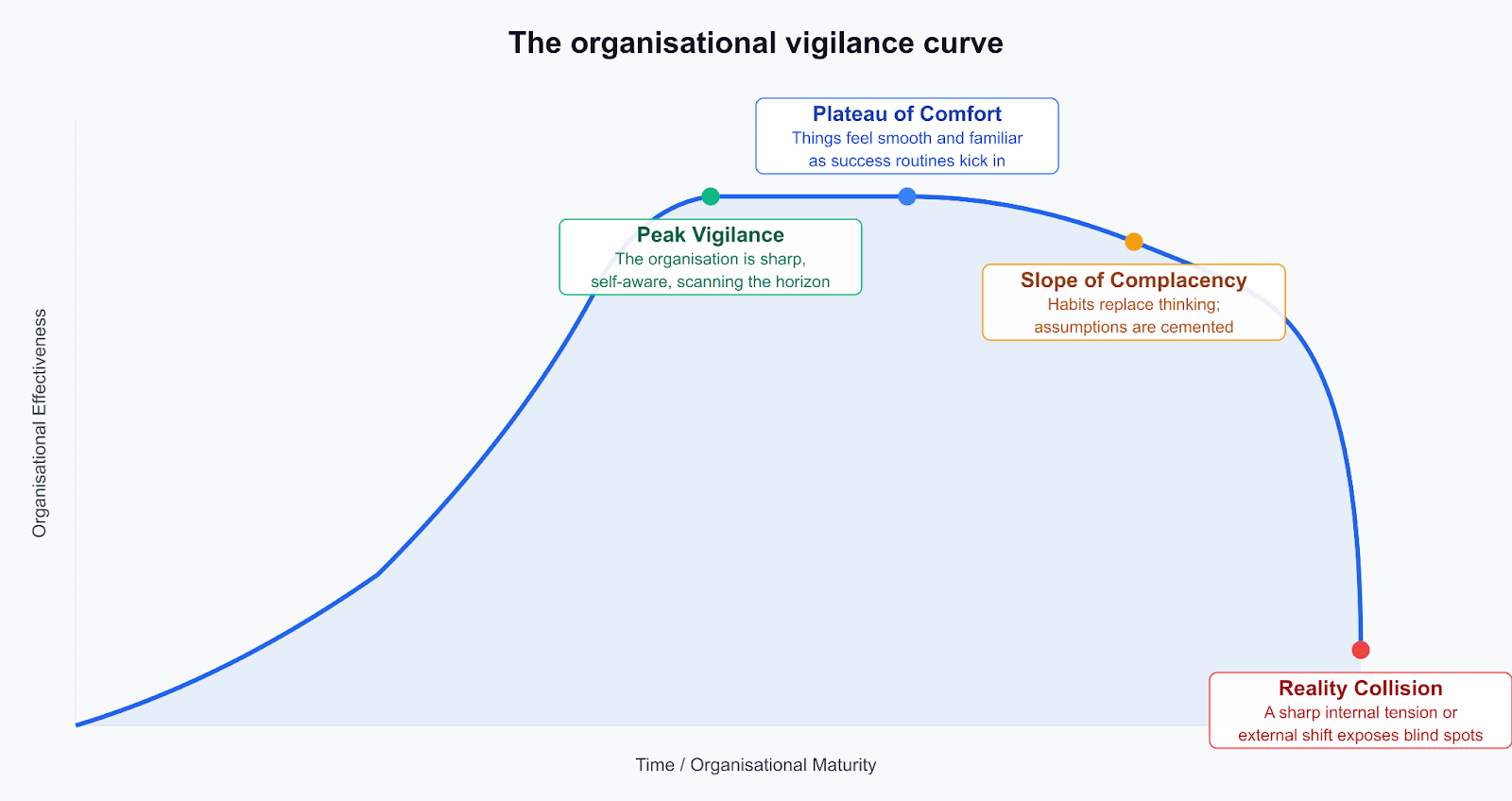
Let’s take a look at how complacency can affect organisations over time (take a look at the chart below!):
Peak Vigilance: the organisation is sharp, self-aware, scanning the horizon.
Plateau of Comfort: things feel smooth and familiar as success routines kick in.
Slope of Complacency: habits replace thinking; assumptions are cemented.
Reality Collision: a sharp internal tension or external shift exposes what the team no longer sees.
The slope of complacency is exactly where strategic drift begins to show its signs. Leaders may start being out of touch with changes in the internal or external environment and, if they don’t make any changes, the risks to their organisation can spiral out of control.
To avoid getting anywhere near this concerning - or, potentially, catastrophic - scenario, here are five questions you should consistently ask in your organisation.
🔍 What assumptions have we stopped challenging?
Remember Kodak's dismissal of digital photography? They clung to assumptions about the unshakeable dominance of film, ignoring clear market shifts and ultimately losing their industry leadership. Similarly, Blockbuster dismissed Netflix, convinced streaming was a niche irrelevance… until it wasn't!
Action: Regularly revisit and critically evaluate your core beliefs about customers, competitors and products. Identify what could disrupt these assumptions.
😲 When did our customers last defy our expectations?
Great organisations stay attuned to unexpected shifts. Surprising feedback or unanticipated customer behaviours are early warning signals of deeper market trends. Think, for example, of how consumers began prioritising experiences over possessions in the past few years.
Companies that assumed growth meant selling more “stuff” missed the cultural shift. Others, like Peloton, leveraged it: they managed to turn exercise equipment into a shared experience streamed into people’s homes.
Action: Systematically document and analyse unexpected customer feedback and behaviours. Use these insights proactively rather than defensively.
🧭 What signals are we overlooking at the edges?
Breakthroughs and breakdowns rarely announce themselves at the centre of your dashboard. They begin at the margins in the form of small shifts or outlier behaviours that don’t quite fit mainstream patterns. Organisations often dismiss these as noise, when they might be the earliest signs of what's to come.
Think that sounds too vague to be strategic? Think again - Nordstrom detected early trends on Pinterest and turned that into an impactful strategy for its retail stores.
Action: Scan for weak signals. Look for emerging needs and subtle shifts in customer habits or competitor experiments. Make it someone’s job to report on what’s changing at the edges, even if it's more qualitative than quantitative insight.
📊 Are our metrics aligned with our evolving strategy?
Metrics provide reassurance only if they're measuring what genuinely matters. Misaligned metrics, like measuring total store visits rather than customer satisfaction, create dangerous blind spots.
In some cases, the wrong KPIs can create toxic behaviours and, indeed, big scandals - ask the folks at Wells Fargo!
Action: Regularly review your KPIs to ensure they align with your strategic priorities. Adjust your measurement systems proactively as your strategic context evolves.
🗣️ Who regularly challenges our thinking?
Without constructive dissent, organisations risk groupthink and stagnation. Employees often sense impending issues but might stay silent without a culture of psychological safety.
Remember the Volkswagen emissions scandal? The chairman of VW’s work council and a member of the executive committee stated that, to avoid similar issues in future, the company would “need a climate where mistakes are not hidden”.
Challenging organisational thinking is also a great reason to bring in consultants every now and then (😉).
Action: Actively promote an organisational culture that welcomes and encourages candid, constructive feedback. Regularly solicit honest input from your teams; on occasion, seek external advice.
Stay Vigilant, Stay Successful
As we explored, complacency isn't loud or dramatic. It will creep in softly, dressed as confidence. It will feel like calm and sound like “We’re doing well.” And that’s what makes it so dangerous. By the time the risks are obvious, your ability to respond has already eroded as you have drifted too far from the trajectory of success.
Effective leadership means resisting the seduction of stability and building habits that keep you connected to reality, even when that reality is inconvenient, contradictory or uncomfortable.
The best leaders ask hard questions in times of crisis and calm alike. They question their successes as critically as their failures. They scan the edges. They listen harder when everything seems quiet.
Don’t wait for urgency to clarify your vision. Start today, while everything still feels “fine.”
I'm Andrea, a management consultant with over a decade of experience across industry and academia. I work with commercial, non-profit, academic and government organisations worldwide, helping them capture meaningful insights through mixed methods research.
I write about practical frameworks to help you discover what others miss. My main goal is to translate complex concepts into techniques that readers can use immediately.
Metrics have to be evolved with strategy. Otherwise, you drift the wrong direction. I can't tell you hoe many times I have witnessed the KPI's set not be correlated to the processes that will drive the desired behavior.