
You Can’t Automate What You Can’t Articulate
Four proven methods to turn ambiguity into clarity

If Medium is your go-to reading spot, you can catch this post there too! Just click here.
Higher education is under sustained criticism. Rising costs, questions about graduate employability and the encroachment of artificial intelligence into knowledge work have all contributed to doubts about what universities are really for.
If machines can already draft an essay or generate design concepts, what remains for students to learn and do?
Some commentators argue that higher education is drifting towards obsolescence, while others defend it as a social and cultural institution whose value cannot be measured in these terms. I am very much with the latter.
My own view is that the central task of education has not diminished; if anything, it has become more urgent. Educating new generations of students to think sharply will remain essential; although they will interact with knowledge through a new ecosystem of tools and technologies, critical thinking will remain central to this.
We will always need to teach people to analyse, to frame, to distinguish between a vague impression and a defined challenge. Indeed, these abilities cannot, and arguably should not, be outsourced to machines. We still need people who can weigh competing priorities and set the direction before any tool, human or artificial, can begin to work effectively.
Four Proven Frameworks for Problem Framing
To move from principle to practice, we need concrete methods. A number of well-established frameworks provide the scaffolding for this kind of work. Each brings a slightly different lens; together, they form a practical toolkit that you can tailor to any situation.
1. E5 Framework: Expanding and Refining
The E5 Framework slows you down to explore before defining solutions. The process begins with Expand, where you gather as many perspectives, data sources and contextual insights as possible, resisting the urge to jump straight to solutions. Next, you Examine the assumptions and biases that may be shaping your understanding. The third stage, Empathise, requires putting yourself in the position of stakeholders and trying to grasp their needs, values and constraints. In Elevate, you zoom out to see how the issue fits into a wider system, noticing how different factors interact. Finally, in Envision, you generate alternative framings of the challenge that could lead to more creative or effective responses.
Example: Imagine you are addressing the broad complaint that “our campus produces too much waste.” Using E5, you would:
Expand your perspective by looking at waste generation data, user habits and institutional practices.
Examine assumptions, such as the idea that recycling bins alone solve the issue.
Through Empathy, you would explore how cleaners, catering staff and students experience waste differently.
By Elevating your perspective, you could link campus waste to supply chains and municipal infrastructure.
In the Envisioning step, you might reframe the issue not as “too much waste” but as “a missing culture of circular practice,” leading to hypothesising new directions for intervention.
2. PICO: Structuring Research Questions
The PICO model originated in clinical research as a tool for framing precise, testable questions. It stands for Population, Intervention, Comparison and Outcome. The Population defines the group or context under study. The Intervention is the approach or treatment being examined. The Comparison is the benchmark or alternative against which the intervention is measured. The Outcome specifies what effect or result is being evaluated.
By forcing you to specify these four elements, PICO sharpens your focus. Its disciplined structure is valuable not only in medicine but in any field where there is a risk of drifting into topics that are interesting but unmanageable.
Example: Imagine you want to understand whether peer-feedback sessions actually improve learning in design studios in architecture school. Using PICO:
Population: undergraduate architecture students.
Intervention: weekly peer-feedback reviews integrated into studio sessions.
Comparison: traditional tutor-only critiques.
Outcome: improved project quality, deeper reflective thinking and greater student confidence.
Framing the study this way moves you from a loose question (“does feedback help?”) to a structured inquiry that clarifies what to test and how to judge the results. The discipline of naming these components early forces precision—not just in your methods, but in your thinking.
3. Cynefin: Matching Frame to Context
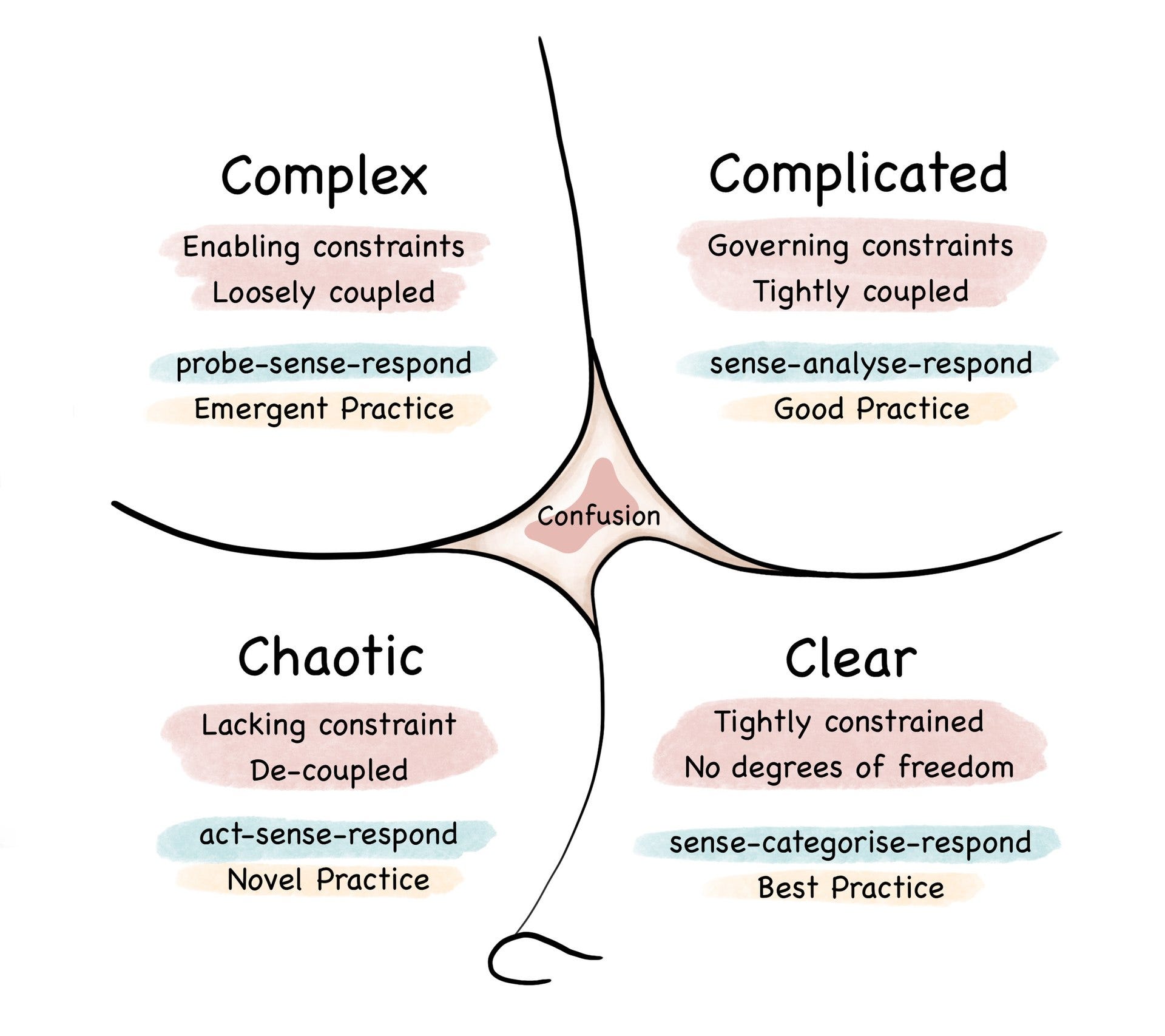
The Cynefin Framework is a sense-making tool that reveals the landscape you’re operating in. It distinguishes between different domains: Clear problems, where cause and effect are obvious; Complicated problems, where cause and effect can be analysed by experts; Complex problems, where patterns only emerge retrospectively and experimentation is required; and Chaotic problems, where no clear causality exists and immediate stabilising action is needed. There is also the domain of Disorder, where it is not yet clear which type of problem one is dealing with.
The strength of Cynefin is that it alerts you to the fact that not all problems should be treated alike. Some can be solved with best practice, others require expert judgment and some demand probing, iteration and adaptation.
Example: Imagine you’re leading a community energy project with the broad goal of accelerating local adoption of renewables. At first glance, it might seem like a single challenge, but Cynefin helps you see that it’s actually several types of scenarios woven together, each requiring a different approach.
Regulatory requirements, such as meeting an emissions cap, sit in the Clear domain: cause and effect are known, and the task is simply to comply through established procedures.
Designing a new renewable energy installation belongs in the Complicated domain: expert analysis and best-practice design can produce the right technical solution.
Persuading residents to change their energy habits falls into the Complex domain: behaviour is unpredictable, so you’ll need to test small interventions, observe patterns and adapt.
And if a sudden blackout disrupts supply, that’s the Chaotic domain: the immediate goal is to restore stability before returning to longer-term learning.
This mapping helps you identify the right management style or solution template for every part of the problem and focus effort where it will actually make a difference.
4. Fishbone / Ishikawa Diagram: Tracing Root Causes
The Fishbone diagram, also known as the Ishikawa diagram, seeks to lay the causes of a problem bare. The problem is placed at the “head” of the fish, while the “bones” branching off represent different categories of possible causes. It could be anything like people, processes, equipment, materials, environment or policies (you and your colleagues will be best placed to hypothesise the most appropriate categories). Within each category, you brainstorm specific contributing factors. The method encourages you to move beyond symptoms and look at the structural sources of an issue.
Fishbone diagram helps you debate and prioritise which areas to investigate further by laying out causes systematically. It is especially insightful when multiple stakeholders have different intuitions about what is driving a problem.
Example: If you are studying construction waste, you might place “excess material sent to landfill” at the head of the fish. Branches could include procurement (ordering too much material), design (specifications that lead to off-cuts), site management (poor storage causing damage) and regulation (lack of enforcement of waste targets). Under each branch, you could list contributing factors such as inaccurate demand forecasting, lack of modular design or insufficient worker training. This process often shifts the problem frame from “builders are careless” to “systemic gaps in design and procurement,” opening the door to more effective solutions.

How Do I Pick?
Early on, the best approach is not to agonise over choosing the perfect method but to try out several. Experiment with E5, PICO, Cynefin and Fishbone in different contexts, and notice which ones yield insights that feel useful. You may discover that one framework helps you open a problem up, while another helps you narrow it down. Some will fit neatly, others less so. The process of testing them is itself part of learning how to frame problems.
With experience, this trial-and-error phase becomes less necessary. The more problems you encounter and the more frames you apply, the more natural it becomes to know which lens will help. Just as a musician learns to hear which chord progression fits, you will begin to sense which framing tool is likely to bring clarity.
Example: Imagine you are trying to understand why a pilot course at your organisation has low enrolment. If you applied the E5 framework, you might begin by expanding your perspective: interviewing potential learners, reviewing past marketing, examining assumptions about demand, empathising with both staff and students, elevating to see how the course fits the wider programme and then envisioning new ways to define the issue. This could lead you to reframe the problem as a mismatch between the course’s positioning and learner expectations. By contrast, if you used a Fishbone diagram, you would start with the observed effect (low enrolment) and branch into categories like promotion, pricing, scheduling and curriculum. This might surface specific contributing factors, such as poor timing in the academic calendar or confusing messaging. Both methods are valid, but they yield different insights. Trying each allows you to see the problem from multiple angles before deciding which framing is most useful to pursue further.
The enduring human skill lies in knowing how to identify and articulate challenges worth solving. In a world where information is cheap and abundant, the ability to define meaningful problems is what sets you apart. That is the kind of education we should be investing in for the future.
Framing is not an academic exercise, but the foundation of intelligent work. It transforms noise into focus and data into direction. When you frame well, you save time later, because your effort and creativity are aimed at the right challenge from the start.
Higher education, at its best, is where this ability is cultivated: the discipline of thinking clearly before acting. Machines may one day master analysis, but deciding what truly matters - what is worth solving - will remain a human art.
If you can learn to frame problems well, you will remain indispensable, no matter how powerful the technology becomes.
I’m Andrea, a management consultant with over a decade of experience across industry and academia. I work with commercial, non-profit, academic and government organisations worldwide, helping them capture meaningful insights through mixed methods research.
I write about practical frameworks to help you discover what others miss. My main goal is to translate complex concepts into techniques that readers can use immediately.
Nice post, Andrea. The line that rings true is, you can’t automate what you can’t articulate.
Fantastic post that weaves its way through both pragmatic and relevant problem-solving frameworks and the principles that should underpin our views of higher education. This was like going to a party with all my favorite people. :)
Andrea, two others I find useful. On the more simple framework side is "Known, Assumed, Unknown, Unknowable". Sometimes walking a team through this first helps provide the clarity to know which of the next frameworks might be needed, where we are confusing opinion with fact, or where we are chasing something that we can't actually know. On the more complex front, you might enjoy Integral Theory which takes a simple four quadrant structure to combine Interior (Subjective) and Exterior (Objective) with Individual and Collective perspectives.