

A few years ago, Brandi Copeland walked into a leadership role at a Fortune 100 multimedia company and was convinced within a month that she wouldn’t last a year.
Nothing on that team made sense. There were no processes. People worked in silos and didn’t trust each other, and within her first six months she watched people on her own team leave faster than she could replace them. There was nothing static for them to stand on, nothing telling them “We’ve got this, let the new manager earn her place before we walk.”
So she started putting something in place. She built processes and she documented expectations, working with the team so they could help shape them. She explained her thinking instead of expecting people to trust her because of her title.
She stayed on that team for over six years. By the time she left, average tenure had gone from people walking within months to three or four years per person. That was the direct result of giving people something solid enough to plant their feet on.
When the manager can’t stay
Now consider a different kind of workplace, like a hospital or a professional services firm that remixes staff based on projects available. The people are broadly the same from one month to the next, but the configurations never stays still.
You’re pulled onto a piece of work with four colleagues, two of whom you’ve never met; you deliver it in six weeks and disperse; the next assignment has a different mix. In this type of organisation, the problem is not turnover or bad management. This is simply how the work is staffed.
But this also means that no grouping lasts long enough for anyone inside it to watch you over time and stretch you deliberately, or earn the standing to tell you a hard truth. And the context each grouping builds (e.g. why a call was made, which dead ends were already explored) thins out with every dissolution, even though all the people involved are still somewhere down the corridor.
This pattern has a name. Amy Edmondson developed the concept of ‘teaming’: when work moves faster than stable teams can keep pace with, you stop relying on people knowing each other well and instead build the conditions for near-strangers to work well together fast: swift trust, psychological safety and quick handover of what each person knows.
The two situations, the one Brandi lived through and the one we just explored, look similar on the surface. Both involve churn, thin trust and people who don’t know each other well. But they also differ significantly:
Brandi’s team was unstable by accident. The churn was a symptom of dysfunction, and the cure was to add stability.
The other example was unstable by design. Teams form around a problem, do the work, and dissolve. And the next team forms with a different cast.
When dissolution is the operating model, the fix that Brandi applied (staying put for six years while trust accumulated) is unavailable to begin with, however good the manager. That said, not every part of what she did depended on those six years.
Developing people in motion
The hardest question is how to grow someone inside a fluid team:
Mentoring assumes a mentor stays close enough for long enough.
Stretch assignments assume someone is tracking your arc across time.
Honest feedback assumes a relationship is sturdy enough to take it.
Fluid teams withdraw all three, and managers are left dealing with development without the continuity it was built on. What these teams most put at risk is the slow, invisible kind of learning: apprenticeship, absorbing judgement by watching someone more experienced navigate ambiguity.
So, if development can no longer attach to the team, it has to attach to something that outlasts the team. That points towards mentoring relationships deliberately kept separate from project assignments, communities of practice that persist while teams come and go, and managers who define their job as being the continuity in a person’s working life.
The Art of Asking Questions is a reader-supported publication. To support my work, please consider becoming a paid subscriber. And check out my Perks page!
Can safety be manufactured?
Psychological safety is usually described as something that accrues: it builds over months as people learn they won’t be punished for speaking up. Fluid teams don’t grant those months. One view argued in the teaming literature is that the manager’s task therefore changes from letting safety accumulate to manufacturing it quickly and repeatedly. For example, they are expected to set norms in the first hour, to model fallibility and to make it cheap to ask a basic question before anyone has earned the right to.
But it is fair to wonder whether psychological safety can truly be manufactured. What Brandi did in her first weeks (explaining her reasoning before anyone trusted her, inviting input before she had earned deference) was exactly the fast-start move the teaming playbook prescribes. The difference is that this set of measures then had months and years in which to mature into the real thing. Under teaming you get the first act without the second, over and over, and whether a string of first acts ever amounts to genuine safety is an open question.
Perhaps the resolution is that both views are right about different objects. Safety cannot be manufactured inside a six-week team, and it doesn’t need to be, because it was never really a property of the team in the first place. It was a property of relationships, and relationships can span configurations.
A person who has once worked under a manager they came to trust will extend that trust faster the next time, and the time after that. What accumulates under teaming is a reputation and a track record that precede people into every new room. This can’t mature within one team any more, but it can mature across a career.
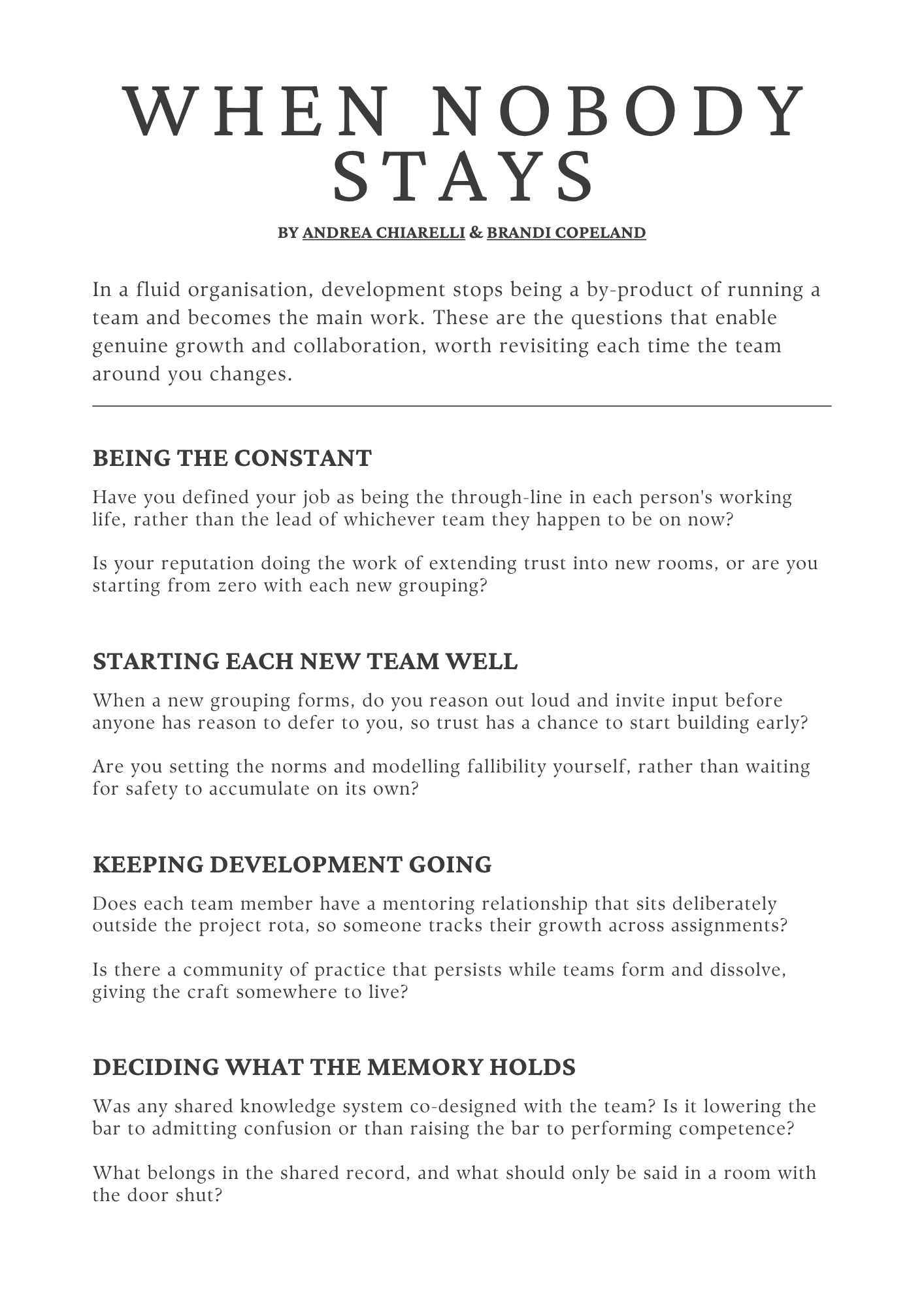
If you are finding this article useful, here’s a visual summary you can save or print. A pdf version is under the image preview.

Where AI enters
Brandi’s team had her presence and her structure to hold onto. A fluid team has neither, so the question becomes whether something else can hold that place instead.
AI enters this story as one of several forces reshaping it rather than the headline. If a system could help hold the project’s memory, then the humans could become the rotating element and the technology could become the continuity layer. That inverts teaming’s oldest problem. The context that used to walk out of the door might now stay, which makes teams cheaper to form and dissolve.
But the remaining tension is interpersonal:
Some people will admit confusion to a system far more readily than to a colleague, since there’s no face to lose, and for them an ever-present, non-judgemental memory might genuinely lower the bar to asking.
Others will do the opposite and perform competence for what they know is a permanent record, which corrodes exactly the candour teaming depends on.
So the same technology can help or harm depending on the person and the culture around it, which is why it can’t be treated as a straightforward fix. This is where Brandi’s original instinct returns in a new form. Her structure worked because the team had a hand in shaping it, and the same holds for a shared memory system: whether people put honest thoughts into it, and whether they trust what comes out, depends far more on having helped set the norms than on the sophistication of the tool.
A manager who imposes a memory system and dictates what goes in it will get the performed competence and the corroded candour. One who does with the tool what Brandi did with her processes, explaining why it’s there and letting the team decide what belongs in it and what stays between people, has a chance of getting the other outcome.
The technology may be new, but the dynamics that drive adoption are not.
Ask yourself this: What would you put in the shared memory, and what would you only ever say behind a shut door?
The early evidence suggests the norms are lagging behind the tools. ManpowerGroup’s 2026 Global Talent Barometer, based on interviews with nearly 14,000 workers across 19 countries, found that regular AI usage jumped 13% in a single year while confidence in the technology dropped 18% over the same window. People are being handed tools faster than they’re being given the information they need to use them well, which is the manager’s lived problem in miniature: leading a team where the tools change faster than the norms can settle.
The one fixed point
The manager is the majority of someone’s employee experience; Gallup has found that managers account for 70% of the variance in employee engagement. In a world of stable teams, that influence was exercised through the team itself. In a world of fluid ones, it has to be exercised across the formations and dissolutions.
The organisations that eagerly remove teaming’s biggest cost, lost context, without noticing what speed does to its biggest enabler, interpersonal safety, will end up with teams that are fast and shallow. And they may not realise what they have traded until the development pipeline dries up.
Brandi’s solution, in the story at the top, was to give people something solid enough to plant their feet on, and she built that solidity out of structure, visible reasoning and her own continued presence. Fluid organisations have taken the first of those away, but what they cannot take away is the other two. A manager can still reason out loud in every room she enters, and she can still be the person who was there last time and will be there next time.
In a stable world, a manager leads a team and develops people as a by-product. In a fluid one, the team is temporary and the people are the through-line, so development has to become the substance of the role.
The measure of a manager shifts accordingly, from what her current team ships to who gets better across every configuration she touches.
Enjoyed this piece? Become a paid member and get my Consulting with AI prompt library, the full Asking Questions Like a Pro course ($199 standalone), practical templates from a decade of fieldwork, and discounts on many other resources. 🔗 See everything included in the paid tier.