
Before You Blame the People, Check the System
A practical guide to diagnosing behaviour before you try to change it

Think of the last time you tried to change a behaviour at work, at home or in a community you care about. You probably started with good intentions and sensible logic. You explained the rationale and shared the guidance; and people might have even been engaging and nodding along.
Then, you watched the real world do what it does: people reverted to familiar routines (maybe because of time pressure, or some other reason) and the change effort shifted into an ongoing conversation about why others are not doing what they are “supposed” to do.
That is not because people are irrational - hardly anything ever can be attributed to such a diagnosis! The COM-B model gives you a way to consistently investigate the conditions that make behaviour change possible.
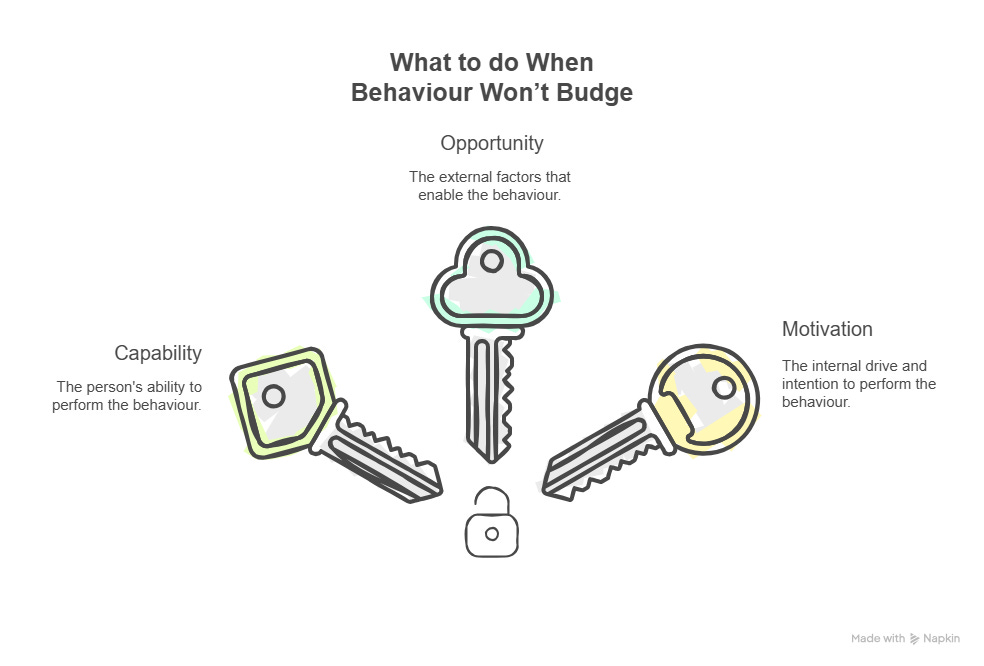
It proposes that Behaviour (B) occurs when three elements are sufficiently in place:
Capability (C): the person can do it.
Opportunity (O): the world around them makes it possible and likely.
Motivation (M): there is enough drive, intention and habit to do it now and keep doing it.
COM-B is useful precisely because it helps you stop arguing about character and start diagnosing the system around the behaviour. It forces you to consider three domains that frequently interact, and it makes it easier to design changes that match the actual constraint rather than the most convenient explanation.
Here are two quick examples before we dive into more detail:
Example 1: When the change is sensible, but the behaviour still does not happen
A team agrees they should capture lessons learned at the end of each project. Everyone likes the idea. Yet it rarely happens. Using COM-B, you could check whether people know what “good” looks like and how to do it quickly (Capability); whether there is protected time and an easy place to capture insights (Opportunity); and whether the team has habits and incentives that prioritise closure over moving straight to the next deadline (Motivation).
In my own work, I know that this kind of reflection sometimes doesn’t happen because of Opportunity. This gives me a clear lever to address the issue: I need to block time explicitly for an activity that otherwise would not take place.
Example 2: “They’re not motivated” is rarely a diagnosis
A department rolls out a new incident reporting process. Managers describe low uptake as a motivation problem. In practice, however, staff may not know what qualifies as a report (Capability); reporting takes too long on shared computers (Opportunity); and people have learned that reporting creates awkward conversations (Motivation). As long as managers keep attributing low uptake to their summary judgment (things like people are not motivated, people are lazy, etc.), the situation won’t move.
This is something I have seen time and time again as a consultant. Managers might attribute incorrect reasoning to employees by thinking only through their own lens. This creates friction and no change takes place because the wrong diagnosis is in place.
COM-Bing Through Behaviour
I hope these initial examples have started to turn the COM-B model from acronym to reality! Let’s have a look at the model in more depth.
Capability
Capability is a person’s capacity to perform a behaviour. It includes what they know, but also whether they can translate that knowledge into action in new circumstances.
Psychological capability includes understanding, memory, attention and the ability to make the right decision at the right moment.
Physical capability includes strength, stamina, coordination and any physical skill required.
Capability is often overestimated because we confuse awareness with competence. People can agree with a behaviour and still be unable to perform it reliably.
Consider this mini-scenario:
A site introduces a daily safety checklist. Completion rates are high, yet incident patterns remain unchanged. Observation shows that supervisors tick boxes quickly because items are vague and open to interpretation (which has to do with psychological capability). When the checklist is rewritten into observable checks, paired with example photos and practised during short walkthroughs, it starts functioning as a control rather than an administrative form.
Opportunity
Opportunity is everything outside the individual that enables or prompts the behaviour. It is the part many change programmes underinvest in because it is less comfortable: it requires resourcing decisions, and, sometimes, leadership trade-offs.
Physical opportunity includes time, access, equipment, layout, digital systems and prompts or cues.
Social opportunity includes norms, role expectations, support, leadership signalling and what is rewarded or punished informally.
Opportunity can be invisible to those designing interventions because they may not be experiencing the system or workflow they are trying to change. This is why observation is often more useful than surveys.
Let’s examine this common barrier to change:
“Lack of time” is frequently treated as resistance. COM-B treats it as an opportunity constraint. If the behaviour must happen during the most congested moment of the day, the intervention is competing with reality. By making this explicit, we can then hypothesise solutions and consider trade-offs.
Motivation
Motivation covers everything that energises and directs behaviour. COM-B treats motivation as more than intention.
Reflective motivation includes beliefs, plans, goals, values and conscious decision-making.
Automatic motivation includes emotions, impulses, habits and learned responses to cues.
This split matters because different mechanisms sustain behaviour. If a behaviour is governed mostly by habit and emotion, arguments and information can help, but they can’t carry the full load.
This scenario clearly illustrates ways in which motivation can prevent change:
A hospital wants nurses to use a new electronic handover template at the end of each shift. Training goes well, staff understand the benefits and most can explain how it improves patient safety. Yet within weeks, many revert to jotting notes on paper and giving quick verbal summaries in the corridor. After a long shift, the old routine feels faster and more natural, and the template is experienced as “one more thing” before going home. Managers respond with reminder emails and policy messages, but behaviour barely changes.
In COM-B terms, reflective motivation is present: nurses endorse safe handover and the new process. But automatic motivation is misaligned: habit, fatigue and the emotional pull of “being done” pull them back to the old pattern. Until the intervention tackles those automatic processes (for example by integrating the template into existing handover rituals and practising it until it becomes the default), more arguments and information just increase pressure without reliably changing behaviour.
This is the end of the free part of the article. After the paywall:
I explore how to use the COM-B model as a diagnostic tool and how it can help you and your organisation shift behaviours over time.
I share the two-stage AI prompt that I regularly use when analysing behaviour change scenarios and possible interventions.
The Art of Asking Questions is a reader-supported publication. To support my work, please consider becoming a paid subscriber.
