
The Questions That Turn a Good Offer Into One People Can’t Ignore
How to stop pitching from your own perspective and start building from the answers that matter

If Medium is your go-to reading spot, you can catch this post there too! Just click here.
Ever had this happen? You’re talking to a potential client. You know you can help them. You’ve done the work before. You’ve got results to prove it.
But as you explain your offer, you see that look.
They nod politely. They smile. They say “Let me think about it.” And then… silence.
It’s not that they didn’t need what you do. It’s that they couldn’t quite see themselves in it.
At its core, building a strong value proposition is an exercise in asking sharper questions: about your audience, your offer and the market. The right questions surface the real overlaps between what people need and what you can deliver, so you stop guessing and start building with clarity.
Mind the Gap
Here’s the hard truth (and one it took me a while to swallow!): most good offers die in the gap between what you know about your work… and what your audience hears when you explain it.
That gap eats up time, money and momentum.
Consultants end up doing endless unpaid ‘education & outreach’ before anyone says yes.
Product managers keep tweaking features without knowing which ones actually matter.
Freelancers and solo creators burn months ‘waiting for the right client’ when the right client already met them - they just didn’t connect.
And the worst part is that we rarely know the gap exists until the moment slips away.
Shifting Perspectives
The gap I’m talking about is there because you’re starting from your perspective, not the user’s or customer’s. You’re seeing your offer through your own expertise rather than the customer’s lived reality.
The most successful offers - whether it’s a product, a service or a one-person creative studio - work because they sit in the tiny, high-value overlap between:
What your audience needs most right now.
What you can deliver best.
What makes you stand out from all the other options.
That overlap doesn’t happen by accident. You have to map it.
The Problem With Most Advice Out There
There’s no shortage of posts, articles, and threads about ‘crafting your value proposition.’ Substack, LinkedIn, Twitter - they’re full of them.
But there is a problem: most of it is theory. It tells you what a good value proposition is, maybe even why it matters… but it rarely shows you exactly how to build one for yourself.
And without a practical, step-by-step process you can actually follow, even the smartest theory stays stuck in your bookmarks folder.
What’s especially helpful is a brief, actionable guide, as opposed to a book or detailed discussion. In my view, you need to ‘get your hands dirty’ to get products and offers right. And you’ll never do this if you’re buried in theory and too busy working out what you should do when you sit in front of the screen.
The right structure forces you to ask the right questions - of your audience, your offer and your priorities - so the answers lead straight to action.
Here’s a Glimpse of What Changes Everything
When I work with clients, I use a simple but ruthless process to cut through noise and turn insight into a value proposition people get in seconds.
Most people start by trying to write ‘the perfect sentence’ for their offer. That’s a mistake. You need to see the building blocks before you can write the headline.
One of the most powerful steps is mapping Customer vs Product Perspectives side by side. It forces you to stop thinking about what you want to say and start looking at what they actually need to hear.
This is a real example from my ‘BuildFlow’ worked example - a fictitious app for small construction firms that are buried in client admin.
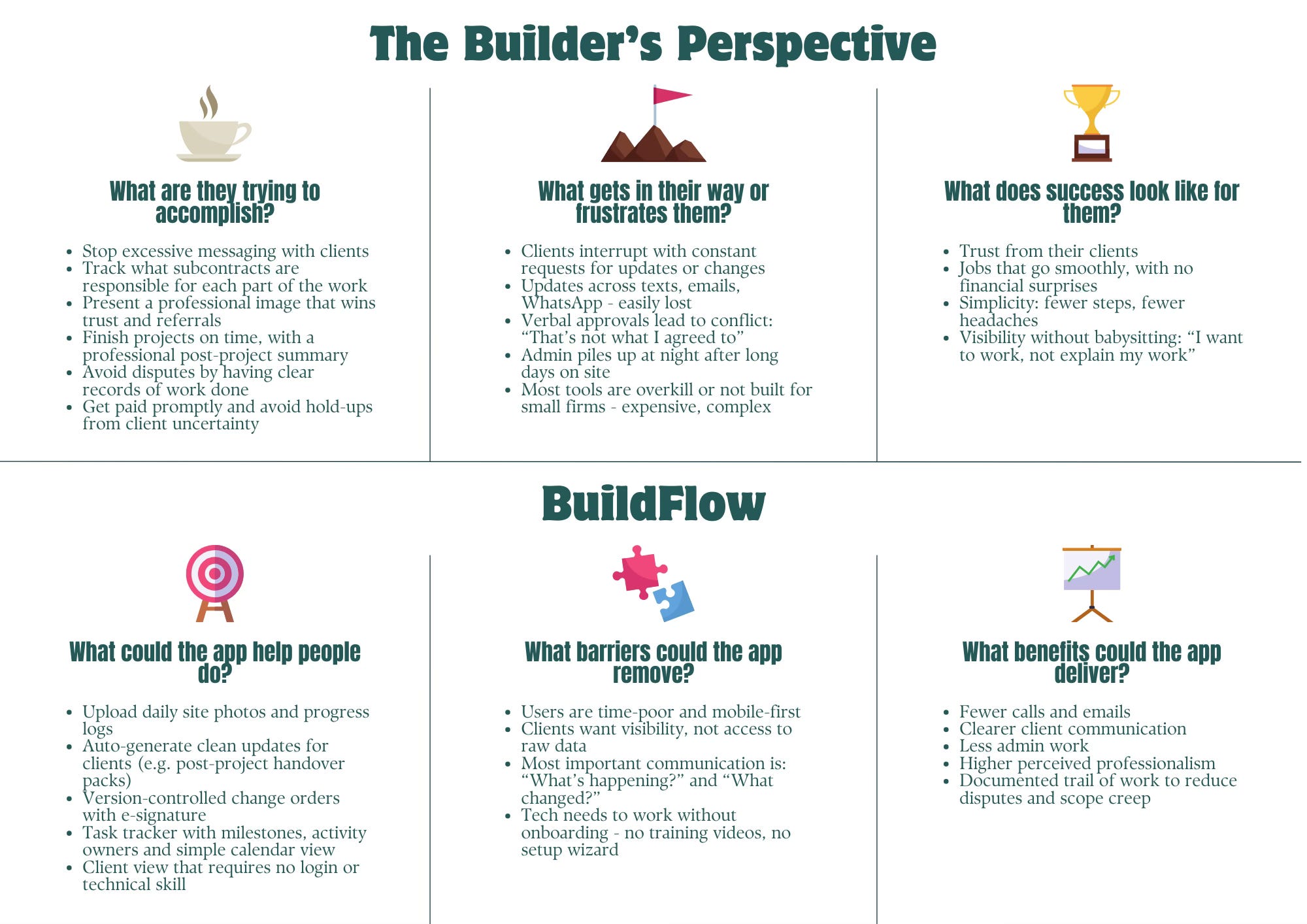
When you lay customer frustrations and goals alongside what your product can deliver, patterns emerge fast. Mapping like this is the difference between guessing your value and knowing it.
But mapping alone isn’t enough. Once you see the possibilities and compare them to opportunities in the market (see my full guide for this), you still have to decide what makes it into your offer now, and what waits for later.
This is where most people overbuild, chasing every idea at once. The result is bloated offers and a launch no one’s excited about.
In the framework, I use a Value-Effort Matrix to strip out the distractions and put the essentials front and centre.
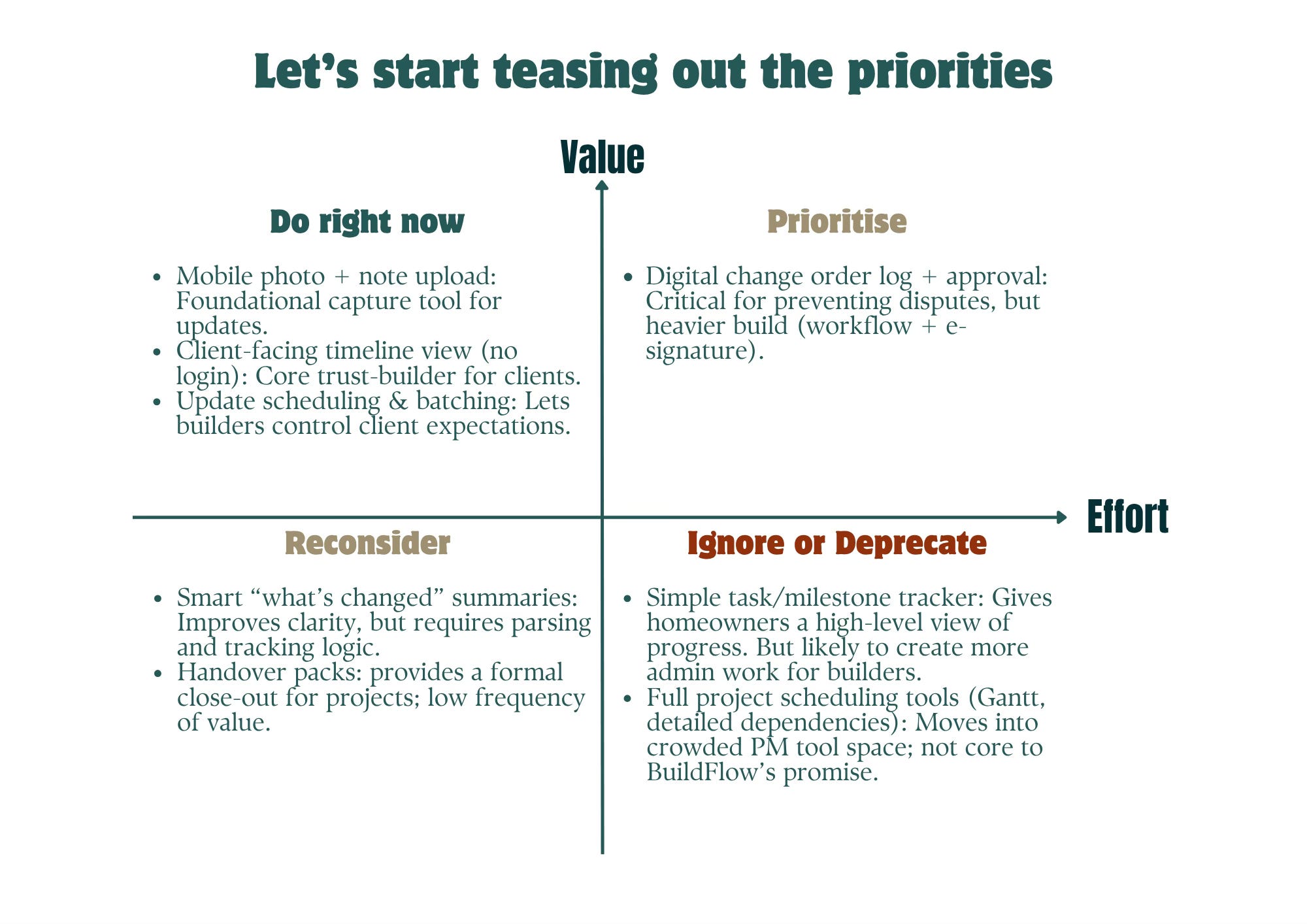
Top right: high value, low effort. That’s where momentum lives. This quadrant becomes your launch focus. The rest either gets scheduled, re-scoped or dropped entirely. Without this step, you risk burning time on features no one actually values - a silent killer of offers.
To sum things up: Two steps and two shifts in perspective. Going from “We have so many ideas” to “We know exactly what to ship first.”
The full process takes you all the way from raw notes to a viable proposition you can explain in one sentence and start testing immediately.
From Scattered Notes to a Market-Ready Proposition
I’ve packaged the full framework - the exact steps, a fill-in-the-blanks template and a worked example you can follow - into a Value Proposition Pack you can get starting today via Gumroad.
It’s a process I have developed by bridging the gap between several frameworks, shaped by years of advising clients in both industry and the non-profit sector.
This package is a powerful combination, because the theory is just enough for you to get started with practical work. In as little as a couple of hours, you will be filling in the template yourself.
You will go from:
I think my offer is good, but I don’t know how to explain it so people get it…
…to:
I can explain exactly who this is for, what it does for them and why it’s better than anything else out there - in one sentence.
The Precise Way to Build Your Offer
If you’ve been spinning your wheels trying to ‘clarify’ your positioning, don’t start from a blank page.
Start with a structure that forces you to see your offer the way your audience does and shows you exactly what to say next.
I'm Andrea, a management consultant with over a decade of experience across industry and academia. I work with commercial, non-profit, academic and government organisations worldwide, helping them capture meaningful insights through mixed methods research.
I write about practical frameworks to help you discover what others miss. My main goal is to translate complex concepts into techniques that readers can use immediately.
Value propositions can be mind boggling. I love the framework you have outlined here.