
The Pyramid Is Crumbling
When AI earns your associates' salary, what does your firm actually sell?


🎥 Some of this article is also covered in a video on Exploring ChatGPT’s YouTube channel - take a look and subscribe!
Around three-quarters of McKinsey’s 43,000 employees now use the firm’s internal AI tool, Lilli, every month. Between them they ask it roughly half a million questions, and McKinsey’s own figures suggest the platform has cut time spent on research and synthesis by up to 30%.
On the surface, this might sound like a productivity story. But if you go slightly deeper, this is actually a business model story.
The distinction is important. The productivity conversation is rather comfortable: cleaner decks, faster research, tidier meeting notes and a confident line in the investor update about AI adoption. The business model conversation is far harder, because it asks whether the economic structure of professional services firms still works when a meaningful share of junior output can be produced by software. This article is about the second conversation.
Why the pyramid worked in the first place
The classical professional services firm is shaped like a pyramid for a reason. A wide base of analysts and associates does the research, the modelling and the drafting. A middle layer of managers and principals frames the problems and runs the project. A narrow apex of partners sells the work and owns the client relationship. Margins come from leverage (the ratio of junior to senior staff on any given engagement) and fees come from time.
The base served a second purpose that firms have only begun to talk about openly now that it is under threat. Doing the repetitive work is how juniors learned judgement. Reading five reports and synthesising them, building a financial model from scratch, producing a first draft of a deck and watching a partner tear it apart: this was a subsidised apprenticeship, paid for by the client and underwritten by the firm’s leverage. For many years, that structure worked.
Underneath it sat a less visible economic bet: information asymmetry. Juniors gathered and processed data; seniors interpreted it and turned it into advice; a lot of the value lived in the gap between the two. But AI narrows that gap considerably, and most of what is happening underneath the current industry noise comes back to that single fact.
What’s starting to crumble right now
Three pressures are moving at once, and they don't quite point in the same direction.
The base is eroding
The headline numbers are consistent across the industry. According to a Financial Times article, first-year packages for undergraduate hires at McKinsey, Bain and BCG have been frozen for three consecutive years, sitting at roughly $135,000 to $140,000; MBA packages hovered around $270,000 to $285,000. The article further highlights that “two senior executives at Big Four firms estimated that, across the UK’s largest consulting and accounting firms, graduate recruitment would be down by about a half in the coming year.” The numbers don’t lie: in 2025, KPMG cut UK graduate intake by around 29%, Deloitte by 18%, and EY by 11%. PwC cut its entry-level scheme by 6%.
Today’s pricing model sits badly with AI
If a task that used to take a junior 60 hours now takes six, time-based billing cannibalises revenue. Most large firms still bill clients on some variant of time-and-materials or effort-adjacent fixed fees. McKinsey has publicly said that around a quarter of its global fees now come from outcome-based pricing, which is significant but also a reminder that three-quarters still don’t.
And that isn't the only pressure. SPI Research’s 2025 Professional Services Maturity Benchmark, which covers 403 firms, found billable utilisation at 68.9%, comfortably below the 75% typically needed for healthy margins.
The pricing model is being squeezed from both ends, and firms have not yet worked out what replaces it.
The training ladder is under strain
The third pressure is arguably the most important. AI is first taking over the work that used to build judgement in juniors, creating a paradox that Harvard Business Review highlighted in 2025: if the wide base of the pyramid disappears, where do future partners come from? Structured training, apprenticeships and other learning pathways can replicate some of that development, but they do not fully replace the value of real responsibility on real work.
Pressure from the other side of the table
A lot of the commentary treats the current level of disruption as an internal firm story. It is at least as interesting when read from the buyer’s side.
Organisations that typically employ consultants and advisers are now building their own AI capability in-house and getting sharper at asking what external professionals uniquely bring. If a client’s team can do the initial research themselves in a weekend, the external fee needs to defend itself differently. Some clients raise this directly in fee negotiations; others simply move work in-house without making a fuss about it.
Clients are also increasingly prepared to litigate over outcomes, not just effort. Zimmer Biomet’s $172 million lawsuit against Deloitte over a failed software implementation is a case in point, and it shows how the risk profile changes when firms sell not just time but the promise of results.
The Art of Asking Questions is a reader-supported publication. To support my work, please consider becoming a paid subscriber.
How this looks in different sectors
Professional services is not a single market, so let’s reflect on how things are shifting across sectors.
In law, privilege, confidentiality and regulator scrutiny slow adoption. But the billable-hour pressure is arguably more intense here, because clients have been grumbling about hourly billing for decades and alternative fee arrangements already exist as a template. The transition may be less about technology and more about making the shift in terms of pricing.
In audit and accounting, independence rules and the regulatory perimeter constrain how far AI can substitute for signed work. The administrative surround (evidence gathering, sampling) is very exposed to AI, but the core signed opinion remains a human responsibility. Productivity gains are likely to outpace revenue compression here for a while yet.
In strategy and management consulting (which is my area) adoption is fastest because outputs are less regulated and the value proposition has always been “smart people applying judgement” rather than a formal signed product. The risk is that when the deliverable is a deck, and the deck can be produced faster by any half-competent team plus AI, the differentiation has to sit somewhere else.
Implementation and technology consulting is in a different category, and this is where the big firms are already growing revenue from AI-related work. Accenture reported roughly $5.9 billion in generative and agentic AI bookings in a 2025 earnings call, and Deloitte, the Big Four more broadly, and the strategy houses are all chasing the same implementation wave. The interesting question here is whether firms can scale AI-delivered implementation without their own internal economics catching up with them.
How exactly each of these sectors will be reshaped is hard to predict, but none of them can credibly defer the conversation.
Read about how the best companies scope out what parts of their AI offerings are client-ready:

If not the pyramid, then what?
The debate about what replaces the pyramid has converged on roughly three shapes. At the same time, despite the volume of commentary and the confidence of the ‘shape vocabulary,’ no major firm has publicly restructured around any of these models. What has actually happened is movement at the margins.
Our recommendation is to reflect carefully on these organisational shapes and make plans in terms of your direction of travel - the shift is coming, but isn’t likely to materialise imminently.
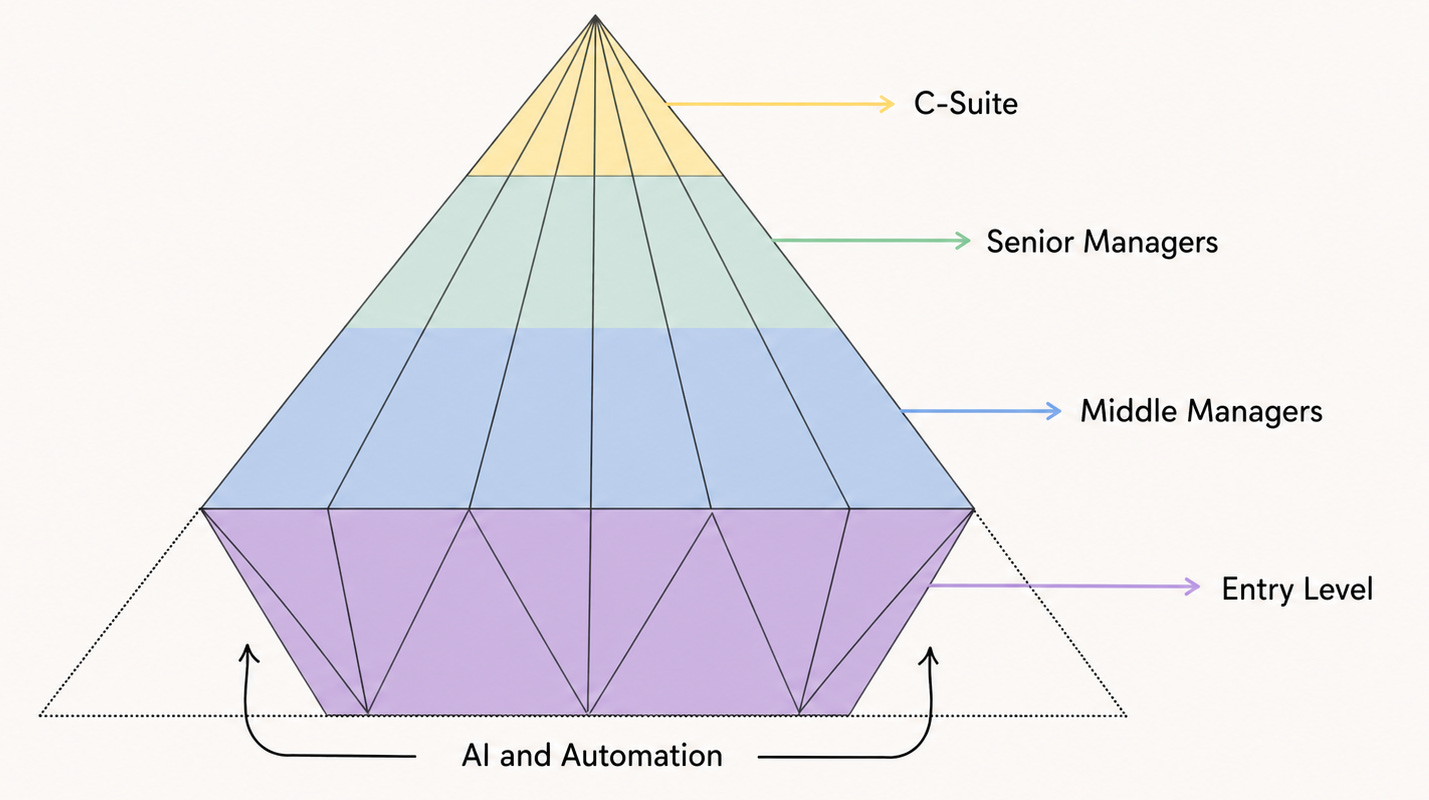
The diamond
In the diamond firm, the base of the pyramid narrows, the middle thickens with experienced specialists and AI-fluent practitioners and the apex stays small and focused on client relationships and judgement. The work that used to be done by armies of analysts is done by AI tools plus a smaller number of mid-level experts who can both interrogate the output and translate it into client-ready conclusions.
The nature of mid-level work changes in the process: the job is increasingly to direct and review what the tools produce rather than to produce the first draft yourself, which puts a premium on judgement and systems thinking, skills that used to be reserved for the apex.
This type of post-pyramid firm is the least disruptive option, which is part of why it has the most momentum (or is it inertia?).
🎥 Check out our video discussing this subject on Exploring ChatGPT’s YouTube channel!
The obelisk
The obelisk is a sharper version of the diamond idea: small, senior-heavy teams, minimal junior support, backed by shared AI infrastructure. The distinction between an obelisk and a merely shrinking pyramid is partly conceptual. A shrinking pyramid still assumes junior talent is a necessary input and is simply trying to make the model more efficient. The obelisk abandons that assumption, on the view that deep expertise plus AI is sufficient and that headcount below a certain seniority creates more coordination cost than value.
The roles people imagine in this model are AI facilitators (who handle the tools and data pipelines), engagement architects (who frame problems and interpret AI output) and client leaders (who own the relationship and carry the judgement). You end up with fewer people on an engagement, with more experience per head, and AI doing the leverage that juniors used to provide.
This is clearly more radical than the diamond, and harder to transition into without breaking the current P&L.
The platform
The platform is the most reinvented option. Leverage stops coming from people and starts coming from products, data and code. AI infrastructure and codified intellectual property form the base of the firm. A thinner middle layer of multidisciplinary experts sits on top of it. Client partners sit at a slim apex and orchestrate the offering.
The firm begins to look less like a partnership and more like a software company with an advisory wrapper. The cleanest analogy is SaaS: a software company doesn’t hire another engineer every time a new customer signs up because the product scales. A platform consultancy aims to work the same way, with revenue growing without headcount growing in lockstep and the firm’s accumulated methods compounding rather than being rebuilt on every engagement.
The hard part is that nobody drifts into this model. It demands deliberate investment in infrastructure and internal systems that most organisations are not structurally set up to make.
What partners need to start talking about
There are a few things worth taking back to your organisations.
Separate the AI productivity conversation from the AI business-model conversation. The first belongs with your operations and technology teams; the second belongs at partner level and probably deserves more discussion than it currently gets.
Decide what share of your revenue you want priced against outcomes in 24 months, and work backwards from there. A quarter is where McKinsey says it is. If that is where you want to be, the pricing conversation with clients needs to start this year, not the year after.
Take the training problem seriously now. The partners of the 2030s are the juniors you are, or are not, hiring in 2026. Cutting the base without redesigning the apprenticeship is a problem that adds up invisibly for five years and then shows up all at once.
Be specific with clients about where AI sits in your delivery. Firms that get caught pretending (to their clients, their people, or themselves) will pay for it in fees and then in trust, and the trust cost is the one that is genuinely hard to repair.
Get some tips about using AI responsibly in your business from this previous live and article. 👇

So, should I start rebuilding?
The pyramid isn’t dead, and the case for tearing it down isn’t quite made either. What the evidence does support is that the base of the pyramid is under genuine pressure, both as a profit centre and as a training ladder, and that time-based billing is increasingly mismatched to the type of work being done. Those are real problems with real costs attached. Neither of them tells you which of the emerging shapes and business models is right for your firm, and the honest answer is that no one knows yet - which is partly why no major firm has publicly or wholly committed to one.
That points to a more cautious conclusion. Drift into the wrong shape is one risk, but committing early to a shape that turns out not to fit, on the basis of trends still settling, is at least as expensive. That isn’t a heroic ending, but it is an honest one.
The advantage over the next two years will go to firms that learn fastest about themselves, not to those who bet earliest on a particular future.
👇 Steal My Toolkit
The newsletter covers ideas, frameworks and honest takes on consulting practice. The paid tier is where those ideas become usable: you get templates you can open in a project, prompts you can run today, and research tools built from over a decade of fieldwork.
Paid members get instant access to:
Consulting with AI Series: the custom AI prompts I use in my own management consulting work, explained and ready to adapt.
Full Course: Asking Questions Like a Pro - A Practitioner’s Guide to Mixed Methods Research ($199 value): practical research techniques refined across 10+ years of consulting engagements, covering design, facilitation and analysis.
Practical Guides, Handbooks, Workbooks and Templates: premium resources from paid posts or 70% off discounts for my Gumroad assets.
Cozora discount (up to $360 off): up to 50% off a Cozora subscription to learn AI from practitioners who use it in real work.
Free subscribers aren’t left out either.
Leader Tools Cards: 10% off with code ANDREA10 at leadertools.co/ANDREA10
Cozora welcome discount: 10% off via https://cozora.substack.com/andre10
Demystifying Academic Research - A practical guide for navigating academic research without a PhD: Available for free (pay what you can, $0+) via Gumroad
Disclosure: I earn a referral fee if you purchase through my links, at no extra cost to you.
 | A guest post by
|
The transition from pyramid to obelisk is incredibly evocative. Well done. I’ve been seeing posts discussing the associated transition from hourly to project based as a consequence of AI-enabled systems. The transition seems vitally important to watch as we see the headcount changes coming and SMEs look to consulting as a strategy for closing their income gap. Ofcourse, if there are business problems, there are going be providers of business solutions. So maybe this is the start of that whole space evolving under the selection pressure of AI.
Interesting post.
On a similar note, I have recently discussed the move to "industrialization" that firms need to adopt by following 5 tenets.
You may be interested:
https://themanagementconsultant.substack.com/p/5-core-tenets-for-the-industrialization-of-intelligence