
The Great Translation
Why we spend our lives misunderstanding each other


This article is a collaboration with Giada Lalli, PhD. Her publication, Generous Ideas, is a place for thinking out loud about work, research and the systems people are sent into, without the polish or optimism that institutions tend to project.
The first time you were powerless, you didn’t have the words to describe it. You were lying in a crib, your stomach was a knot of hunger and the only tool in your arsenal was a scream.
In that moment, your survival depended entirely on a “translator”: a parent or caregiver who had to decide if that specific pitch of crying meant you were hungry, wet or perhaps scared of the silence. This is where everyone’s story as a human being starts - with a massive power imbalance and a desperate need to bridge it.
We often describe conflict as a clash of personalities, but most friction is simpler than that. It’s a meaning problem: something was communicated (not necessarily said), something was heard and those two things did not match. From the toddler’s tantrum to the CEO’s cold email, the breakdown usually sits in the space between intention and interpretation.
We are all walking dictionaries. The trouble is that we keep assuming we’re using the same one.
Where The Dictionary Gets Written
In our earliest years, we learn how existing power structures respond to our signals. When a caregiver successfully decodes a baby’s cry, a powerful feedback loop is born: I have a need, I send a signal and the world changes. This is the birth of agency, and, over time, a basic kind of constancy: the sense that someone else can hold you in their mind, even before you can articulate what you need.
However, this type of translation isn’t always perfect, because it relies on guesswork, pattern recognition and a caregiver’s capacity in that moment. Even so, we become fluent in emotional language early. We learn what a heavy footstep in the hallway means, or what a sudden silence in the kitchen implies.
If our signals are consistently misread or ignored when we’re children, we are likely to develop ‘survival’ translations:
some of us learned to “shout,” becoming the loudest person in the room to ensure we are heard;
others learned to “disappear,” performing compliance to avoid conflict.
These patterns first appear as somatic scripts that we write to survive the power gaps we experience.
When Your World Meets Someone Else’s
As we grow and step into the world of peers, we experience our first culture shock. We realise that a raised voice in our friend’s house is just how they discuss dinner; while, at your house, a raised voice means that a fight is coming. As we age, the stakes of these gaps in meaning grow deeper. We begin to encounter the structural dictionaries of society as a whole. These include things that you’d experience everywhere in the world, like the weight of the ‘norm’, as well as regional patterns like patriarchy and class divides.
In a patriarchal society, the translation gap is often weaponised. When a woman speaks with authority, the cultural dictionary often translates it as aggressive; when she speaks with emotion, it is translated as irrational. Here, the power imbalance is so deep that the burden of translation falls almost entirely on one side. The marginalised must become fluent in the language of the dominant group just to survive, while the dominant group rarely feels the need to learn the language of the other.
This is equally true in the divide between rich and poor. A wealthy person may view a networking event as a casual exchange of ideas, while someone from a less wealthy background translates it as a high-stakes minefield of unspoken etiquette and gatekeeping.
When you are a minority (whether by race, gender, neurodivergence or something else), you spend your life code-switching, which is a high-intensity form of forced translation. You are constantly rewriting your internal dictionary to fit into a world that was designed by people who don’t speak your language.
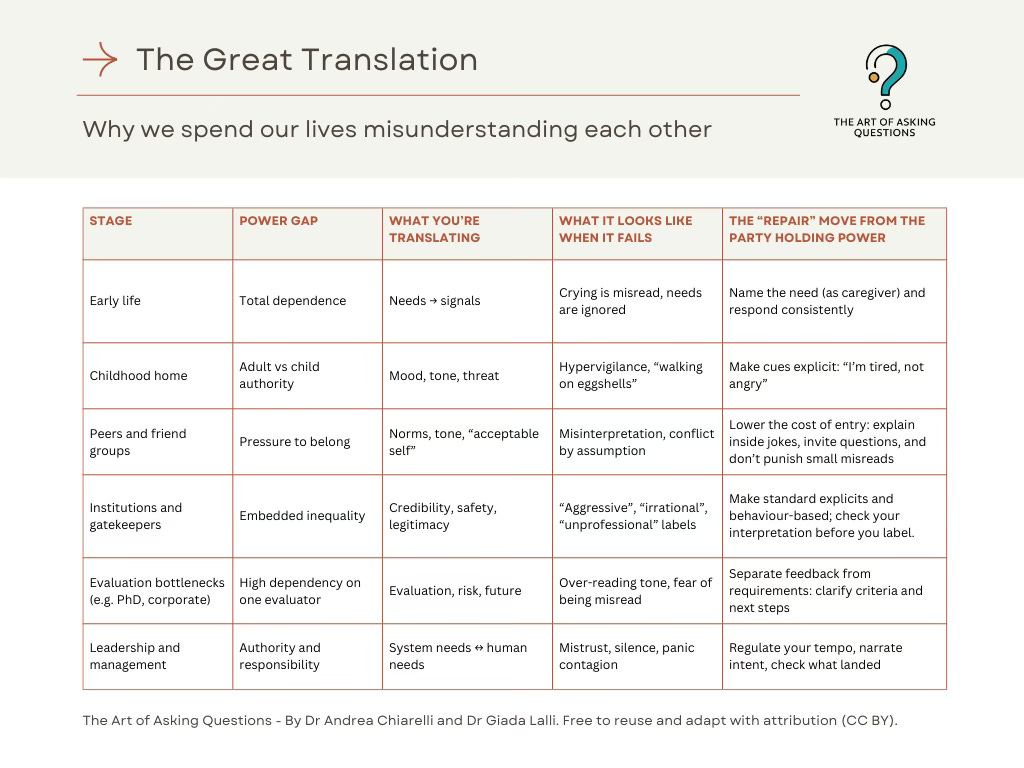
Here’s a pdf if you’d like to print this out:

The Invisible Gaps
Even in spaces where power should be balanced, like friendship, the ghost of hierarchy haunts the room. Think of the complexity of trying to enter a new social group. You are the outsider, the one who doesn’t get the inside jokes (the group’s private dictionary). Every signal you send feels like a risk; you over-translate your own behaviour to fit in, while the group decides what counts.
Perhaps nowhere is this hush-hush power imbalance more acute than in the world of academia, specifically for the PhD candidate. On paper, it is a collaboration between a mentor and a student. In reality, it is a feudal system. The PhD student exists in a state of suspended adulthood, where their entire future (their visa, their funding, their career) depends on the ‘translation’ of one supervisor. When a supervisor says, ‘This draft needs work,’ the student hears a threat to their survival. It’s almost like going back to those early childhood years where you needed to read the heavy footsteps in the hallway.
This is why small moments in academic life can carry such disproportionate weight. The language is often mild, but the dependency is not. When one person holds the power to open or close doors, the other person becomes hyper-attuned to tone and subtext. That is adaptation to a system where being misread has consequences - and the same pattern shows up anywhere progression depends on one person’s interpretation, including corporate life.
The Architecture Of Authority
By the time we reach our professional years, the power imbalances become structural and more rigid. In the early days of a career, translation is almost entirely upward. You spend your energy trying to turn your raw effort into a language your boss finds valuable. You are trying to prove you are a safe investment.
But the real shift happens when you begin to lead. Management is, at its core, a bridge-building exercise between two wildly different worlds. On one side, you have the organisation, a cold machine that speaks in KPIs, profit margins and efficiency. On the other, you have individuals, human beings who speak in the language of meaning, safety and recognition. A great manager is a bilingual translator who can explain the machine’s needs to the humans and the humans’ value to the machine.
In moments of uncertainty, that role becomes visible. People listen to what a leader says, but at the same time they watch what the leader’s pace, posture and attention seem to confirm. If their movements are frantic, the room reads panic. If they are steady and attentive, the room reads containment. In a power imbalance, people register the rhythm before they process any words or slides.
Read more about leadership across generations in this article from the Archive:

The Art of Asking Questions is a reader-supported publication. To support my work, please consider becoming a paid subscriber.
Translate the Gap While It’s Still Small
If we start viewing our misunderstandings as meaning gaps, the world becomes a much more manageable place. When someone doesn’t get you, it’s usually because the interface between your two dictionaries isn’ t working.
This is especially true when bridging the gaps of class, gender or institutional power. The person with more power has the luxury of being ‘clear’ in their own mind, while the person with less power must become a master of interpretation.
The next time you feel the heat of a conflict rising - whether it’s with a friend, a partner, or a supervisor - try to shift your internal questioning. Instead of wondering why they are being so difficult, ask yourself:
What are they protecting right now? Status, safety, control, dignity, reputation?
What did they actually hear you say? Not your words, but your signals, and what your message translates to in their dictionary.
What would “accurate translation” look like? A clean reflection: “What I’m hearing is X; have I got that right?”
The challenge is straightforward to see but difficult to address. But you will find that once the power gap is bridged by more accurate translation, disagreement becomes easier to navigate, and sometimes it even dissolves.
Remember that power is exercised through formal decisions and outcomes, but also through whose meaning becomes the default. When you start translating to understand rather than to win, you become more precise about what is happening between two people - and you give the conversation a chance to change.
👇 Steal My Toolkit
If you want the actionable version of this newsletter (templates you can copy, prompts you can run and frameworks you can reuse), it’s inside the paid tier.
Paid members get instant access to:
Consulting with AI Series: the custom AI prompts I use in my own management consulting work, explained and ready to adapt.
Course on Surveys, Interviews and Group Exercises ($199 value): practical research techniques refined across 10+ years of consulting engagements, covering design, facilitation and analysis.
Practical Guides, Handbooks, Workbooks and Templates: every premium resource from paid posts.
Cozora discount (up to $360 off): up to 50% off a Cozora subscription to learn AI from practitioners who use it in real work.
Free subscribers get perks, too:
Leader Tools Cards: 10% off with code ANDREA10 via https://leadertools.co/ANDREA10
Cozora welcome discount: 10% off with code WELCOME10 via https://www.cozora.org/a/2148167109/ovrPtvuC
Heads-up: I earn a fee if you purchase through my referral links, at no extra cost to you.
 | A guest post by
|
The idea of translation described here resonates a lot. Understanding the gaps + identity threats is what’s going to make managing conflicts easier for me. Thank you!
The metaphor of translation is a powerful way to describe these gaps.
One thing that often becomes visible in organisations is how early “survival translations” quietly solidify into professional identities. Someone who once learned to be the loudest signal in the room may later be labelled as assertive or difficult. Someone who learned to disappear may become the reliable, low-maintenance colleague who rarely challenges the system.
What originally helped a person navigate power gaps can later be misread as personality.
Which makes misunderstandings even more persistent: people believe they are reacting to character, while they are often reacting to adaptations that were written much earlier, in a completely different context.