
The Five Superpowers of Consultants (And How to Develop Them)
SCALE your career in complex, fast-moving environments


This article is a collaboration with Cécile. In her publication, Colleague, Interrupted, she helps you be the best version of yourself and get promoted faster without losing your mind.
If Medium is your go-to reading spot, you can catch this post there too! Just click here.
The consulting industry isn’t just big - it’s nearly $400 billion strong (2024 figures). It is one of the most lucrative and entrenched professional services industries in the world. It’s a machine that runs on high-stake decisions.
Every day, clients pay hundreds of millions for guidance, planning and decisions they often couldn’t solve internally. Whether that’s because the problems are ambiguous, the data is a mess or the stakes are extremely high.
Imagine you’re in the middle of one of those high stakes moments, at 9 p.m. in a meeting room. The problem is ambiguous, the data is messy and whatever you recommend tonight will set the company’s course for the next two years. This is where the right consultant can shape outcomes. Not with luck, but with a set of rare, well-trained skills that turn a wall of static into a clear signal others can act on.
Cécile and I are both in management consulting and have experienced these moments many times. Over the years, we have seen that certain skills consistently shape great consulting work.
We call these skills the five superpowers of consultants. And the upside is that they’re just as critical if you’re leading a product launch, negotiating a partnership or managing a crisis in-house in a completely different sector.
The risk? A lot of people overestimate how well they’ve mastered them, and those gaps tend to show up in the moments that matter most.
In this article, we unpack each of these superpowers, showing what they look like in practice and how you can build them into your own approach.
We have thought quite hard about the best way to frame them and landed on the acronym SCALE:
Synthesis
Curiosity
Adaptability
Leadership
Engagement
These might sound straightforward enough, but as we’ll see there is a lot more to each of them. We are planning to explore each superpower in more detail in a series of dedicated articles in case you’d like to dig deeper - but, for the time being, let’s dig in!

Synthesis
Consultants take large amounts of messy information and shape it into insight that others can act on. We are not talking about simply summarising things. Consultants spot patterns and turn raw data into new insight. Whether it’s pages of interview notes, years of financial data or conflicting opinions, the goal is the same: find what matters and make it clear.
Some might think that this is about being the fastest analyst in the room. But it’s actually about knowing what to look for, how to frame it and when to stop digging. Effective consultants are good at stepping back to see what picture is emerging, and then homing on the signal that others miss.
What challenges this superpower will help you address:
In a world overwhelmed by information, the ability to synthesise quickly helps others cut through noise and act more quickly and decisively.
Key sub-skills:
Pattern recognition: finding common themes across a variety of data
Prioritisation: Zeroing in on the few things that matter most
Storytelling: turning fragmented data into coherent narratives with clear messages and language that people can act on
A book we recommend: Thinking in Systems by Donella Meadows
Why: This book teaches you how to recognise patterns, simplify complexity and identify leverage points - the very heart of synthesis.
Curiosity
Consultants ask very good questions. Not more, but sharper than most. These are questions that disrupt assumptions and surface tensions that need to be addressed. They understand that every question carries weight, and they choose them accordingly.
This is also a way of building trust. Great questions signal attentiveness, intellectual rigour and respect for the client’s expertise.
What challenges this superpower will help you address:
Curious enquiry changes conversations - particularly difficult ones. Good questions can reveal gaps, shift perspectives and generate momentum.
Key sub-skills:
Precision in language: Crafting questions that cut through noise
Active listening: Reading between the lines and steering in real time
Going with the flow: Knowing when to push, pause or pivot
A book we recommend: A More Beautiful Question by Warren Berger
Why: A practical, inspiring guide to asking better questions, especially the kind that spark change. Excellent for developing intellectual curiosity and strategic inquiry.
Adaptability
Consultants jump between industries, contexts and problem types without missing a beat. They absorb new information quickly and reframe issues in novel ways. They can be both generalists and deep divers, adapting their lens depending on the situation.
What sets this skill apart is adaptability. We also like to think of this as Intellectual agility. This means getting up to speed fast without becoming superficial, and applying lessons from one domain to another with relevance and care.
What challenges this superpower will help you address:
Modern problems don’t stay in one lane. The ability to shift lenses depending on the problem and stay useful in unfamiliar territory is critical.
Key sub-skills:
Learning fast: Quickly mastering new concepts and sectors
Zooming in and out: Moving fluently between detail and big picture
Mental reframing: Seeing problems from unexpected angles
A book we recommend: Range by David Epstein
Why: It explores how generalists thrive by drawing from diverse domains, mirroring how consultants shift between industries and reframe problems creatively.
This article is a collaboration with Cécile. In her publication, Colleague, Interrupted, she helps you be the best version of yourself and get promoted faster without losing your mind.
Leadership
Leadership in consulting comes from the ability to find an anchor point when the room is drifting; and to hold productive tension when it would be easier to smooth things over.
Clients bring consultants in when stakes are high, answers are fuzzy and the usual processes don’t work. In those moments, what’s needed is a catalyst. Someone who can help the group pause, step back and reframe the challenge. Someone who can absorb ambiguity without transmitting panic.
This kind of leadership is deeply situational. It shows up in the way you steer a room through conflicting priorities, help clients zoom out when they're stuck in the weeds, or call time on a decision that’s going in circles.
What challenges this superpower will help you address:
When problems are ambiguous and the stakes are high, leadership is what helps groups shift from analysis to action. Consultants lead by creating traction.
Key sub-skills:
Creating traction: Nudging stakeholders from talk to action when decisions stall
Holding space for complexity: Helping groups think clearly without rushing to simplify
Harnessing conflict: Leveraging disagreement as a source of insight
A book we recommend: The Practice of Adaptive Leadership by Ronald Heifetz, Marty Linsky & Alexander Grashow
Why: A field guide to leading through uncertainty, especially when problems don’t have clear answers. It’s about holding space for complexity and mobilising people when authority alone won’t cut it.
Clients bring consultants in when stakes are high, answers are fuzzy and the usual processes don’t work. I remember one board workshop where senior leaders were deadlocked over a significant investment. Instead of choosing a side, we called a time out and reframed the decision from “Which option should we pick?” to “What risks do we need to resolve before either option is viable?” That pivot broke the stalemate and moved the group to action. In those moments, what’s needed is a catalyst. Someone who can help the group pause, step back and reframe the challenge.
Engagement
Consultants rarely own decisions. Their impact comes from earning trust and nudging clients toward better choices - all without formal power. This makes soft power central to the craft: trust, credibility and timing matter as much as logic. In other words: How do you make sure you have the right form of engagement with the right stakeholders to achieve your goals?
What makes this tricky is that influence must be built and rebuilt every time you walk into the room. It’s not enough to be right: you have to be relevant and attuned to the people in the room.
What challenges this superpower will help you address:
Consultants only succeed when people on the inside trust them enough to listen, challenge and act. Engagement is the groundwork that makes everything else land.
Key sub-skills:
Crafting relationship: Building bridges between diverse organisations and individuals
Empathy: Understanding what drives each person in the room
Building long-term credibility: Showing up prepared, thoughtful and dependable
A book we recommend:The Trusted Advisor by David H. Maister, Charles H. Green, and Robert M. Galford
Why: The gold standard on how to build trust, manage client dynamics and influence without formal power. A must-read for anyone in client-facing roles.
Are you already using these superpowers?
This checklist is designed to give you a snapshot of how each consulting superpower currently shows up in your work. By reflecting on these statements, you will see where your strengths are already delivering impact and where there is room to deepen your capabilities. It is not a test but a tool for focus, helping you decide which superpower to develop next so you can perform at your best in complex, high-pressure environments.
Whatever your score, remember: the gap between knowing and doing under pressure is where careers are made (or stalled). Closing that gap is exactly what our upcoming deep dives will help you do.
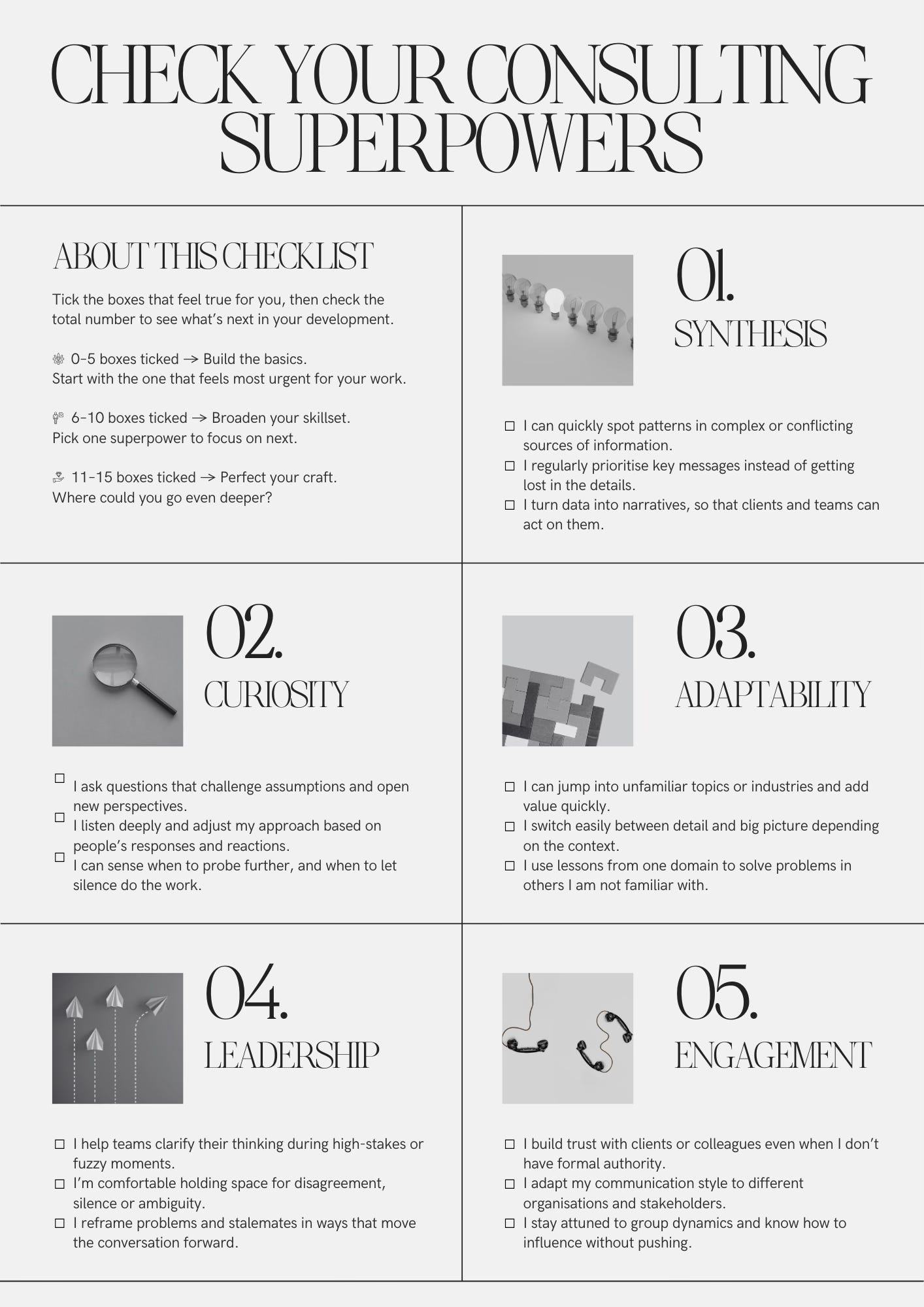
Would you like to print this? Here’s a pdf:

What’s next?
These five superpowers are survival skills for anyone working in complex, ambiguous or fast-moving environments. You don’t need to be in our sector to benefit, but you do need to start before the next high-stakes moment finds you.
In the coming weeks, we’ll explore each of these skills further - one at a time - with practical examples and prompts you can apply, no matter your role. These will be practical tips and tools that you can use immediately to turn pressure into progress.
Pick the one that feels most urgent. Start there. By the time we’re done, you won’t just recognise these skills… you’ll be the person everyone trusts to bring them into the room.
I'm Andrea, a management consultant with over a decade of experience across industry and academia. I work with commercial, non-profit, academic and government organisations worldwide, helping them capture meaningful insights through mixed methods research.
I write about practical frameworks to help you discover what others miss. My main goal is to translate complex concepts into techniques that readers can use immediately.
 | A guest post by
|
Having advised in other industries, adaptability and curiosity are key for me.
So much "Yes!" here. I'm looking forward to your deep dive into each super power.