
Five Tips to Become a Master of Persuasion
Actionable lessons from consultants and lawyers that everyone can borrow


This article is a collaboration with fenix. Check out his publication, with weekly posts aimed at helping others learn the principles of power in the workplace.
If Medium is your go-to reading spot, you can catch this post there too! Just click here.
Have you ever convinced someone to support your idea, only to find out later that they didn’t really believe in it? What if there was a better way to win support - one that actually sticks?
Whether it’s convincing your partner to try a new restaurant or nudging your boss toward that promotion, building trust and creating collaborative relationships are skills everybody should develop.
Recently, fenix and I spoke to unpack how we get buy-in as part of our professional roles, based on our backgrounds as a consultant (myself) and a lawyer (fenix).
Our discussion led us to shortlisting five practical tips you can start using in your own job to influence decisions, win support and get things moving.
These are not all the techniques in our toolbox - but a killer combination to hit your goals with minimal effort. Let’s take a look.
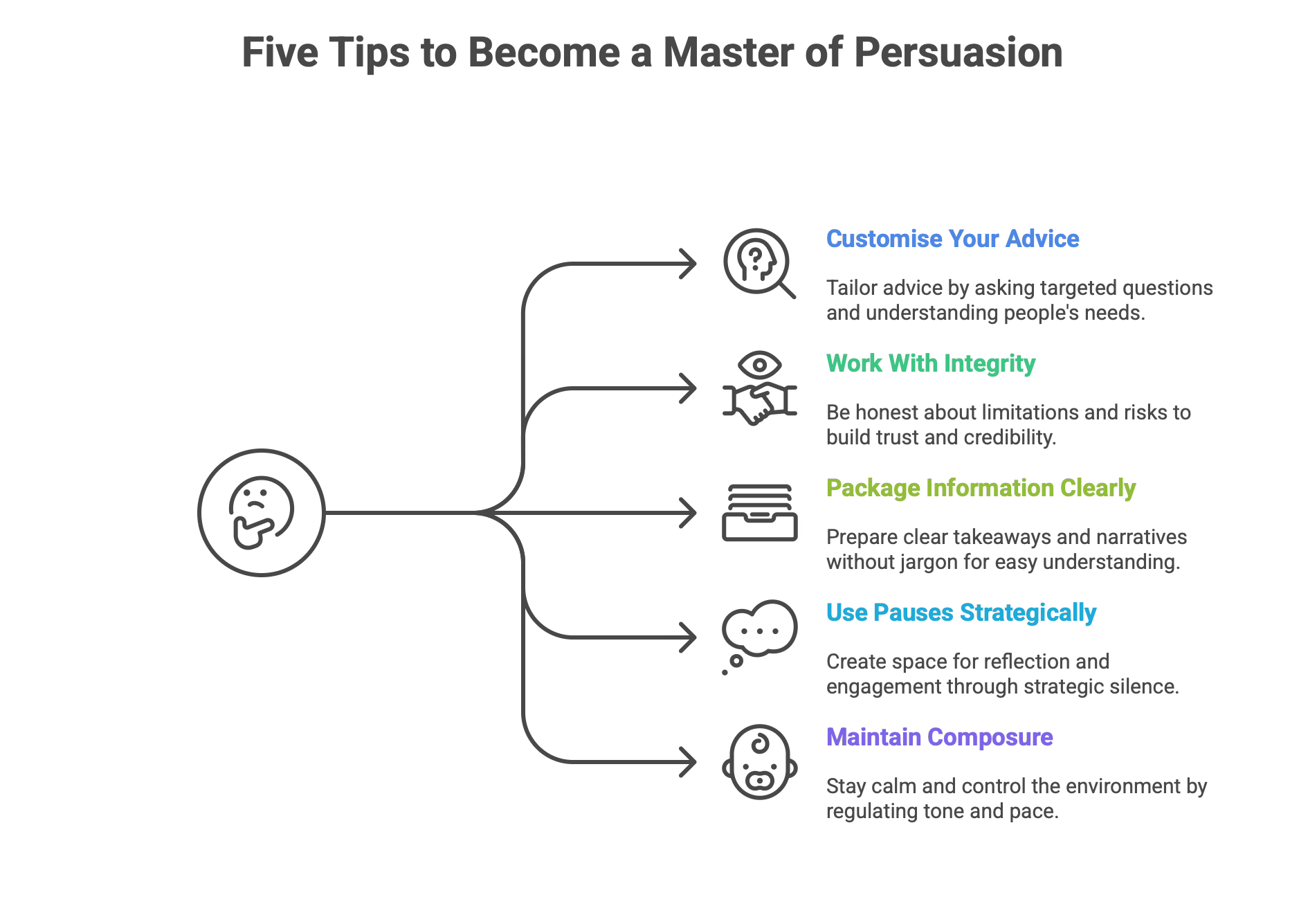
1. Customise Your Advice
To get people on your side, you first need to know what matters most to them: the only way to find out is by asking targeted questions - a key focus of my publication. This should be complemented by actively listening to people’s words and their tone, as well as paying attention to body language and the dynamics around them. There might be things that people don’t articulate verbally but might transpire from the interaction.
💼 Consultants are trained for this. Their ability to dig beneath the surface to uncover what stakeholders truly care about, whether that’s power struggles, reputational risk or the fear of another failed transformation, can make or break projects.
⚖️ Lawyers do the same, though often more subtly. Before negotiations or meetings, they don’t just review facts; they watch and listen, picking up on personalities, egos and subtle cues in the room to spot where the real pressure points lie.
When people feel heard, your ideas will feel like collaboration, not confrontation.
✅ Use it yourself: In your next meeting or presentation, spend more time asking questions than making statements. Try: “What’s most important to you here?” or “What concerns you about this?” Also pay attention to the dynamics in the room, to see who interrupts, who stays quiet and where the tension builds. With this understanding of people’s perspectives, you can frame your ideas so they connect with what others value.
2. Work With Integrity
Credentials may get you in the door, but credibility is built when you’re honest about trade-offs, limits and risks. This can sometimes be difficult in service-based industries where there is the temptation to tell clients and people what they want to hear… but it is extremely important.
💼 Consultants will often say, “Here’s where the data is incomplete” as they know that, counterintuitively, it makes clients trust their advice more. This feels hard at first, as there’s an idea out there that consultants must always be confident and certain. But being honest is far more valuable.
⚖️ Lawyers take the same approach in deals by flagging risks instead of pretending everything works. They also use their understanding of what the client values most to steer negotiations, winning the points that matter and conceding on the ones that don’t.
✅ Use it yourself: Never misrepresent the facts. If you lack certain information or there’s a downside to your plan, acknowledge it and propose a way to find the answer or mitigate the risk. Saying “I don’t know, but I will find out” or “There are trade-offs here, and here’s how we can manage them” can boost your integrity in others’ eyes. People are more easily persuaded by someone they consider honest and competent.
I recently advised a client launching a new product, and the market analysis revealed significant gaps they hadn’t anticipated. Instead of glossing over it, I told them, 'The stakeholder consultation has revealed a gap here. If we ignore it and move forward with the launch by the planned date, we are likely to face bigger issues. Here’s how we can address it with a minimal delay.' While it was uncomfortable, they appreciated the honesty, and we adjusted the strategy to mitigate the risks we’d identified. That transparency strengthened our relationship and helped us move forward confidently. The launch was, indeed, a bit delayed - but successful!
3. Package Information Clearly
Cold, hard facts rarely persuade on their own. Both consultants and lawyers know that how you present information can be just as important as the content itself. In the end, people trust what they can grasp quickly, and they’re far more likely to agree when they fully understand what you’re saying.
💼 In reflection of these principles, top consultants package their recommendations so they’re easy to follow: key points upfront, no unnecessary jargon and a clear story that ties the numbers to outcomes people care about.
⚖️ The best lawyers do the same. They strip away legalese, write in plain language and deliver their advice so clients instantly understand what’s at stake and what needs to be done.
Ultimately, clear, structured communication makes you more persuasive - and keep in mind that this can apply to anything from an email to a document! It’s a key skill that sometimes even the smartest people struggle with.
✅ Use it yourself: When presenting an idea, lead with the takeaways, avoid jargon your audience doesn’t use and make your points short and concrete. Clarity builds trust and confidence, and it makes it far easier for people to say “yes.”
4. Use Pauses Strategically
The best persuaders have mastered the art of the pause. That is, knowing when to stop talking to enable the other party to engage. Lawyers and consultants use this technique in surprisingly different ways!
⚖️ In deal negotiations, lawyers will often make a point or proposal and then say nothing. That quiet moment can create subtle pressure, prompting the other side to fill the gap by revealing concerns, making concessions or simply agreeing to move things forward. Silence also projects calm confidence; it signals you’re not desperate to be heard or to rush a deal.
💼 Consultants also use silence to prompt the other side to fill a gap. In carefully picked moments, they pause and create a slightly uncomfortable silence, so that participants in interviews, focus groups or workshops feel the pressure to contribute (or, in some cases, simply have time to collect their thoughts).
✅ Use it yourself: After making a key point or request, resist the urge to fill the silence. Let the silence work for you by having others process and respond. Yes, it’s as simple as that - but you do need to get used to that lingering silence!
5. Maintain Composure
Whether it’s a billion‑dollar deal or a project on the brink, both lawyers and consultants know that composure can sway outcomes. Calm confidence steadies everyone else in the room.
⚖️ Skilled lawyers act as emotional anchors in tense negotiations. They keep their clients focused on long‑term goals when frustration starts to take over, and they read the opposing side’s emotions just as carefully. If tensions flare, they slow the conversation, call for a break or soften their tone to de‑escalate.
💼 Consultants do something similar, staying grounded when challenged by executives, which makes their advice land more credibly. Consultants are also masters at building consensus ahead of meetings, engaging stakeholders throughout a project so that views are as aligned as possible at the most critical moment.
Steady voices travel farther than loud ones in settings where persuasion matters. Nervousness or anger can make you sound less credible, while a composed presence projects authority even when you’re under pressure.
✅ Use it yourself: In tough conversations, slow your pace and lower your tone. If things heat up, pause before responding or suggest a break. Never, ever raise your voice - or you lose. Composure keeps you in control of the room and makes people far more willing to buy into your perspective.
Bringing It All Together
Persuasion is a multifaceted skill that requires a deep understanding of people, trust-building, strategic communication and emotional intelligence. It’s an ongoing practice that integrates these elements into every interaction.
Mastery of persuasion takes time. But each conversation is an opportunity to sharpen your approach, so do go ahead and incorporate these techniques into your everyday exchanges. As you do, you’ll notice a transformation - not just in how others respond to you, but in how you navigate challenges, make decisions and build connections.
Start practicing these strategies in your next meeting and see how your ability to influence grows. It’s a powerful shift you can immediately begin to leverage.
And remember: the most effective persuaders are those who prioritise making others feel heard, valued and understood - not those who seek to dominate or manipulate.
I'm Andrea, a management consultant with over a decade of experience across industry and academia. I work with commercial, non-profit, academic and government organisations worldwide, helping them capture meaningful insights through mixed methods research.
I write about practical frameworks to help you discover what others miss. My main goal is to translate complex concepts into techniques that readers can use immediately.
 | A guest post by
|
Thanks you for all the practical tips listed in the article. I found myself keep nodding while reading it. And it's very interesting, those tips can be applied to parenting more or less. Can't wait to try it later. (I found myself start losing negotiation battles with my 3yo...)
These are absolutely stellar and clearly well-earned insights. And, nicely supported by science!
Number one struck me from the consultant lens, too, but recently played out live with a (now former) advisor in my own company. They are brilliant, but their delivery was never tailored. Listeners had to work hard to align their ideas to the topic and interests at hand.
Ultimately, we had to part ways with the advisor. It was just too taxing, jarring, and difficult to manage. So it has real impact and appreciated effort when I am working with individuals that keep this in mind. To your article’s title, it’s persuasive!
*And, small aside, your structure makes for an enjoyable read of the concepts, peppered nicely by two perspectives and woven together at the end… informative, a pleasure to read, and, well, clear evidence of your five points in action!