
Make Your Career Bloom
The cognitive ladder of career growth

When you look around at colleagues who seem to rise faster than others, what do they actually do differently? It’s tempting to assume they’re more confident, better connected or simply luckier. More often, the real difference lies beneath the surface: it’s in how they think.
We tend to describe career progression in visible terms, focusing on things like titles, years of experience, achievements, networks. Yet, beneath that visible climb (which is arguably a thing of the past) runs a shift in cognitive depth. The more complex the thinking, the greater the impact.
That’s what psychologist Benjamin Bloom and his collaborators captured decades ago in their taxonomy of learning. The framework originally described three dimensions of human growth: the cognitive (how we think), the affective (how we feel and value) and the psychomotor (how we act and perform).
Later scholars refined this model into what we now call Bloom’s Revised Taxonomy, expanding and modernising its treatment of the cognitive domain: the dimension that concerns how people acquire, process and apply knowledge.
This cognitive strand translates really powerfully into professional life. The six levels of cognition — from remembering information to creating new knowledge — describe remarkably well both how students learn and how professionals evolve. Applied to our careers, the taxonomy turns into a map for development: how we move from competence to creativity, from execution to leadership.
Let’s take a look at the taxonomy:
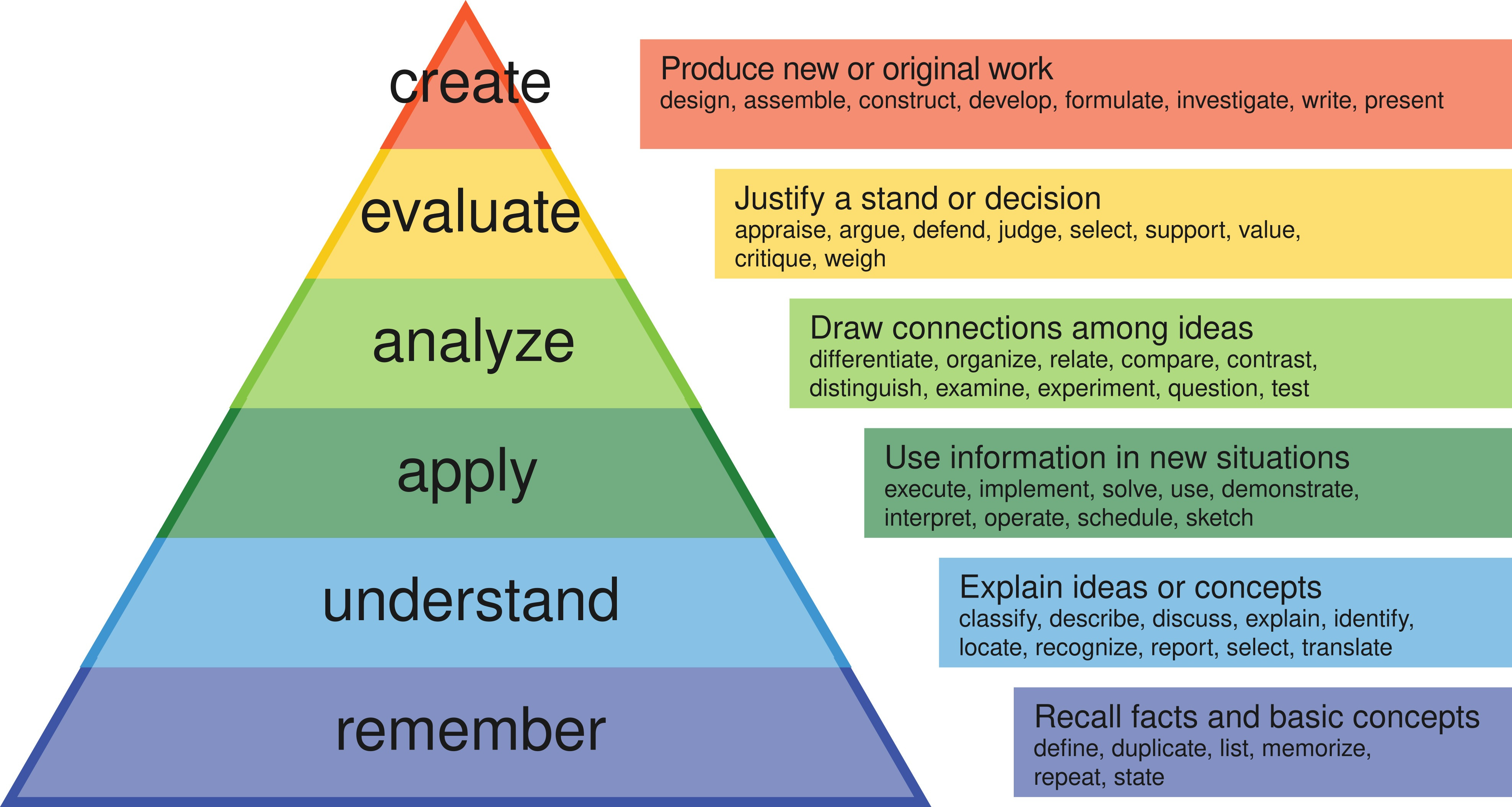
I think this is genuinely cool. You start by building a foundation of knowledge and then create more leverage as you move higher up in the layers.
Growth might look simple in this chart, but, as ever, there is a lot more to it! Let’s explore how these concepts can translate into career progression and what questions you could ask yourself to see where you stand.
Just a quick note: After the text, you’ll find a neat visual summary of the article that you can print!
1. Remember
Every career begins with knowing. In your early years (or anytime you step into a new domain) your value lies in mastering the language of the field: its tools, terms, codes and unwritten norms. You study processes, observe others, learn what “good” looks like. It’s a time of absorption.
This is the Foundation stage of your career: your attention is on accuracy and reliability. You’re learning how things work. The aim is not to be the most original thinker out there, but making sure you can find your way in an unknown territory.
🪴 Career reflection: What must I know by heart to be credible in this field?
2. Understand
Soon, facts aren’t enough. You begin to see that what you know is table stakes, and that success depends on how well you grasp the why behind it.
You start connecting dots: understanding how your task links to a bigger process, how your work affects others, how decisions cascade across departments. You stop asking What do I do? and start asking Why does this matter?
At this stage, your perspective expands beyond your own to the organisation’s or field’s logic. You’re learning to read the system and to Contextualise your knowledge.
🪴 Career reflection: Do I understand the logic behind my work, or just the steps?
3. Apply
This is where confidence starts to take root. You can now translate understanding into consistent, reliable action. You take theory and make it work. You start delivering results and solving problems without constant direction.
This is your Performance stage, where people trust you not only to know but to do. You become a person others rely on.
🪴 Career reflection: Can I apply what I know flexibly across different situations?
4. Analyse
Something shifts here. You stop just executing within the system and you begin to see the system.
You can trace patterns and question assumptions. You start anticipating rather than reacting. You don’t just complete projects; you can immediately understand why they might be stuck, and what needs changing to move forward.
This is analytical maturity: the moment you cross from doing the work to improving it. In leadership terms, this is where influence begins as you start to Strategise: you are now seeing structures where others see chaos thanks to the experience accumulated to this point.
🪴 Career reflection: What patterns do I notice that others might not?
5. Evaluate
Now, your strength becomes discernment. You develop a sharper sense of what matters most. You can weigh trade-offs, judge priorities and make calls under uncertainty. Others begin to seek your opinion for judgement.
You start mentoring others, offering feedback and taking responsibility for decisions. You’ve moved from analysis to Influence: from diagnosing problems to defining direction.
🪴 Career reflection: When people seek my opinion, what kinds of decisions do they trust me with?
6. Create
Eventually, your thinking becomes generative. You’re no longer just fitting into systems that others have made for you: you are directly shaping them through your Leadership.
You build new frameworks, launch initiatives and challenge conventions. Leadership here is about creation, not hierarchy. The point is that you can turn insight into innovation, and experience into guidance for others.
Clearly, at senior levels creation and evaluation often work in tandem, as leadership requires the ability to invent and to discern — to judge which ideas are viable and which structures deserve to endure. So vision and critical thinking have to coexist.
This is also the stage where you start creating culture, not just projects or products. The work begins to carry your signature: as leadership expert Spider-Man’s uncle Ben would say, “With great power comes great responsibility.“
🪴 Career reflection: What am I building that didn’t exist before I came?
The Ladder Isn’t Linear
It’s tempting to read this taxonomy as a staircase with each level neatly following the next. But professional reality is far more fluid.
In practice, you often move between levels daily: analysing in the morning, applying after lunch, evaluating by evening. Roles, projects and crises pull on different kinds of cognition. A consultant, for instance, might analyse a client’s system, apply a proven framework and create a new process… all in the same day!
The progression is effectively a deepening spiral. You do climb your way up in a somewhat linear way over time, but as this happens you will be deploying all the different capabilities you have mastered to that point. Essentially, by the time you are at the top, you will have strong ownership of the whole toolkit and will be expected to deploy just the right mode of thinking at the right time.
Cognitive agility, not rigid progression, is what distinguishes those who lead and thrive.
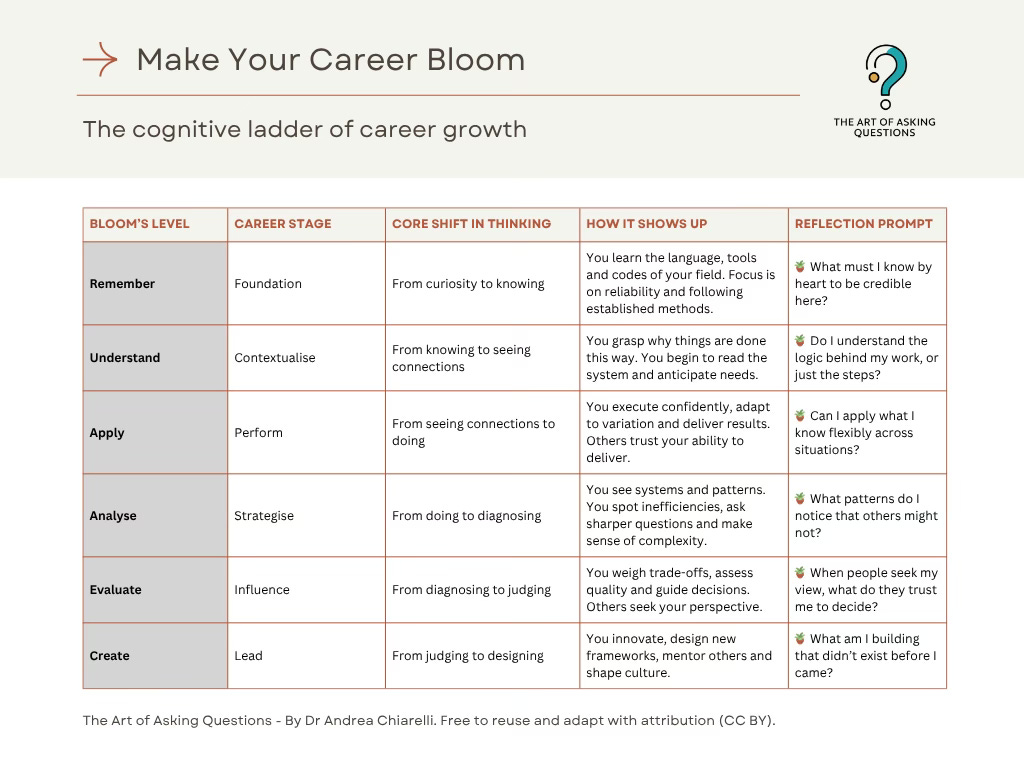
Prefer a pdf? I got you:

Every Promotion Is a Cognitive Step Up
What this model shows is that career advancement is not just about seniority or skill. To grow with impact, you need a shift in perspective.
You can stay at the Apply level for years, doing excellent work but not expanding your thinking. Or you can start experimenting with Analyse, Evaluate, and Create now, questioning assumptions and shaping better systems.
In my experience, the more you stretch to think at the next level, the more naturally you grow into it.
That’s why the most effective professionals seem to “arrive early” to leadership: they start thinking like leaders long before anyone gives them the title.
So here’s what I recommend you do next:
Locate yourself: Which level best describes how you currently think or work?
Stretch deliberately: Choose one verb from the next level — analyse, evaluate, create — and practise it consciously for the next few weeks.
Reflect often: Keep a brief learning log of when your thinking expanded and what it changed in your results.
Teach it: The fastest way to consolidate new thinking is to explain it to someone else.
The Evolution of Thought
Careers grow by thinking deeper: every stage of your development will demand a different kind of cognition, from precision at the start, to discernment in the middle, to imagination at the top.
The most fulfilled professionals keep evolving. They learn to operate across all six levels, switching fluidly between analysis, application and creation depending on what the moment demands.
This is what sustainable career growth looks like: a lifelong practice of deepening thought.
Once you start seeing your professional life through the lens of how you think, the path ahead becomes unmistakably clear. Not a ladder, but a rhythm. You realise that progress is about learning to think at the next level — and then design from there.
I’m Andrea, a management consultant with over a decade of experience across industry and academia. I work with commercial, non-profit, academic and government organisations worldwide, helping them capture meaningful insights through mixed methods research.
I write about practical frameworks to help you discover what others miss. My main goal is to translate complex concepts into techniques that readers can use immediately.
The ladder is definitely not linear, and can indeed fluctuate even on the same day. By morning, I can be a manager prepping the team for an upcoming challenge, and by late afternoon, I can be back in my analyst brain, facing another data challenge head-on.
Bloom's taxonomy as a career progression framework maps really well onto The Ready Set's leadership model. Most people get stuck at "Apply" (reliably executing) and never make the cognitive leap to "Analyze" or "Evaluate," which is where real influence starts.
In The Ready Set, it emphasizes intentional awareness and adaptive thinking as core behaviors, and that's exactly what this framework is describing: the shift from doing the work to seeing the system, then shaping it. The question "What am I building that didn't exist before I came?" is the Create-level version of legacy leadership: not just performing well, but leaving something meaningful behind that others can build on.