
Leading When The Machines Get Loud
Why automation demands better people leadership, not less


This article is a collaboration with Diamantino Almeida. In his publication, Leadership as a verb, he helps leaders navigate leadership, AI, and culture not with quick fixes, but with frameworks grounded in solidarity.
If Medium is your go-to reading spot, you can catch this post there too! Just click here.
We live in an age of astonishing technological fluency. Artificial Intelligence (AI) drafts our emails, schedules our meetings, and analyses our data—yet something essential is slipping away: the ability to lead.
Leadership has always been forged through experience: through criticism, setbacks, learning, and growth. No algorithm can replicate the insight that comes from navigating uncertainty with others. The essence of leadership remains profoundly human: the capacity to motivate, to guide, and to create meaning within complexity.

Despite this, the modern workplace increasingly treats technology as a universal solution. Investments in applications and platforms often outpace investments in people. With ChatGPT, Claude, Perplexity, and Gemini at our fingertips, leaders now manage a hybrid environment in which human and machine contributions intertwine.
These systems can feel like collaborators, but they remain tools (though powerful ones).
The Operator’s Trap
As AI becomes more capable, many leaders find themselves absorbed in orchestrating and optimising its use: refining outputs and deploying systems strategically across their organisations.
We know of many leaders who now spend hours fine-tuning prompts—a new form of managerial micromanagement disguised as innovation.
This work can feel like leadership, yet it is a different kind of engagement. When an AI model performs well, there is no growth to celebrate; when it fails, there is no learning process to nurture. Machines respond to parameters, not purpose.
AI can analyse vast datasets and communicate in ways that resemble human fluency. These abilities can easily give the impression of understanding, but imitation should not be mistaken for comprehension. Leadership is rooted in qualities developed through human interaction, not algorithmic iteration. The challenge for today’s leaders is to remain attuned to the difference.
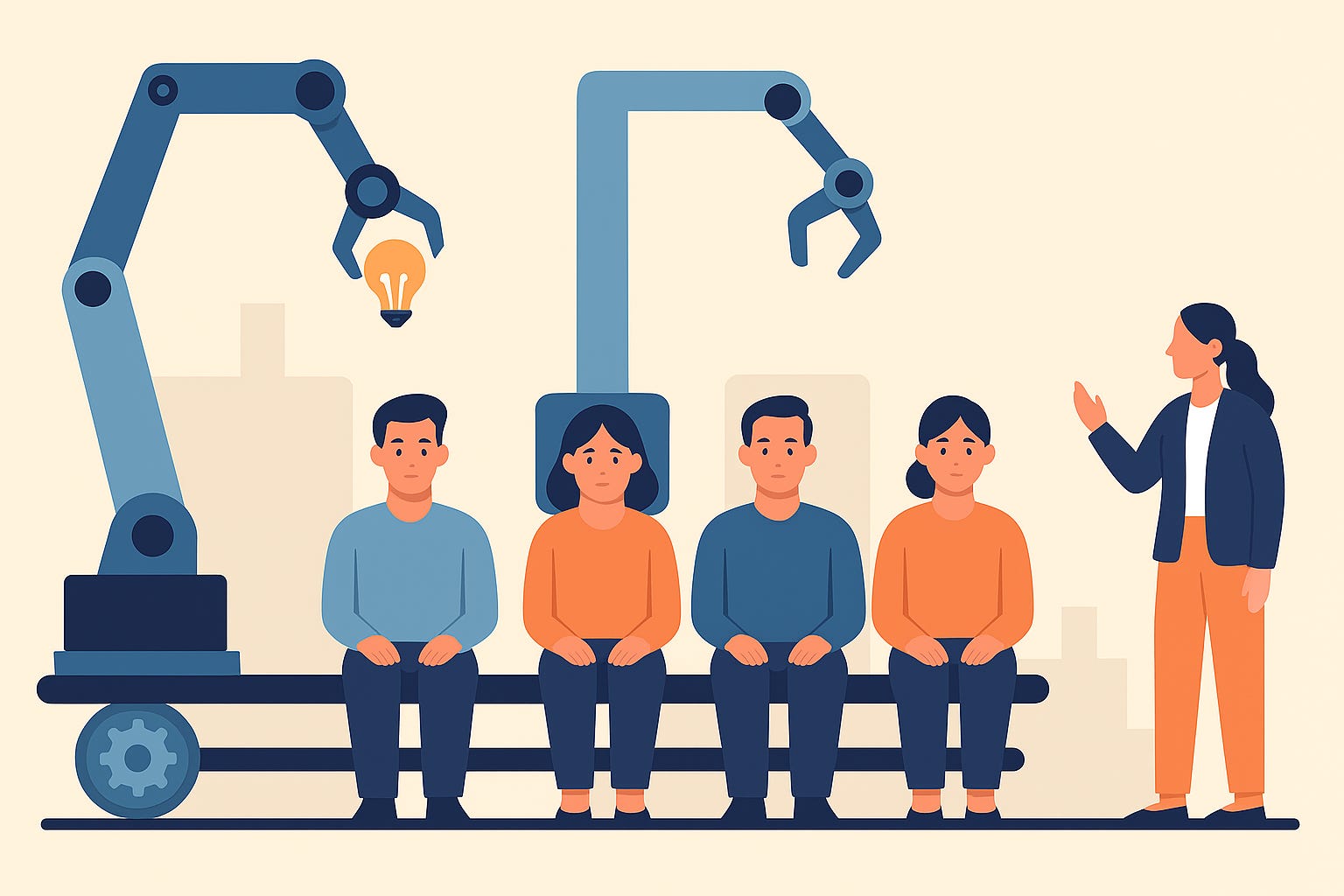
When Machines Speak Louder Than Teams
Workplaces have accelerated to a relentless pace. Short meetings, instant communication, and constant deadlines define the rhythm of modern collaboration. Large language models now summarise discussions and detect patterns faster than entire teams once could. Efficiency has become synonymous with progress.
This speed, however, introduces a subtle but significant shift. As teams grow accustomed to consulting AI for validation (“Let me check that with ChatGPT”) trust within human networks begins to erode. Confidence moves from colleagues to tools, and with that shift, feedback loops collapse. People stop seeking affirmation from each other, and start seeking it from the interface.
Over time, people start to measure their worth against systems that never tire and never make emotional demands. The human contribution becomes obscured within the automation that surrounds it.
As reliance on AI deepens, expectations rise. Deadlines compress and the margin for error narrows. When teams struggle to meet these new demands, the assumption often follows that they are not leveraging technology effectively enough. The underlying issue, however, is not a lack of automation skill but a diminishing appreciation for the human pace of thought and the care that makes work sustainable.
The Costs of Acceleration
Today’s leaders operate in an environment of constant alerts and algorithmic recommendations. The volume of information can easily overwhelm the human capacity to process and prioritise. When the pressure mounts, the instinct is often to automate further. To add dashboards, agents, and monitoring tools. Yet this layering of systems rarely addresses the deeper challenge: the erosion of time for reflection and connection.
When creation and decision-making are increasingly delegated to machines, leaders risk drifting into the role of operators, supervising processes rather than shaping ideas. Innovation begins to narrow, confined to what machines can model or predict. The collaborative spaces where new insights emerge shrink as individuals work more independently, each equipped with a personal suite of AI tools.
This shift also carries a social cost. The collective experience of building together gradually fades, and we lose the debate and the shared exploration of uncertainty. Meetings become summaries, conversations become transcripts, and teamwork becomes coordination rather than collaboration. What is lost is not efficiency, but the sense of shared endeavor that sustains purpose.
Reclaiming Human Leadership
Leaders have a choice in how they respond to these changes. AI can serve as an exceptional analytical partner, capable of accelerating learning and expanding perspective. Yet its value depends entirely on how it is used. The most effective leaders will treat AI as an instrument to enhance human capacity, not as a substitute for human judgment.
This requires deliberate design. For example:
Bringing teams together to explore what AI uncovers, to test ideas, and to determine what ideas should be pursued.
Encouraging curiosity and critical dialogue about how technology shapes the work itself.
Remember that AI can generate possibilities, but it is human creativity that determines which of those possibilities matter.
Leaders should also resist the temptation to offload complexity entirely to machines. Technology can simulate reasoning, but it cannot assign meaning. The ability to discern significance, to decide what should be done, not merely what can be done, remains an exclusively human responsibility.

The Leadership Imperative
The temptation today is to equate operational efficiency with effective leadership. Yet leadership extends far beyond process management. It lives in trust, empathy, and the willingness to engage with uncertainty.
AI will continue to refine our ability to process information. What it cannot do is create the emotional and ethical frameworks that turn information into wisdom. True leadership cultivates environments where people feel safe to experiment and disagree productively. It values the human friction that sparks progress, rather than seeking to eliminate it through automation.
The narrative of AI as a “second brain” risks narrowing our understanding of what leadership entails. Leaders who delegate too much of their judgment to machines may find that their organisations become faster but less cohesive, more productive yet less inspired.
Machines will continue to organise our information with increasing sophistication. But the task of transforming that information into meaning and impact still belongs to people.
The future of leadership depends on our ability to remember that distinction and to lead accordingly.
I’m Andrea, a management consultant with over a decade of experience across industry and academia. I work with commercial, non-profit, academic and government organisations worldwide, helping them capture meaningful insights through mixed methods research.
I write about practical frameworks to help you discover what others miss. My main goal is to translate complex concepts into techniques that readers can use immediately.
 | A guest post by
|
Great piece!
I do notice in myself that the more I create rules for a GPT, the more I am actually micromanaging, and how impatient I get when I don't get the result I want. It's like I just threw away all my management skills, and I am playing a video game. There is a real potential that people management might suffer at least at first here. Positive note, might open up a new world of coaching --> managing those who manage AI :)
Great to see this collaboration! Living the leadership!