
Leading Across Operating Systems
When a 30-year gap sounds like a values clash (but usually isn’t)


This article is a collaboration with Andrew Barban. He writes about leadership, communication, and relationships. What drives work behind the scenes, why it works that way, and what you can do to survive it or change it.
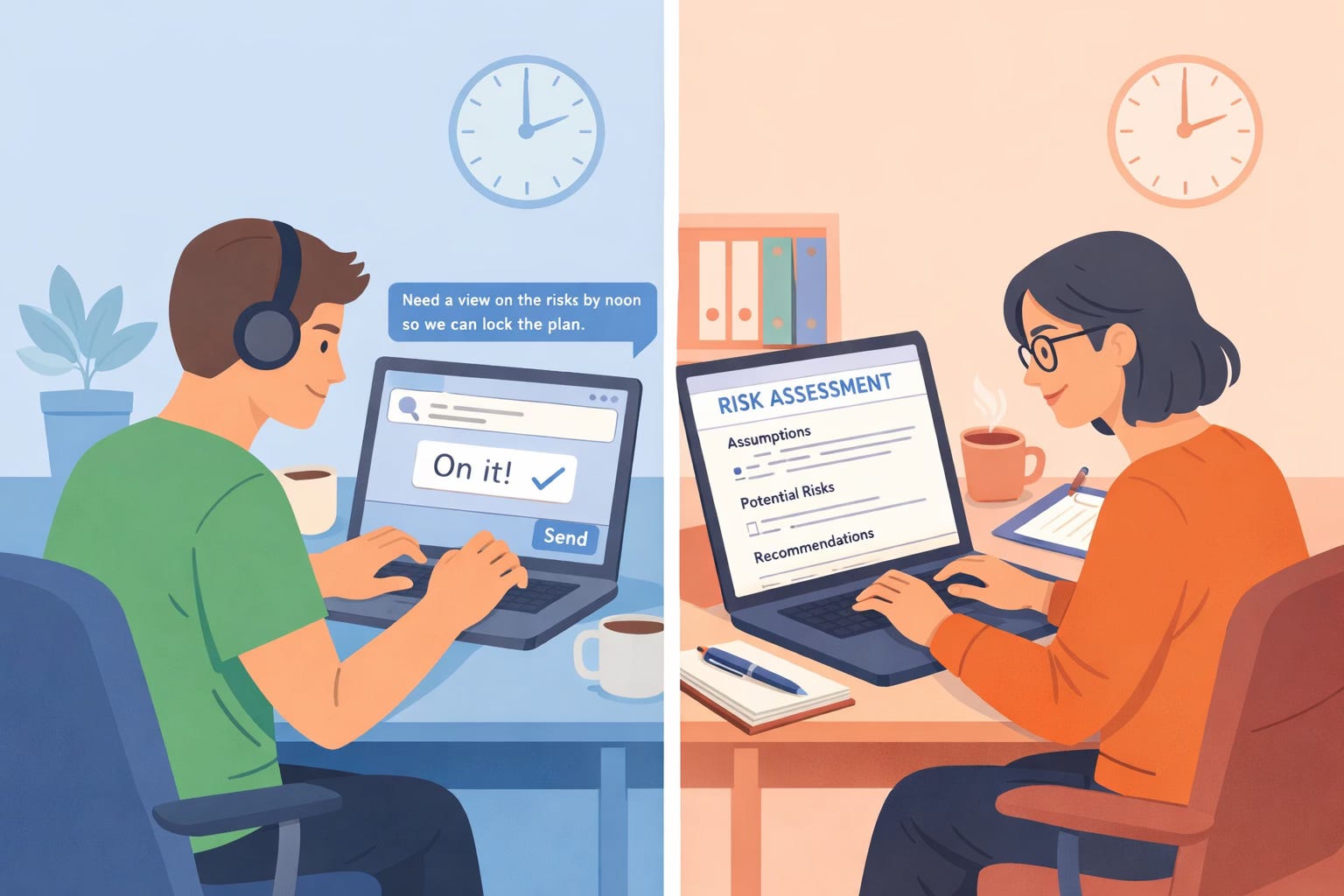
It’s Monday, 9:07am. A project lead drops a message into the team chat: “Need a view on the risks by noon so we can lock the plan.” One person replies immediately: “On it.” Another says nothing for two hours, then shares a careful note with assumptions, caveats and a recommended path. By lunchtime, both are mildly annoyed, and neither is quite sure why.
The fast responder reads the silence as indifference. If you respect the team, you acknowledge quickly. The careful responder reads the chat interaction as premature. If you respect the work, you think properly before speaking. In the afternoon meeting, the friction shows up as tone: one side sounds impatient, the other sounds defensive. Neither is trying to be difficult. Both are expressing rather different default behaviours and values.
These striking differences show when people bring different “work operating systems” into the same room, and is especially common when individuals are separated by decades. Our defaults are naturally shaped by the conditions in which we learn what “good work” looks like: the economic climate when we enter the workforce, the management fashions that reward certain behaviours, the tools available for coordination and the social norms around authority, identity and risk.
Here’s Andrew’s own experience of how different socio-economic realities can shape us:
I entered the workforce when companies still offered pensions. You could work at the same place for twenty years and retire with security. Layoffs happened to people who performed poorly. If you were good at your job and loyal to the company, the company would be loyal back. That was the deal. It mostly held.
People who entered the workforce in the last fifteen years walked into a different world. Companies eliminated entire divisions of high performers to hit quarterly numbers. Pensions disappeared. Job security became a joke. The deal broke. Loyalty became a liability. The people who survived learned to keep options open, move fast, and never count on a company to protect them.
When different defaults collide, the mismatch can sound like a values conflict even when both sides want the exact same outcomes. This is a case where leadership has to pursue integration, by helping the team see these hidden default assumptions and developing a shared way of working. Let’s dig deeper.
People React To Stories
A lot of workplace conflict is caused by the stories that different people attach to what is happening and what others are doing. Karl Weick’s work on organisational sensemaking is helpful here: under ambiguity, people interpret cues, then act as if the interpretation is “what’s going on” (which, subjectively, will feel true!).
That is how ordinary interactions become evidence of intent:
A short Slack message might land as efficient or brusque.
A delayed reply might land as focus or disregard.
A public brainstorm might land as collaborative or chaotic.
Generational stereotyping is a dead end here. A more consequential question is where these instincts will show up. In our experience, they will sneakily appear in moments where people make fast judgments about someone else’s tone and intent.
Here’s Andrew:
These are not beliefs, but adaptations to real conditions. The older generation built instincts around stability, long relationships and reliability over time. The younger generation built instincts around adaptability, growth and protecting their own mobility. Both sets of instincts made perfect sense in the world that shaped them.
This reflection helps us stop feeling like differences between people from different cohorts are personality defects. Even better, it can help us start seeing that what is in front of us is just different risk-management and coping strategies that we all learn to adopt in response to different socio-economic climates.
The Differences That Show Up In Everyday Collaboration
A few misinterpretations are common in the workplace. Let’s have a look - we’re sure that you have come across at least some of these:
Professionalism
For some, professionalism means restraint: a measured tone, fewer messages and a preference to resolve uncertainty before speaking. For others, professionalism is visible coordination: sharing early, updating often and using lightweight exchanges to reduce uncertainty together. Neither is inherently superior; each simply optimises for different risks. As you’d expect, the conflict emerges because each side interprets the other through its own defaults.
Daft and Lengel’s media richness theory argues that communication channels differ in how many cues they carry and how well they reduce equivocality (misinterpretation), with richer media generally better suited to ambiguous issues than lean media. As people built their professional instincts in different communication environments, when different defaults meet the same choice of channel can be read as competence or carelessness, respect or disregard.
Urgency
One cohort may treat fast response as care and respect. Another may treat uninterrupted focus as care and respect. In practice, this becomes an underlying moral argument about commitment: responsiveness gets mistaken for reliability, whereas protected focus can be mistaken for avoidance.
Sophie Leroy’s research on “attention residue” showed that switching tasks can leave part of your attention stuck on the previous task and reduce performance on the next one. That doesn’t prove that quick replies are bad or that deep work is always better, but it does give leaders a neutral language for design. The team can choose when speed is worth the cognitive cost, rather than turning response time into a character test, without attributing made-up motives to other people’s actions. An article by Giacomo Falcone explores this in more detail!
Feedback
Some people grew up in environments where feedback was infrequent, formal and strongly tied to hierarchy. Others are used to continuous, lightweight feedback loops. The hazard is mutual misinterpretation: frequent feedback can be read as micromanagement by one person, while sparse feedback can be read as neglect by another.
In Kluger and DeNisi’s meta-analysis of feedback interventions, feedback improved performance on average, but a substantial proportion of feedback interventions actually reduced performance. In other words, “more feedback” isn’t automatically better; what matters is where the feedback directs attention and how it fits the context. Which is why cross-cohort teams benefit from making feedback cadence and purpose explicit, as people are often reacting to different inherited assumptions rather than to the feedback itself.
Values, Interpretations, Protocols
The most useful move a leader can make is to separate what’s genuinely non-negotiable from what’s easier to misread. In cross-cohort teams, people often argue at the wrong level: they defend behaviours as if they were values, and they treat preferences as if they were principles.
A cleaner approach is to map the “work operating system” in three layers and then intervene where alignment is actually possible.
Here’s our thinking:
Layer 1: Values. These are the shared anchors that most people, across ages and backgrounds, rarely disagree on: fairness, competence, growth, respect, responsibility and doing work you can stand behind. Leaders should acknowledge these explicitly, because it lowers the temperature.
Layer 2: Interpretations. This is where conflict typically hides, because interpretations attach meaning to behaviour in a way that is almost purely subjective. The leader’s move here is to try to pause the snap interpretations and make them discussable: separate the observable behaviour from the assumed intent, surface a few credible alternative readings and then turn this into an organisational habit.
Layer 3: Protocols. Protocols are the integration layer: the explicit rules of engagement that convert our own private assumptions into expectations we can share with team members and colleagues (if you want to be less formal, you can call these ‘ways of working’). When protocols are clear, people don’t have to infer intent from behaviour nearly as much, and that is where a lot of resentment evaporates.
For example: teams can separate acknowledgement from delivery. “Acknowledge within 30 minutes during core hours” can mean a simple “Seen, will respond by 3pm” rather than an instant answer. Pair that with a channel rule (“If it’s ambiguous or sensitive, move to a call”) and a definition of what counts as urgent. Suddenly, people stop inferring character from response time.
Let’s explore these dynamics through Andrew’s experience:
The tension shows up when instincts collide and people assume that misalignment is about character. They call each other lazy or rigid or entitled or stuck. What they miss is that these responses were forged over decades in completely different environments.
I spent the first part of my career wanting to move fast and push against systems that felt slow. I spent the last part wanting clarity and stability. If my younger self met my older self, we would have driven each other crazy.
The younger version of me was not wrong. The older version of me was not wrong. We were both trying to be valuable in the conditions we faced. That is what this piece aims to show: the gap is often just risk-management shaped by different realities.
Once you see that, the conflict becomes workable. Not easy. Not comfortable. But workable. You stop making assumptions about the other side and start asking what they learned and what they are trying to protect. That is when collaboration becomes possible.
Design Over Mind-Reading
Treating cross-cohort collaboration as an integration challenge changes the nature of the work. The leader stops asking the team to “be more understanding” (which is vague and rarely actionable) and instead asks a concrete question: What do we need to make explicit so we can move with less friction? That is the point of the protocols layer. It gives people a shared interface; once this is in place, differences in style become less consequential because the collaboration is no longer dependent on interpretation.
The additional payoff is that this approach also improves learning. When a team has explicit norms, it can revisit them without shame: “Is our response-time agreement still working?” “Are we using chat for things that really need richer conversation?” This is how teams start treating tension as information about whether the system is working.
Most importantly, an integration mindset turns the differences between cohorts from a liability into a form of coverage. People who have worked through different cycles tend to be good at anticipating second-order risks, spotting patterns and protecting quality under pressure. People who have grown up with the latest tools and norms tend to be good at adaptability and have more appetite for iterative coordination.
When leaders build a shared way of working that makes those strengths compatible, the team gets both: institutional memory and momentum; rigour and iteration; judgement and experimentation. The goal is to make them interoperable, so the work benefits from range, rather than being slowed down by misunderstanding.
Enjoyed this post? Paid members receive exclusive access to my practical guides, templates, the Value Proposition workbook, my Consulting with AI series, and my course on surveys, interviews and group exercises.
If you want a practical companion for real-world management and leadership conversations, Leader Tools is something I use that might also help you. The referral link below gives you 10% off, or you can use the code ANDREA10 at checkout (I will earn a fee if you purchase through this link, at no cost to you).
I’m Andrea, a management consultant with over a decade of experience across industry and academia. I work with commercial, non-profit, academic and government organisations worldwide, helping them capture meaningful insights through mixed methods research.
I write about practical frameworks to help you discover what others miss. My main goal is to translate complex concepts into techniques that readers can use immediately.
 | A guest post by
|
Thank you Andrea and Andrew for articulating something I’ve felt but struggled to name. The distinction between values, interpretations, and protocols felt like a cognitive exhale—it explains so much unnecessary friction I’ve seen in teams that otherwise want the same outcomes.
What your framework made me wonder is whether organizations underestimate how unspoken success criteria shape these operating systems. People don’t just adapt to tools and norms; they adapt to what gets rewarded quietly over time. Surfacing not just how we work, but what survival once required, might be another powerful layer of integration.
An excellent example. I've found myself on the side of not saying anything until I have something thoughtful to say and internally discounting the quick "I'm on it" response as unnecessary brown nosing. Of course "I'm on it." That's the job. It's good to become aware of these differing interpretations.