
How to Think Like a Leader Before You Feel Like One
Three sentences I wish someone had told me about leadership

After years of working with leaders, teams and boards, I’ve learned that most of what matters can be captured in a brief, well-crafted sentence. It’s true in slides (check out MC’s wisdom after reading my article!), and it’s true in our own learning.
Some sentences unlock a new way of seeing, and once you’ve heard them you can’t quite go back.
So I’ve started a four-part series: “Three Sentences I Wish Someone Had Told Me.” Each part will distil things that experience eventually teaches you. I will cover lessons I learned the slow way on four fronts: the leadership mindset; decision-making; career and growth; and the human side of work.
Today we start with three sentences on the leadership mindset, which is the part that shifts first when you move from doing the work to leading it.
1️⃣ You don’t need to have the answer. You need to provide space for others to think.
Early in my career I felt that credibility came from speed and execution. Clients asked a question; I raced to answer. Teams brought a problem; I offered a fix. As I took on leadership roles, I realised that (1) I didn’t have time to be a doer in the same way; and (2) it was no longer my job to do so! Instead of acting and effectively closing spaces that others could own, I had to provide the space for others to think for themselves.
The very same principle applies when leading clients:
I remember facilitating a strategy session for a research organisation that was struggling with direction. Half an hour in, a senior manager asked, “So what do you think we should do?”
My natural instinct was (and still is!) to sketch a solution. Instead, I asked, “What would success look like if we got this right?”
The room went quiet for a few seconds. Then, ideas started to surface: hesitant at first, then layered and richer. Within twenty minutes they had built a vision none of us could have produced alone, and certainly not me as an external adviser.
Holding a question like in this example doesn’t mean being evasive or lacking confidence. It means resisting the reflex to perform knowledge and instead creating a space for shared sense-making (which has a lot to do with coaching, too).
Leaders who can sit with uncertainty also signal safety: it’s okay not to know yet. That signal changes everything, from how openly people speak to how deeply they think.
You can find out more about the power of strategic silence in this article I co-authored with Adi:

2️⃣ Most leadership work is reducing friction, not increasing momentum.
When I first stepped into leadership roles, I thought the job was to push. Push projects forward, push performance, push for change. It took me a while to realise that most people and teams actually struggle because something is slowing them down, and that what helps them the most is to create enabling conditions:
A few years ago, I worked with a colleague who kept missing internal deadlines despite having time and the right skillset. I assumed at first it was a prioritisation issue. But when I sat with them, the problem was simpler and more human: they didn’t want to ask another colleague for information, because that particular individual turned each interaction into a time pit.
So, instead of confronting that small blockage, they built workarounds, each slightly inefficient, each adding drag. To unlock that situation, I had a conversation with the colleague who was unintentionally creating delays: after that, the interactions became quicker and bounded and the work stopped detouring. This enabled the first colleague to do their job smoothly and grow, and the deadlines stopped slipping, too!
Leadership, I’ve learned, is often about identifying and removing these hidden barriers. You can spot them by paying attention to what hinders colleagues: unclear roles, competing expectations, unspoken conflict, fragmented processes, interpersonal tensions that people are worried they can’t voice.
Reducing friction might sound mundane, but the effect really is transformative. When you remove what holds a system back, everything just flows. In practice, you don’t need to energise or motivate people as much when you make it easier for them to do their best work.
In a way, I’m saying that momentum is the outcome, whereas managing friction is the work.
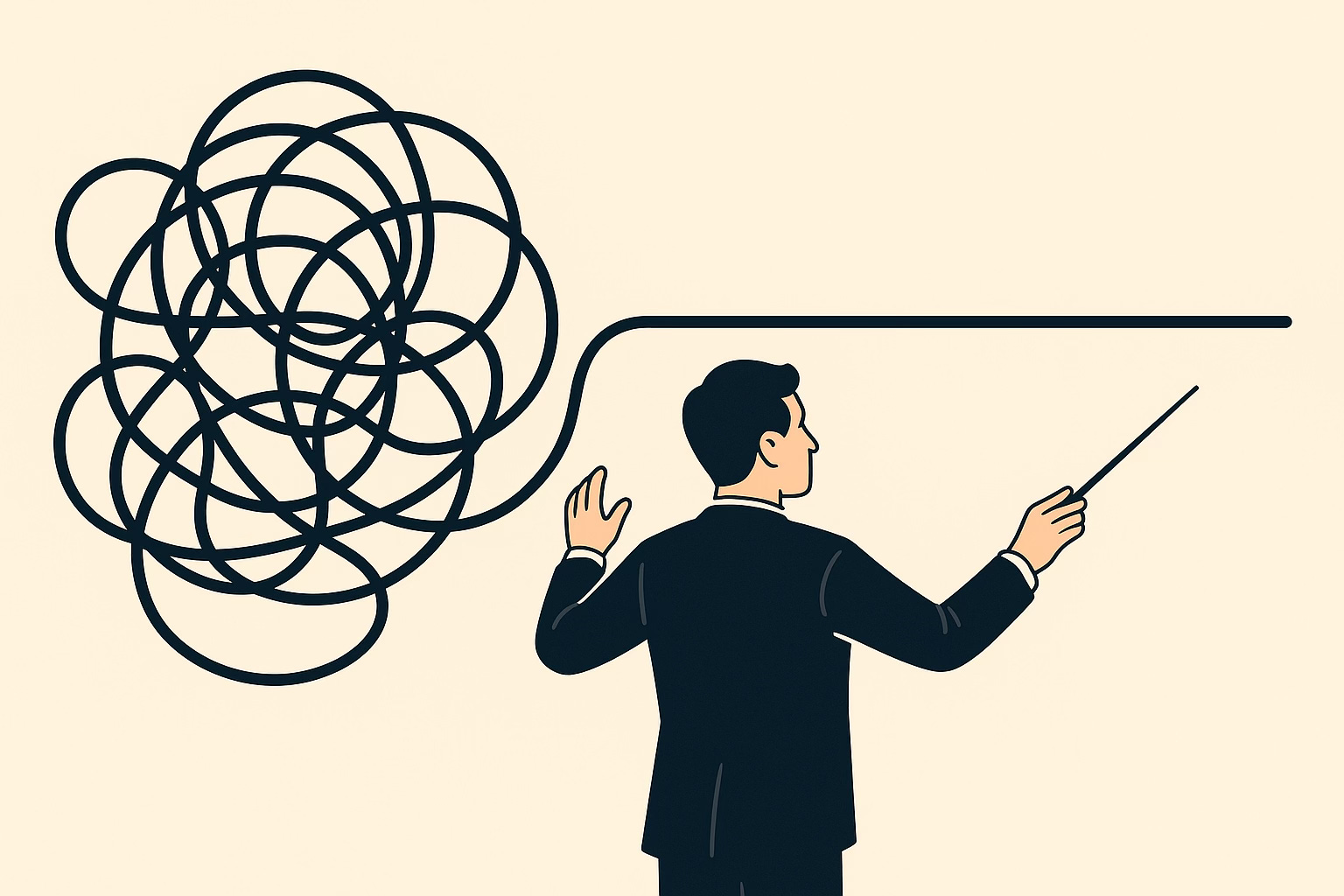
3️⃣ If you can’t regulate your reactions, you end up managing your consequences.
One of the hardest transitions in leadership is realising that your internal weather becomes everyone else’s climate. You may think you’re having a private moment of frustration, but people feel the shift instantly. Tone, posture, speed of speech - teams track these cues far more than we imagine.
I remember a specific day when I walked into a team meeting annoyed from a last-minute hiccup in a project. I told myself I was composed enough to hide it, but within minutes I could see the room tightening.
My irritation didn’t stay contained. It set the emotional baseline, and the meeting shifted toward managing the tension I had brought into the room. We spent the next hour dealing with the consequences of a mood swing rather than the substance of the work.
To be clear, I am not suggesting that emotional regulation means you should suppress or hide your feelings. The point here is recognising when your reaction is disproportionate to the moment or inappropriate to the context and pausing so you can reset. The leaders I admire most aren’t necessarily serene by nature; they simply create fewer emotional aftershocks and protect the team’s psychological stability by anchoring their own reactions (I also had an interesting exchange with Super Cool & Hyper Critical on this).
People work better when the emotional environment is predictable. Just steady enough to think clearly, not flat or emotionless! And that predictability starts with the leader’s self-regulation.
Closing reflections
A leadership mindset is the craft of shaping the conditions under which good thinking, good work and good relationships can emerge. That mindset rests on three disciplines I wish I had understood much earlier:
Holding questions long enough for others to think.
Reducing friction so momentum can take care of itself.
Regulating your reactions so the emotional climate stays stable enough for people to do their best work.
Together, these practices shift leadership from performance to stewardship: you are not trying to be impressive, but to be useful. Most high-performing teams I’ve seen had someone in the driving seat making it easier for them to move and think clearly.
Of course, you could achieve short-term performance by applying pressure or throwing money at the problem. But that isn’t leadership, it’s extraction! And extraction always has a bill attached: burnout, plus a culture that erodes faster than you can rebuild it.
Leadership that people embrace has a durability to it. It’s the kind people feel in the quality of your questions, the steadiness of your presence and the ease with which they can do their best work. Those are the leaders people choose to follow, long after the pressure tactics stop working.
Next week, I’ll continue the series with Part 2: Three Sentences I Wish Someone Had Told Me About Decision-Making.
Enjoyed this post? Paid members receive exclusive access to my practical guides, templates, the Value Proposition workbook, my Consulting with AI series, and my course on surveys, interviews and group exercises.
I’m Andrea, a management consultant with over a decade of experience across industry and academia. I work with commercial, non-profit, academic and government organisations worldwide, helping them capture meaningful insights through mixed methods research.
I write about practical frameworks to help you discover what others miss. My main goal is to translate complex concepts into techniques that readers can use immediately.
Way back when, I read Act Like a Leader, Think Like a Leader by Herminia Ibarra. Your article has similar core frameworks of act-before-you-think, network diversification, authenticity challenges, and self-assessment.
This is true, as you get more senior, your main job becomes building talent and managing relationships with clients. You can't do everything yourself, you will be a bottle neck.
Effective leadership is empowering (unblocking) & getting out of the way of future talent, while providing a cushion if things go wrong.
Love the personal angles to the article! Makes the stories more powerful & definitely helps land the messages!