
How to Lead When the Path Isn’t Clear
My tips to be a 'momentum maker'

If Medium is your go-to reading spot, you can catch this post there too! Just click here.
Let me describe a scene I’ve seen play out in rooms of all kinds: team meetings, executive huddles, cross-functional workshops.
😬 Something isn’t working. A big decision needs to be made, but the variables are blurry. When faced with an unclear path, people hesitate.
And in that moment, uncertainty becomes the enemy. If the team doesn’t break the deadlock, they risk making a hasty decision. Or, in some cases, no decision at all. In these moments, the real challenge isn’t the uncertainty itself but how we choose to approach it.
It’s around this point that someone often asks, “So… what are the next steps?” It’s a question that sounds helpful, but it rarely leads to clarity.
Moments like this are uncomfortable, but also telling. Some people look for answers, whereas others start asking questions. And the difference is huge… Because when you’re in a fuzzy space - messy, unscripted, full of half-formed ideas - clarity doesn’t come from certainty, but from inquiry.
The Myth of The Clear Path
We like to imagine that leadership involves moving along a clear track. Strategy defines the way forward. The team executes. Progress follows.
But, in practice, most of the interesting work happens off-road.
🔮 New markets, new technologies, new audiences, sudden constraints… these don’t come with rulebooks! They come with friction. Ambiguity. Incomplete data. Conflicting incentives.
In these moments, the desire for clarity can lead us into two traps:
Rushing to answers that feel satisfying but rest on weak ground.
Waiting until every detail is known, which means never starting at all.
Good leadership avoids both. It begins with questions that reveal what’s really going on.
Momentum Makers vs Momentum Takers
🚶🏽 Some people wait for someone else to clear the fog. Others get curious and start walking.
Momentum makers don’t force clarity where there is none. But they don’t freeze either. They ask questions that generate forward motion and alignment.
That might sound abstract, but it does shows up in the real world in very concrete ways:
When someone asks, “What’s the real decision we’re making here?”, and everyone in the room realises they’ve been talking past each other.
When a team member says, “Can we map what we do and what we don’t know?”, and suddenly the planning session becomes useful.
When someone stops a cycle of complaints with, “What part of this is under our control?”, and the team starts acting instead of reacting.
These are all small shifts. But over time, they change the texture of an organisation.
The Skillset of Momentum Makers
If creating momentum sounds like a trait that some people just "have," here’s the good news: you can build it.
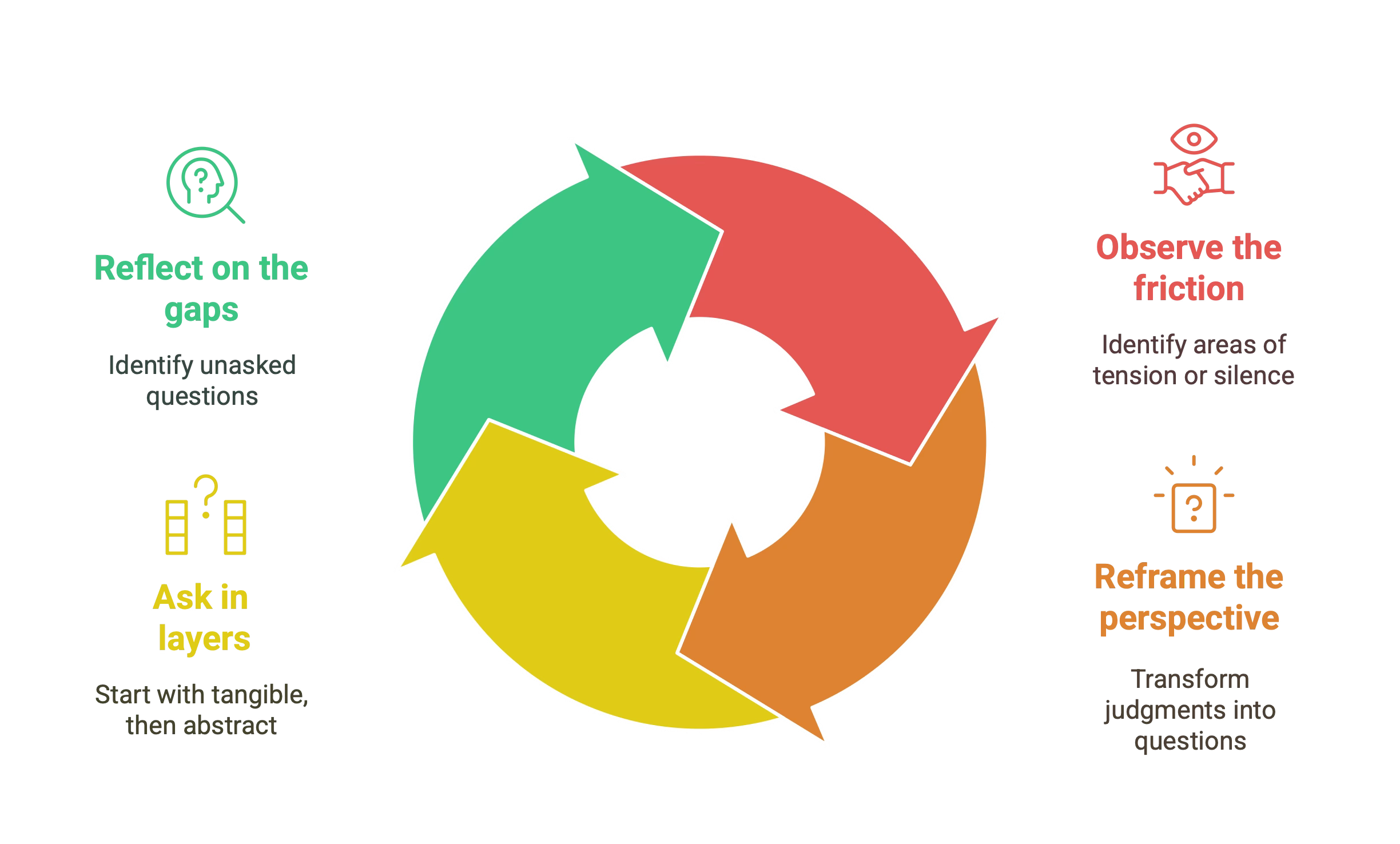
In my experience, it comes down to practice in four areas:
Observation: Spot the friction.
Pay attention to stuck conversations, repeated arguments or moments of awkward silence. These aren’t dead ends but clues! Great questions often start by noticing what isn’t being said.
Reframing: Flip the perspective.
Turn judgments into hypotheses. Change “We’re too slow” into “Where is speed actually required?” Shift “Nobody gets it” into “What assumptions are we making about their context?”
Sequencing: Ask in layers.
Big, abstract questions stall progress. The best insights come from well-sequenced inquiry: start with the tangible, then zoom out. Ask what’s happening (and truly listen!) before asking why.
Exploration: Reflect on the gaps.
After a meeting or decision, ask yourself: “What questions didn’t we ask?” Often, your clearest thinking comes once the pressure is off.
Building on Leadership Frameworks
The skillset of momentum makers is not just intuitive of course. By practicing observation, reframing, sequencing and exploration, leaders can begin to navigate ambiguity with greater ease.
And full disclosure… these skills aren’t entirely new ideas. They align with several well-established leadership frameworks that have long advocated for the power of inquiry and adaptability in leadership:
Situational Leadership teaches us that effective leaders adapt their approach based on the situation. Momentum makers embrace this flexibility, adjusting their questions and methods to fit the team's needs and the task at hand.
David Marquet’s Leader-Leader Model reinforces the idea that true leadership comes from empowering others. Momentum makers support autonomy by asking questions that enable their teams to take ownership of the process.
Carol Dweck’s Growth Mindset shows that when we view challenges as opportunities for learning, we open ourselves to innovative solutions. Momentum makers excel in this space, asking questions that promote growth rather than fixating on limitations.
Peter Senge’s work emphasises the importance of inquiry, dialogue and systems thinking in leadership. Momentum makers balance advocacy and inquiry. They ask thoughtful questions that promote learning, adaptation and collective problem-solving.
What’s striking across these frameworks is the consistent emphasis on the power of asking the right questions.
Each model reinforces that effective leadership isn’t about having all the answers, but about guiding teams through uncertainty by focusing on the right inquiries, which ultimately drives better decision-making and long-term success.
From Reflection to Action
When the path isn’t clear, the instinct to rush toward certainty is strong. But, as we've seen, clarity doesn't always emerge from immediate answers. Momentum makers understand that navigating uncertainty is a process. By embracing inquiry, they create a space where clarity can emerge, and progress can begin.
Take a moment to reflect: When was the last time you asked a question that shifted the direction of a conversation or decision? How can you integrate this approach into your leadership toolkit?
The next time you're faced with uncertainty, rather than waiting for the perfect solution, start by asking questions that can move you forward. It's a small shift, but one that has the power to change the way you lead and the way your team collaborates.
I'm Andrea, a management consultant with over a decade of experience across industry and academia. I work with commercial, non-profit, academic and government organisations worldwide, helping them capture meaningful insights through mixed methods research.
I write about practical frameworks to help you discover what others miss. My main goal is to translate complex concepts into techniques that readers can use immediately.
Andrea, your distinction between asking "what are the next steps?" (which often closes thinking) versus staying in inquiry (which opens possibility) is exactly what I've been articulating as the sense-making difference.
Your insight resonates perfectly: "clarity doesn't come from certainty, but from inquiry." This is the missing piece in organizational transformation. When faced with uncertainty from AI adoption or change, most organizations rush to answers. They mistake motion for progress.
What you're describing—staying in the "fuzzy space" long enough to ask deeper questions—is exactly what sense-making requires. It's not comfortable. But that discomfort is where real understanding emerges.
The "momentum maker" who can hold uncertainty and ask powerful questions instead of providing premature answers: that's the leadership skill every organization needs right now.
Beautifully articulated distinction.
Great article! The four author's books you reference are great reads too. Questions are very important, as is listening. Mapping these conversations visually helps with progress and reinforces the 'listening' parts.