
How To Get Out Of Your Own Way When The Pressure Is On
Getting on top of your 'Inner Game'


The biggest factor in how you perform under pressure is one you can’t easily see in yourself: your inner state.
Between the two of us (Andrea and Deri) we have watched capable people come undone under pressure, losing their judgement and their composure when they most needed it. Deri spent six years at Bain & Company and another six in other consulting roles before founding Honeycomb Consulting Skills Training, which has now trained thousands of consultants; alongside that he coaches kids’ rugby and football and is a father of four (talk about pressure!). Andrea is a management and strategy consultant at a boutique firm, where the pace is unrelenting and the inner critic has plenty to feed on.
We have learned the hard way that, for real progress to be made, you have to get past the visible Outer Game of appearance, behaviours and achievements. The real gold lies in the invisible world underneath: the parts of ourselves that Deri and his Honeycomb colleagues call the ‘Inner Game’.
What we argue in this article is straightforward: when the Inner Game is off, the Outer Game follows.
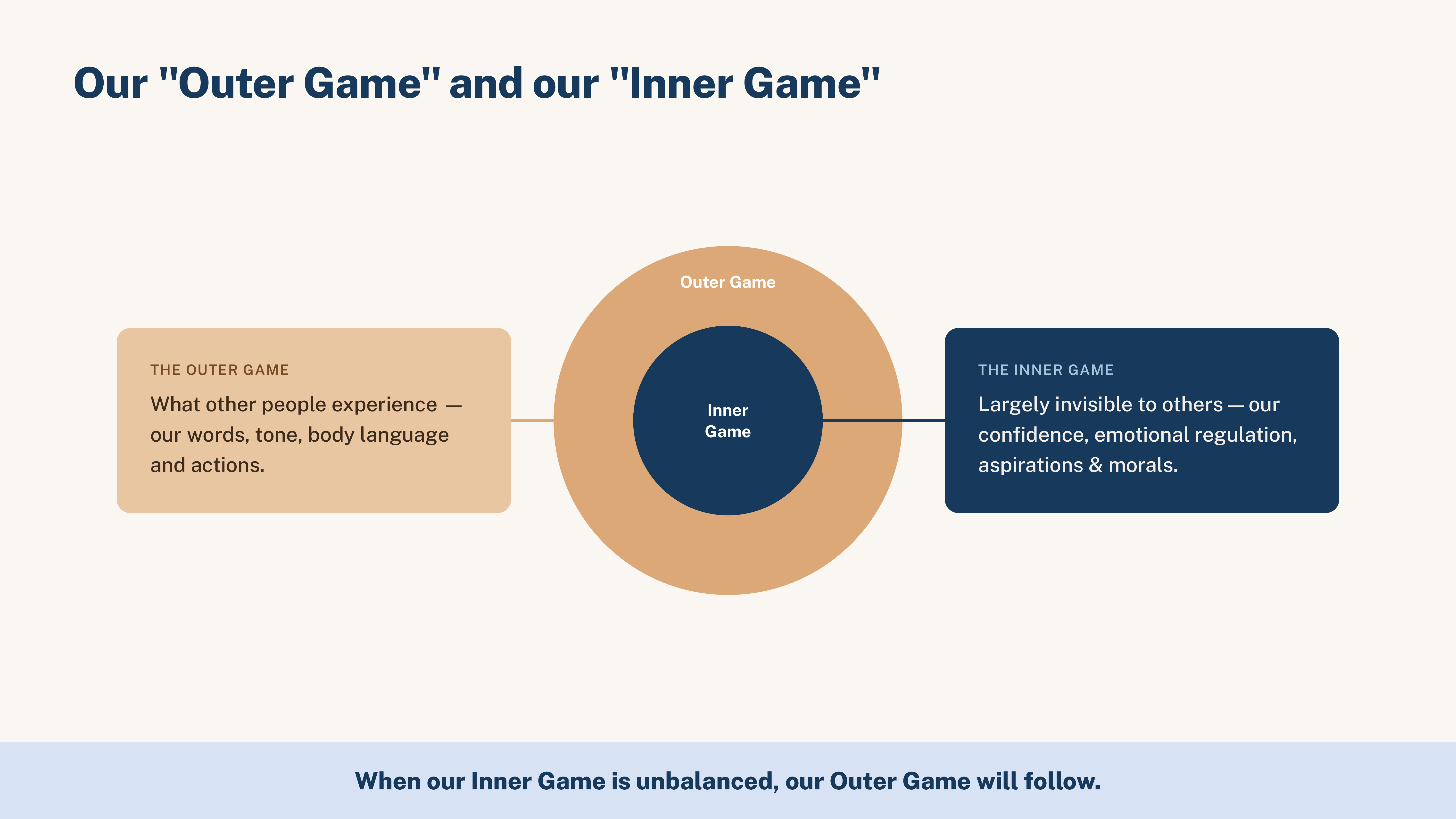
The Inner Game shapes our behaviour
The Inner Game is invisible, yet it deeply affects our interactions and responses to everything that happens to us. It is our emotional state and the beliefs running underneath.
The Conscious Leadership Group, in their book The 15 Commitments of Conscious Leadership, clearly articulate the impact of our Inner Game being off. When you are Above the line, you are open, curious and committed to learning; conversely, when you are Below the line, you are closed, defensive, and committed to being right.
Being Below the line tends to be the baseline, because our brains are wired to perceive threat and respond accordingly, through what you will probably have heard of as the fight-or-flight response. The additional challenge is that the brain cannot reliably distinguish between a physical threat and a threat to our ego: a client who challenges your expertise in front of senior stakeholders activates the same neurochemical response as genuine danger. The amygdala fires, higher thinking shuts down and we drop Below the line without choosing to.
This is biology rather than a character flaw, and it happens to all of us, multiple times a day. We might not be able to stop it, but we can learn to notice it. And, even better, we can build the skill of finding our way back Above the line.

Consulting is built to push you Below the line
Consulting is unusually rich in pressure points that pull people Below the line:
The work swings between feast and famine, lurching from stretches where you are drowning in deadlines to sudden lulls with very little booked in.
A project’s goalposts can move halfway through, so the analysis you spent two weeks perfecting is dropped because the client’s goals have shifted.
You can find yourself “on the bench,” watching colleagues buried in client work and wondering whether you are still useful.
A client might challenge you publicly on something you know better than they do.
A common mindset among consultants is known as the Insecure Overachiever: driven, high standards, externally successful and carrying a deep yet largely hidden fear of being found out as inadequate. This character produces excellent work, and it comes with a psychological cost that many firms do little about. In a recent webinar, Deri and his colleague Greg Segal asked participants to share the message that plays in their head when the pressure rises, and imposter syndrome dominated the responses. “I am not good enough.” “I do not belong here.” “My peers are better.” “What if they find out?” These are self-sabotaging messages, and they activate when we are triggered, pulling us Below the line.
The Art of Asking Questions is a reader-supported publication. To support my work, please consider becoming a paid subscriber. And check out my Perks page!
Three roles you fall into under pressure
When we go Below the line, we typically slip into one of three dysfunctional roles, described by psychologist Stephen Karpman as the Drama Triangle:
🥺 The Victim feels powerless and helpless. In consulting this looks like “this client is impossible,” “my partner keeps editing my slides for no reason,” or “I don’t know where to find the data I need.” The Victim seeks rescuers, avoids accountability and externalises blame.
🛟 The Rescuer feels compelled to help, often without being asked. In consulting this looks like the Manager who avoids the difficult conversation with an under-performing junior, or the Partner who says “yes” to every request from the client. The Rescuer grows resentful when their help is not appreciated, and that resentment tips them into Victim or Persecutor.
👆🏼 The Persecutor is critical, controlling and blaming. In consulting this looks like micromanaging, criticising colleagues publicly or endlessly beating yourself up for a mistake you have made (yes, you can Persecute yourself, too!). The Persecutor often believes they are simply being direct or holding standards.
If these scenarios feel familiar, then you and your team have moments where you drop Below the line. If they do not feel familiar, that suggests you are not paying close enough attention (and, if you want to dig deeper, check our this article by Dr. Nicole Ohebshalom).
A practical first step is trigger tracking. For one week, note which situations pull you Below the line; what thought each one generates; and what behaviour follows. You do not need to fix anything just yet, because mapping the pattern is the bulk of the work. If you want to explore the self-awareness dimension of this, Deri has written more on the topic here:

Finding your way back Above the line
Self-regulation is the most important immediate skill. It means changing your brain state deliberately, moving from survival mode back to clear thinking.
When you are in survival mode, your body tells you first. You might experience shallow breathing or tension in the jaw or shoulders (or many other variations on this theme). Most of us only realise we were activated once the conversation or difficult situation is over. Catching it in the moment is learnable, and it changes everything.
In our experience, the template below can help you start to notice how you respond to pressure (a blank workbook is available under the image):
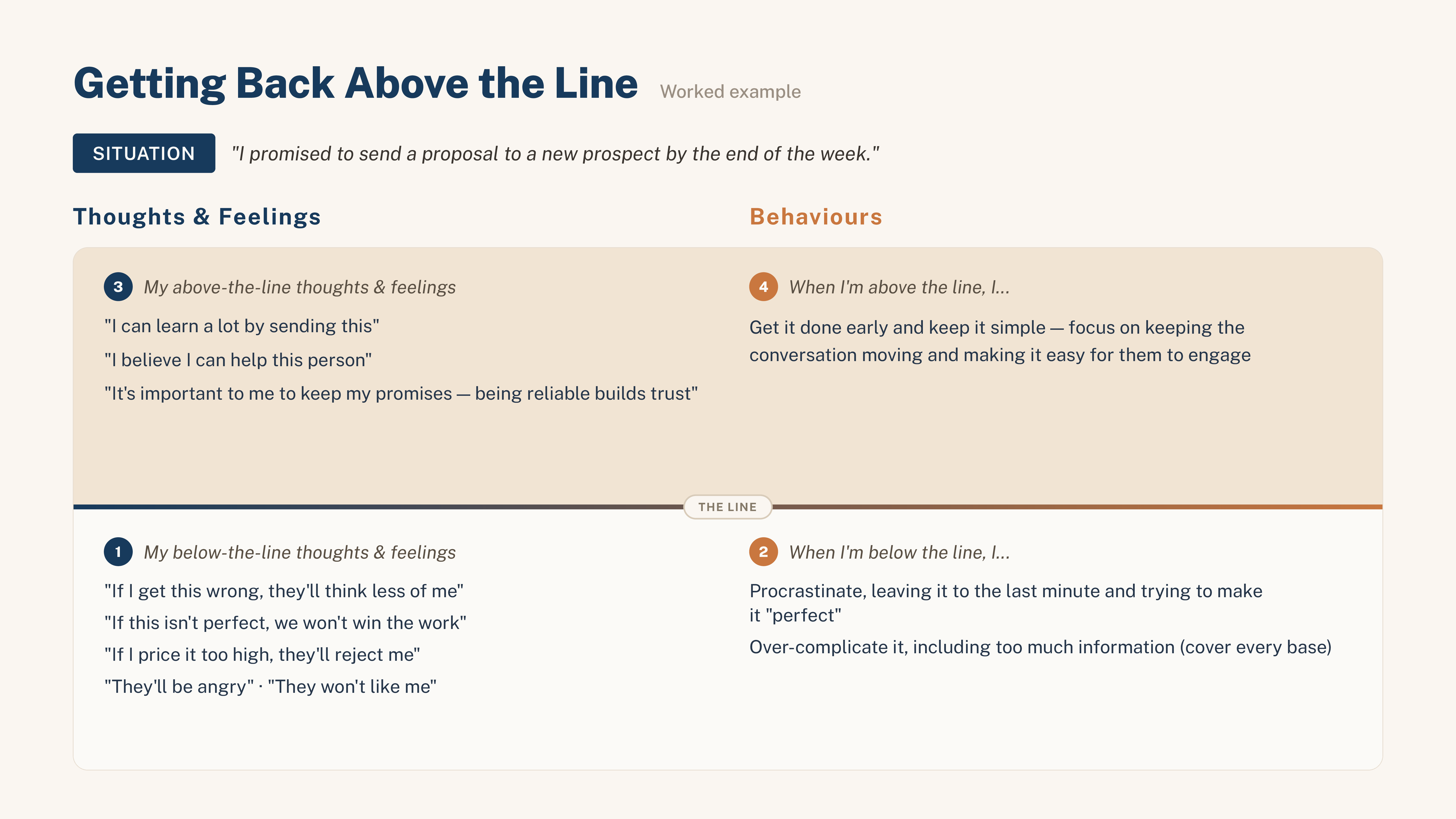

Under pressure, our minds catastrophise, and everything feels urgent. When you notice you’re in such a state, the most valuable response is to create space. Acknowledge it, even just to yourself. Sixty seconds of deliberate calm is enough to begin the shift back. And here are three questions that help to restore focus:
What are the three things that matter most today?
What can I actually control here?
What is one meaningful next step?
Another tool is something that Deri calls a ‘High Road Mission Statement.’ In practice, you need to know what the best version of yourself looks like, and the person you are committed to being on the way there. Building this starts with an honest look back.
What did your younger self find hardest to handle?
What belief did you take on from that experience?
What would a wiser, older version of yourself say to that younger person now?
From there, the format is: My mission is to create a world of [three aspirational words] by being [three committed ways of behaving].
This produces a statement that looks something like: “My mission is to create a world of connection, calmness and fun by being vulnerable, supportive and playful.” Over time, this type of statement should evolve as you do.
The key is to make the behaviours a genuine stretch. They should be something that does not come easily and that pushes you into a development edge. If the behaviours feel comfortable already, you have probably written what you already do rather than what you are trying to become.
When you have a statement that is honest, the self-sabotaging messages start to lose their grip. It is harder to believe “I am not good enough” when you know clearly the world you are trying to create and how you have committed to showing up in it.
The Inner Game is a skill, and teams can build it together
The Inner Game is the foundation on which every visible consulting skill rests. Most professional development focuses on the Outer Game: communication, analytical frameworks, client management, business development. These all matter, but the skills that most readily fall apart are the ones that depend on our Inner Game being stable.
There is real value in closing this gap, at the individual level first and then at the team level. A team that has shared language for Below-the-line states, and the courage to say openly when they are in one, operates very differently from one that pretends the Inner Game does not exist and insists on projecting confidence at all times.
The switch between Above- and Below-the-line states happens dozens of times every day, mostly invisibly. Making it a more conscious choice is one of the most impactful changes we know.
Deri Hughes is Founder and Managing Director of Honeycomb Consulting Skills Training. He trains consulting teams across professional services firms and, through the Mankind Project, a global organisation focused on men’s personal development, has supported hundreds of individuals through personal development work.
Enjoyed this piece? Become a paid member and get my Consulting with AI prompt library, the full Asking Questions Like a Pro course ($199 standalone), practical templates from a decade of fieldwork, and discounts on many other resources. 🔗 See everything included in the paid tier.
 | A guest post by
|
the rescuer role is the one that's easiest to miss in yourself specifically because it doesn't look like losing control, it looks like being helpful. saying yes to the client's extra ask or covering for the junior who's behind reads as generosity in the moment, not as a below-the-line state. it's probably the quietest of the three to catch precisely because nobody around you is complaining about it, they're thanking you for it.
the trigger-tracking exercise seems like the actual unlock here, a week of just noticing without trying to fix anything yet.
really useful framework, thanks for laying it out this clearly 🙏
Love this perspective. Everyone talks about pressure, but the harder skill is knowing yourself well enough to self regulate through it