
Decisions Are Processes, Not Events
Three sentences I wish someone had told me about decision-making

Last week, I wrote about the leadership mindset, focusing on holding the question, reducing friction and regulating your reactions. Those three ideas shape how I show up as a leader. But once you’re in the role, you realise something quickly: the way you think casts a long shadow. How you make decisions (not just what decisions you make!) influences trust and momentum across your team.
Most people learn decision-making the hard way: through stalled projects, misaligned stakeholders, false urgency and choices made under pressure. Over the years, I’ve found that my best decisions, and the decisions I’ve seen in high-performing teams, follow three principles. So here are the Three Sentences I Wish Someone Had Told Me much earlier in my career.
1️⃣ Change the framing and you change the options you can see.
Most poor decisions don’t fail at the moment you actually make a choice. They fail much earlier, at the moment the problem you’re trying to solve is framed.
In a recent project, I was interviewing organisations around the world about a highly technical topic. My client insisted that I open each conversation with a very specific technical term, one that made sense to specialists, but meant nothing to most of the people we were speaking to.
It became a problem almost immediately. Participants would pause, look confused and ask me to explain what the term actually meant. I found myself spending the first part of every interview unpicking a phrase that didn’t need to be there in the first place. And because I was trying to gather recommendations, not run a vocabulary lesson, the framing was getting in the way of the thinking.
After a handful of interviews, I had enough evidence to show the pattern. I went back to the client and proposed a full reframe: simpler language, clearer prompts and an entry point that people could actually relate to. Once we did that, the quality of insight changed dramatically. Participants could finally engage with the substance of the question and offer recommendations that were thoughtful and actionable.
In that project, the client needed to make decisions about future policy directions based on the recommendations we were going to gather. But because the opening framing relied on a dense technical term, participants couldn’t engage with the question. As a result, the early recommendations were cautious and practically unusable, which meant the client was on track to make decisions based on weak input.
Once we reframed the terminology into something people instantly understood, a different set of options came into view and the recommendations became far more usable.
Read more about the power of framing:

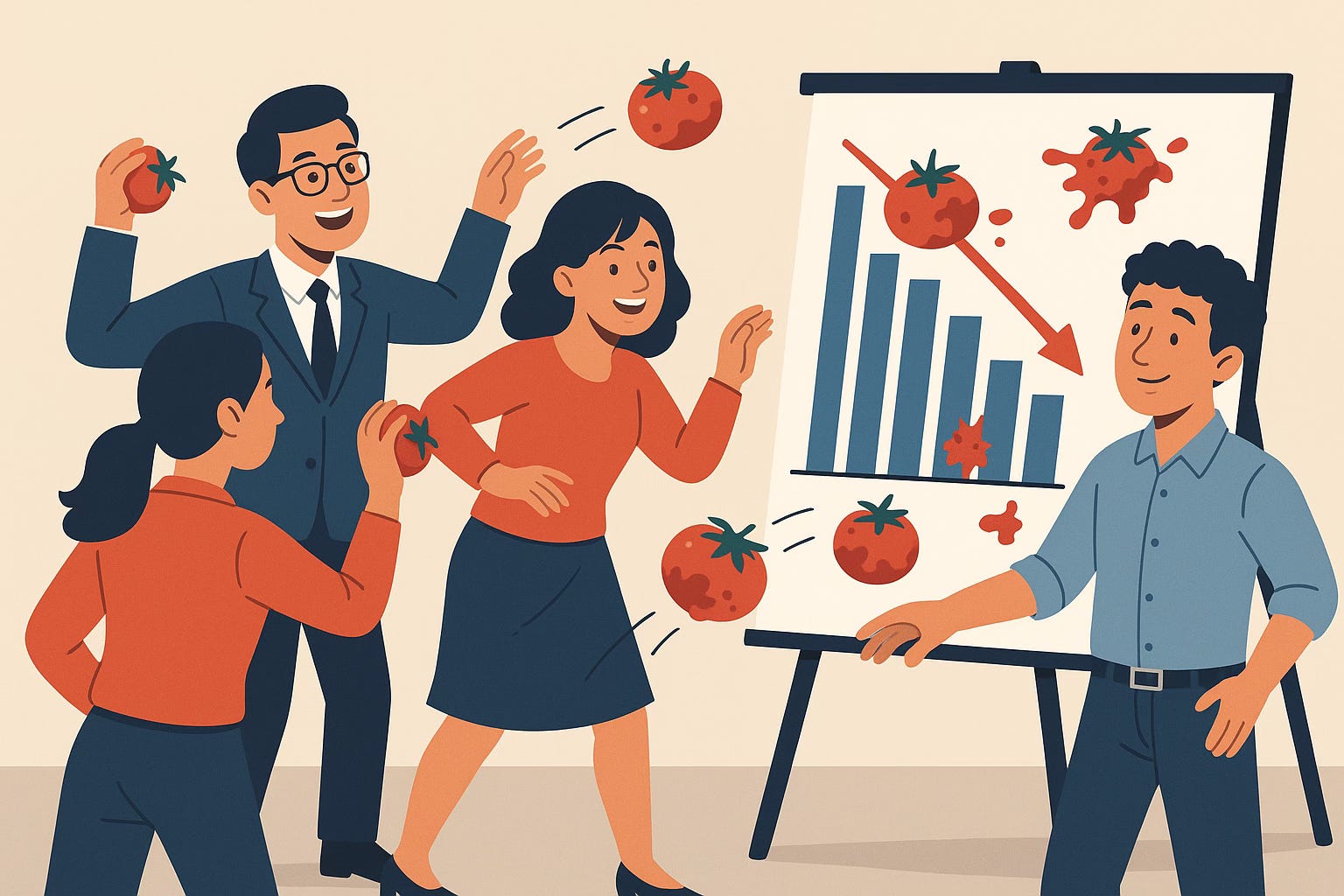
2️⃣ Good decisions come from testing your thinking, not defending it.
Early in my consulting career, I felt an almost compulsive need to “prove” my ideas and recommendations. I’d enter meetings armed with rationale and evidence, ready to defend every point. But over time I noticed something pretty uncomfortable: the more I defended my thinking, the less it improved.
The realisation was that defence mode optimises for being right, whereas testing mode optimises for getting it right. So, great decision-makers expose their ideas rather than defending them. They treat decisions like working hypotheses, not finished arguments.
A few years ago, I supported a public-sector client in developing a new long-term strategy. The sponsor had a clear plan in mind and initially invited me to help validate it. Instead, I suggested we stress-test it with the people who would have to implement it. We held a series of small workshops where operational managers were encouraged to poke holes in the proposal.
Let me tell you: they didn’t hold back. Assumptions were challenged and constraints surfaced sharply. The sponsor later admitted it was rather painful to hear, but it saved them from a decision that would have failed rapidly.
Testing your thinking is not a sign of uncertainty, but a discipline. It helps you avoid blind spots and strengthen your decisions before they meet reality.
And, sometimes, we have to accept that our great ideas will collapse when challenged. But that’s normal. In those cases, the challenge itself wasn’t the problem: it was the idea that was fragile to begin with. All this means is that you’ll need to find a stronger plan that can survive scrutiny thanks to stronger foundations.
3️⃣ People commit more quickly to decisions they helped shape.
Even the best decisions fail to materialise if the people responsible for acting on them don’t feel any ownership. You can have perfect logic and a beautifully structured plan, but if the decision is delivered to people rather than built with them, the reaction is predictable: you will likely experience slow uptake or only surface compliance.
A good word to describe this is ‘co-creation.’ Here’s what it looks like in practice:
I supported the UK Data Service (UKDS) in developing their 2024-2030 strategy, not through top-down planning, but through a series of interactive co-creation workshops held at key stages of development and with teams across different layers of the organisation. These were complemented by targeted interviews to deepen the insights generated in group settings.
The approach was especially powerful because it brought together geographically dispersed teams as well as people at different levels of seniority. Not just to share opinions, but to actively shape priorities and challenge assumptions that had emerged from different parts of the organisation.
The lesson here is that people commit when they have fingerprints on the work and are far more likely to execute decisions they feel ownership over.
If you want to become a master at co-creation, take a look at this article from the archive!

Closing reflections
Decision-making is rarely about finding the one perfect choice (often, there isn’t one!). In most cases, it’s about expertly shaping how you and others are thinking, so you can make informed, shared decisions with the other people in the room.
The three principles I wish I’d learned earlier are these:
Changing the framing can show you previously unseen options.
Sharing your thinking is much more effective and helpful than defending it.
Engaging people in shaping decisions helps them embrace change and commit more quickly.
Together, they transform decision-making from a solitary exercise into a collaborative and iterative process. They build trust and help you act with greater clarity and speed, even when everything around you seems uncertain.
Next week, I’ll continue the series with Part 3: Three Sentences I Wish Someone Had Told Me About Career and Growth.
👉 For subscribers: The Better Decisions Field Guide
If you’d like to turn what we just explored into something you can actually use on your next big choice, I have put together a Better Decisions Field Guide for subscribers.
It helps you walk through decisions you’re facing and:
clarify the frame
stress-test your thinking
and bring others in so they feel ownership rather than resistance
My suggestion: pick one decision that matters next month and run it through this. It should quickly show you where you could improve your strategy… or maybe that you are already a decision-making star!
What’s in This Guide:
1. Decision Clarity Canvas
This helps you slow down long enough to define the decision properly. You will articulate the problem in plain language, clarify success criteria and constraints and ask whether this is really the decision or just a proxy for something else (like resourcing, politics or timing).
If you’ve ever sat in a meeting where everyone is arguing but not quite about the same thing, this is the antidote.
2. The Thinking Test
Once you have a working frame through Step 1, this checklist helps you stress-test your preferred option(s). It forces you to name your assumptions, look for failure modes and consider what a pilot or smaller experiment might look like.
It’s a way of testing your thinking without slipping into defensiveness or endless over-analysis.
3. Co-Creation Script
Finally, if the decision affects other people (which is most often the case), Step 3 gives you a lightweight agenda for shaping it with them instead of presenting a fully baked answer.
It’s designed to surface worries early and build commitment because people have had a hand in shaping the path forward.
You can use all three together on a big decision, or just pick the one that speaks most to where you usually get stuck.
🔒 What follows is for paid subscribers.
Get Your Resources
I have developed these resources in Notion, so you can easily clone them or copy and paste them in your preferred software.
I’m Andrea, a management consultant with over a decade of experience across industry and academia. I work with commercial, non-profit, academic and government organisations worldwide, helping them capture meaningful insights through mixed methods research.
I write about practical frameworks to help you discover what others miss. My main goal is to translate complex concepts into techniques that readers can use immediately.