
Co-Creation Done Right
Designing for shared ownership, not just input

If Medium is your go-to reading spot, you can catch this post there too! Just click here.
Co-creation is not a buzzword.
Every organisation claims to value collaboration. Yet, in practice, too many co-creation sessions (e.g. workshops) end up as performative rituals: sticky notes, vague themes and little follow-through.
Co-creation, when done well, is different. It’s about creating structured opportunities for people to contribute meaningfully to a shared challenge. In this article, I’ll unpack what co-creation means to me and when I find it most powerful.
Whether you're redesigning a service, tackling a complex strategic decision or simply trying to get diverse perspectives on the table, co-creation can help. But only if you take the approach seriously.
What Is Co-Creation, Really?
Co-creation is obviously not just another name for a group discussion. It’s a design approach that actively engages participants in problem-solving. Unlike interviews, which aim to extract stories, or focus groups, which explore shared experiences, co-creation brings people into the process as collaborators. Participants help shape the solution, not just comment on it.
This matters because the people closest to a problem often hold the key to new ideas, if you give them the right context and tools. Done right, co-creation turns participants into co-designers.
In practice, participants are not being studied: they are building. And, in that process, you access a different kind of data: experiential, embodied, contextual. Insight emerges from watching what people create when you invite them to solve something real.
When to Use (and Not Use) Co-Creation
Co-creation works best when you’re at a generative stage of a project or initiative: it’s cases where you’re exploring possibilities, developing options or surfacing trade-offs. It’s especially powerful when the topic is complex, because it allows people to negotiate meaning together rather than being asked for isolated opinions.
Here’s what successful co-creation looks like in practice. I supported the UK Data Service (UKDS) in developing their 2024-2030 strategy, not through top-down planning, but through a series of interactive co-creation workshops held at key stages of development. These were complemented by targeted interviews to deepen the insights generated in group settings. The approach was especially powerful because it brought together geographically dispersed teams as well as people at different levels of seniority - not just to share opinions, but to actively shape priorities, challenge assumptions and test emerging ideas in real time.
That said, co-creation isn’t always the answer. It can backfire when participants can’t speak freely or feel unsafe sharing candid thoughts. Imagine a very junior employee asked to contribute ideas in a room with their senior manager… it’s unlikely you’ll get candour! It’s also a poor fit when the topic is deeply personal or emotionally charged. In those cases, one-on-one interviews or anonymous surveys are more ethical and effective.
In short: co-creation is a high-leverage tool for the right kind of problem. Use it when you need shared ownership or when insight depends on collaboration.
Formats That Work
In my experience, most co-creation happens in workshops - and, if possible, in person. But not every workshop qualifies. For a session to be truly co-creative, participants need to do more than talk. They need to build, sketch, map, vote and prioritise.
Here are some formats that work especially well:
Affinity clustering helps a group identify shared pain points by sorting and grouping ideas.
Journey mapping visualises processes and uncovers friction points or opportunities.
Dot voting quickly surfaces what matters most to the group.
Scenario role-play encourages people to explore decision-making under realistic constraints.
Card sorting tests whether people categorise or understand concepts the way you think they do.
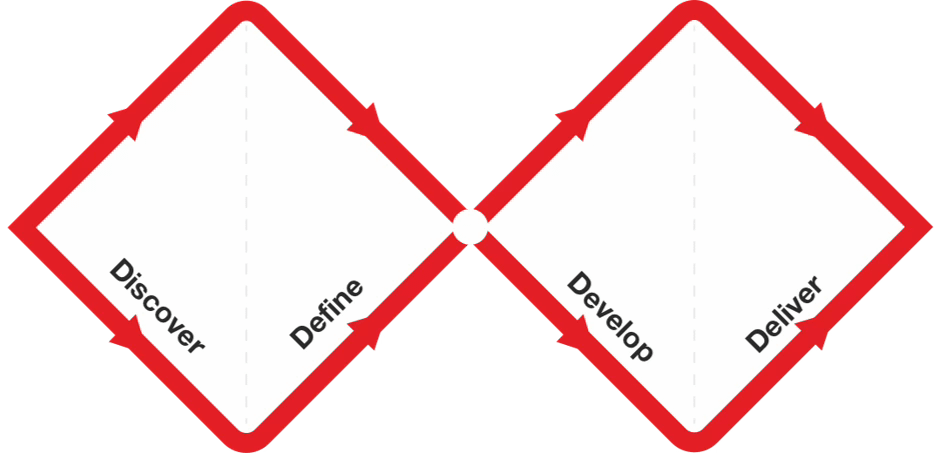
You don’t need to run all of these in a single session. In fact, the best co-creation workshops use just two or three methods, with plenty of time for sense-making in between. These formats are especially powerful when combined as part of a design thinking framework, such as the Double Diamond developed by the UK Design Council.
The Double Diamond model (see the image below) breaks creative problem-solving into four clear phases:
In the the Discover phase, you explore widely, researching, listening and digging deep into what’s really going on, rather than jumping to conclusions
In Define, you narrow that learning into a sharp, clear problem to solve.
Next, Develop opens things up again as you brainstorm and test multiple possible solutions.
Finally, Deliver means selecting the strongest idea (or ideas), refining it and putting it into the world.
At its core, the model balances divergent thinking (opening up) with convergent thinking (narrowing down), helping teams move from confusion to clarity, and from ideas to impact. This process pairs naturally with co-creation, because each phase offers a chance to involve participants as collaborators. They can work jointly to surface insights, shape problems and test solutions together.
Principles for Good Design
If you want your co-creation session to yield real value, design it like you would a great research tool: with rigour, clarity and care.
🎭 Start by building your session around activities, not just discussion themes. Ask yourself what you want participants to do: Create a customer journey? Prioritise service improvements? Design a new process? Each goal needs specific methods and materials.
👯 Next, break large groups into smaller ones. Groups of 3–5 work best they’re small enough for everyone to speak, but large enough for diversity of thought. Assigning roles (like notetaker, facilitator, timekeeper) can also help equalise participation. As you develop an agenda for your session, you can create a nice mix of plenary and small group discussions, so that energy levels are managed throughout and you can keep everyone engaged.
💭 Don’t skip the synthesis. The magic is in how your participants make sense of the shared challenge together. Build in time for small groups to report back and reflect. Ask: What patterns are emerging? What’s still unclear? Where do we disagree?
📸 And finally, capture everything. Post-it notes fade. Conversations are forgotten. Use worksheets, photographs, digital whiteboards - anything that preserves the logic of the discussion and the context behind the decisions. If you don’t document it, you can’t use it.
Pitfalls to Avoid
Many co-creation efforts fail because they treat structure as optional. Here are common traps:
Overstuffed agendas: More activities don’t mean better results. ➡️ Leave time for sense-making.
Vague tasks: “Brainstorm ideas” is not a brief. ➡️ Give constraints, examples and suggested response formats.
Ignoring power dynamics: If one group or individual dominates, the insight is skewed. ➡️ Design to surface marginal voices.
Treating co-creation as consensus: Agreement isn’t the goal. Clarity is. ➡️ Tension is part of the process, and you should capture this accurately.
Asking for openness without safety: Mixed attendance can be great, but power dynamics are always at play. ➡️ Don’t invite people to share if their honesty might hurt them later.
Insight Needs Structure
Co-creation is a method, with its set of underlying principles. One that can produce rich, collaborative insight, but only if you plan for it! When people work together to build something real, they engage differently. They reveal assumptions, surface unintended consequences and find common ground.
What comes out of a well-designed co-creation process is shared ownership of what happens next. That’s the difference between buy-in and resistance, between lip service and lasting change.
Next time you’re facing a thorny challenge, design a process that lets people build with you. Because when people co-create the path, they’re far more likely to walk it.
I'm Andrea, a management consultant with over a decade of experience across industry and academia. I work with commercial, non-profit, academic and government organisations worldwide, helping them capture meaningful insights through mixed methods research.
I write about practical frameworks to help you discover what others miss. My main goal is to translate complex concepts into techniques that readers can use immediately.
Love these insights, especially "break large groups into smaller ones". It is such an important one. Coming from education, individual > pair > small group > big group thinking is an essential way to scaffold the co-creation process that we work to consensus after giving people time to think on their own. To me, group thinking isn't as valuable when it comes to ideation, it often becomes the herd mentality that doesn't give way to the other smaller voices in the room that you talk about. It's often misunderstood when designing these co-creation sessions to "get to the answer quicker".
My favourite part of design thinking workshops is always the ways the team comes together, often from very different, siloed part of the business, to agree and align on a vision as one, often never meeting in person before. If I don't get a "wow, look what we did together" reaction, I've missed the mark.
This is such an interesting read. Especially loved this line "Treating co-creation as consensus: Agreement isn’t the goal. Clarity is. Tension is part of the process, and you should capture this accurately."