
Nobody Taught Me How to Sell
Rethinking how junior consultants learn their role in growing the business


The instinctive reaction when you’re a junior professional and asked to “sell” is to assume someone has made a mistake. You haven’t been trained for this. Business development is what partners do, once they’ve spent fifteen years building the relationships and the judgement to do it well. Sending someone two years into their career to a conference with a vague brief seems, at best, optimistic.
My director caught me between meetings one afternoon. A conference was coming up in a few weeks, loosely adjacent to some work I’d been involved in, and they thought I should go. “It’ll be good exposure. Just have a chat with people about what we do.” I said yes, of course, because it sounded straightforward enough at the time.
It stopped sounding straightforward somewhere between picking up my name badge and walking into the main room. The lanyards, the coffee queues, the clusters of people who already seemed to know each other all made the instruction feel suddenly enormous. Talk to people about what we do. Which people, exactly, and about what?
I knew, without anyone having said so directly, that I was meant to be doing something that looked like selling. That was presumably the reason I’d been sent. But I’d never sold anything in my life. Up to that point my career had been about delivering: running analyses, drafting decks, sitting in client meetings and taking careful notes. I was pretty good at that. But this was a different register entirely, and I genuinely didn’t know whether it was one I could operate in.
So I did what most people do in that situation. I stayed loosely in the orbit of the colleagues I’d travelled with and nodded along in conversations rather than starting them. When someone asked what I worked on I gave an answer that was accurate but flat, the kind of description that closes a conversation rather than opens one. I left at the end of the day with a pocket full of business cards I wasn’t sure what to do with, and a nagging feeling that I’d missed the point of being there.
No one had explicitly told me to sell. But it was fairly obvious, in retrospect, that I’d been expected to.
Versions of that moment play out across professional services firms all the time. A junior colleague is sent to a conference or an industry event with a broad brief to “represent the firm” or “get involved in business development.” They arrive unsure what success actually looks like, and leave wondering whether any of what they said and did landed.
Why business development is everyone’s job (but not in the same way)
The expectation that everyone contribute to business development and sales isn’t a mistake, but it’s often communicated badly. In professional services, revenue is a function of relationships, and relationships are shaped by every person a client encounters, not just the partners formally responsible for originating work or running the final presentation. Much of what eventually becomes a pipeline starts as small, unshowy contributions from people across the team, none of which look like selling in the traditional sense. The firm’s growth depends on them all the same.
There’s also a structural reason the expectation has crept down the hierarchy. The model where a handful of senior partners hold all the client relationships and do all the originating doesn’t scale well. As firms grow, those partners become bottlenecks, and the relationships themselves become fragile: they are concentrated in a few people, vulnerable to departures, and thin on the kind of day-to-day contact that actually sustains trust. Distributing business development across levels is partly a growth strategy and partly a resilience one.
What makes this difficult in practice is that the expectation tends to arrive without any accompanying definition: the suggestion that you should “get involved in business development” is identical whether you’re a junior analyst or a senior manager, even though the implied behaviours are very different. And in the absence of a clearer translation, most people fall back on the version of selling they’ve seen in films, which is approximately no one’s actual job.
For most junior colleagues, the actual contribution has very little to do with pitching or closing deals. It tends to show up in smaller, more embedded ways:
Noticing a client need in passing that could lead to follow-on work.
Asking a follow-up question in a meeting that deepens understanding of a problem.
Spotting a pattern across several conversations and raising it internally.
Making a useful connection between something a client mentioned and someone on the team who has worked on that exact problem.
Supporting a proposal through research, coordination or careful editing.
None of these are selling in the sense the word usually carries. They’re closer to paying attention and connecting the dots: behaviours that are already well within reach at that career stage, and ones that no AI tool is going to do on a junior’s behalf. As Maurizio says, “In an era where AI can automate your code, draft your emails, synthesise your data, and make videos of singing cats, these human-centric influence skills are the only truly resilient assets we have left.”
Defined this way, business development becomes considerably more concrete, and considerably more learnable. It’s the kind of thing you can practise on a Tuesday afternoon in a client meeting rather than something you have to wait to be handed later in your career.
The Art of Asking Questions is a reader-supported publication. To support my work, please consider becoming a paid subscriber.
Why this feels so hard, and what firms often miss
The difficulty, for most junior colleagues, sits in a handful of predictable places
Expectations are broad without a clear entry point, so it’s hard to know where to start.
Contributing to business development still feels like something that belongs to more senior people, which creates a low-level identity tension every time the moment arises.
Client-facing situations feel high-stakes because the consequences of getting something wrong in front of a client are immediate and visible.
With limited experience to draw on, there are few mental models for what a good contribution actually looks like, which makes the whole thing harder to imagine, let alone attempt.
Through an adult learning lens, this response is entirely predictable. Adults engage more readily when learning is clearly relevant and actionable. When expectations are vague, cognitive load increases and people fall back on safer, more familiar behaviours. And when a skill is tied to identity, like representing the firm in front of a client or a room of strangers, trying it without support feels considerably riskier. Hesitation in these moments usually reflects uncertainty rather than any shortage of motivation.
The reframe from lack of initiative to lack of clarity and support is important because it changes what the problem actually is: treated as a performance issue, the response tends to be firmer expectations or more pressure, neither of which reliably changes behaviour. Treated as a learning and development challenge, the response becomes design: small, deliberate choices about how people are introduced to this part of the job, and how they build capability over time.
What actually helps: Designing for development
So far, we focused on framing the challenge. Now, let’s take a look at some approaches that help junior colleagues in professional services develop business development skills as part of their everyday work.
This is where Dr. Jody Peleo-Lazar’s expertise really shines. If you haven’t yet checked out her publication, Adult Learning at Work, go and take a look! She writes for leaders, managers, and learning professionals who are responsible—formally or informally—for helping others grow on the job.
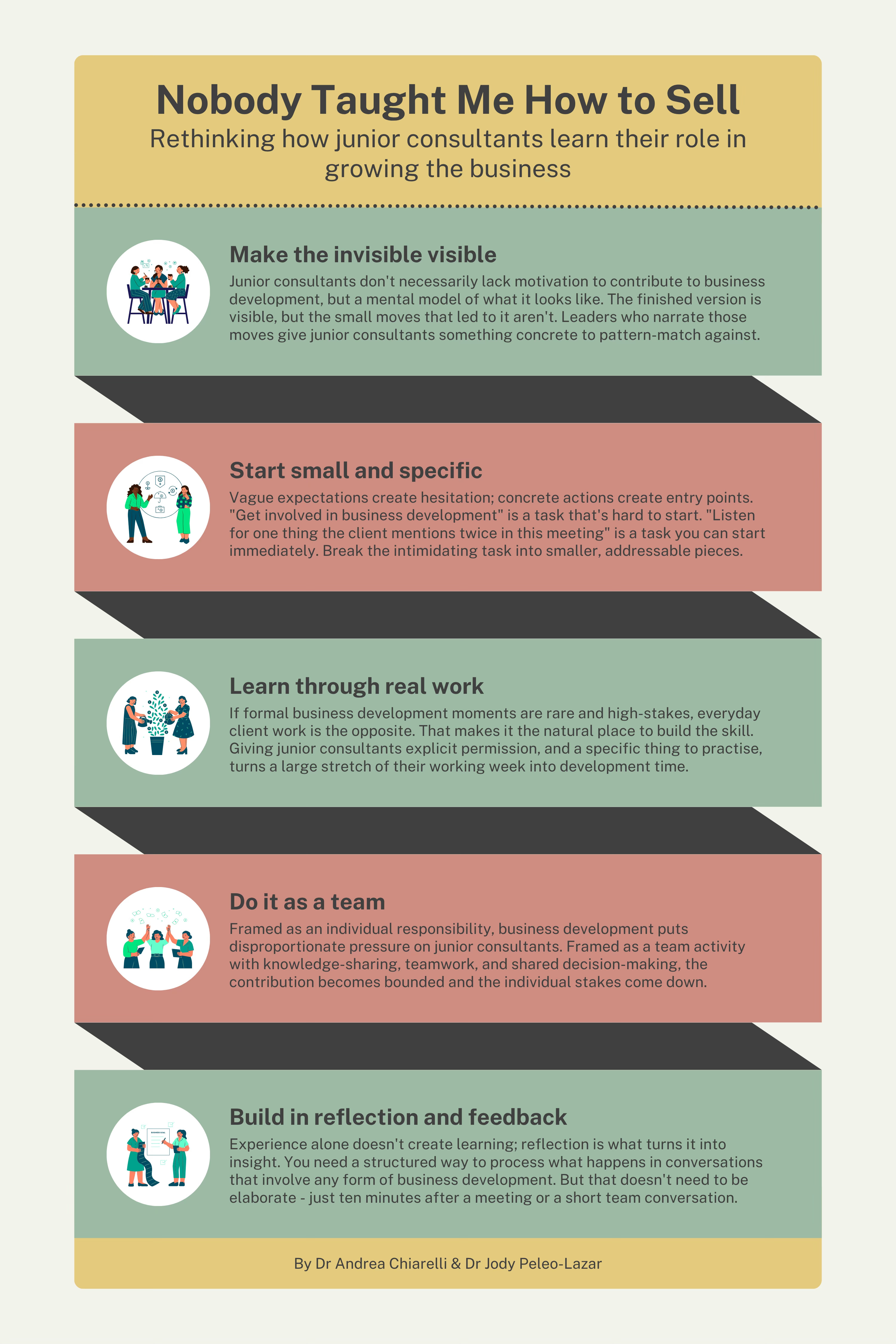

Make the invisible visible
Juniors don’t necessarily lack motivation to contribute to business development, but a mental model of what it actually looks like. The finished version is visible, but the hundred small moves that led to it usually aren’t. Leaders who narrate those moves, including the awkward and unsuccessful ones, give juniors something concrete to pattern-match against.
What can I do?
If you are a leader: Narrate your thinking. Don’t just say what happened, you have to explain how you recognised the opportunity.
If you are a junior consultant: Ask follow-up questions. “What made you notice that?” or “What would you listen for next time?”
Start small and specific
Vague expectations create hesitation; concrete actions create entry points. “Get involved in business development” is a task that’s hard to start. “Listen for one thing the client mentions twice in this meeting” is a task you can start immediately. The principle is the familiar one of breaking a big, intimidating task into smaller, more addressable pieces.
What can I do?
If you are a leader: Define small, observable behaviours, not abstract expectations.
If you are a junior consultant: Focus on one action at a time. You don’t need to “do business development,” but build your confidence around the component habits over time.
Learn through real work
If formal business development moments are rare and high-stakes, everyday client work is the opposite: frequent, lower-stakes and already in the diary. That makes it the natural place to build the skill, but juniors often don’t realise they’re allowed to treat it that way. Giving them explicit permission, and a specific thing to practise, turns a large stretch of their working week into development time.
What can I do?
If you are a leader: Point out these moments in real time. Help people see that business development is already happening. This could be as simple as a quick observation after a meeting.
If you are a junior consultant: Pay attention to patterns. Where do clients seem stuck? What do they return to?
Do it as a team
Framed as an individual responsibility, business development puts disproportionate pressure on juniors, who can feel set up to fail at something they haven’t been taught. Framed as a team activity with knowledge-sharing, teamwork, and shared decision-making, the contribution becomes bounded and the individual stakes come down. It also lets juniors watch more experienced colleagues take the parts of the work they aren’t yet ready for, in the same meeting, on the same account.
What can I do?
If you are a leader: Distribute roles and explicitly make business development a shared effort.
If you are a junior consultant: Lean into the team, and appreciate that your role might be observing, asking or connecting dots. Embrace multiple facets of the work over time.
Build in reflection and feedback
Experience alone doesn’t create learning; reflection is what turns it into insight. You need a structured way to process what happens in conversations that involve any form of business development. But that doesn’t need to be elaborate: ten minutes after a meeting or a short team conversation after an event is usually enough, provided it goes beyond “how do you think that went?”
What can I do?
If you are a leader: Create space for quick debriefs. Ask simple, consistent questions and aim to coach, not give answers.
If you are a junior consultant: Take a few minutes to capture what you noticed and what you would try next time. Notice the perspective of your client, of your seniors and your own.
Coming back to the conference
Looking back at my first conference, what would have made the difference was fairly small. A concrete thing to listen for, perhaps, or a way of describing our work that I could actually remember under fluorescent lighting without feeling like I was performing. Something pitched at where I actually was in my career.
Most junior professionals will have a version of that moment at some point. Whether they come away from it having learned something, or simply having survived it, depends a great deal on how the firm around them has chosen to design the experience.
Capability in business development accumulates slowly, through a long series of small, specific, well-supported attempts. The firms that invest in designing those attempts tend to produce junior consultants who, a few years in, have developed real instincts for this work. The ones that don’t tend to produce senior consultants who, years later, still occasionally walk into rooms with a name badge and a faint sense that they’ve missed the point of being there.
If you’re leading a team, pick one of the five approaches above and try it with one junior colleague over the next month. Not as a formal programme, but as a small experiment you can observe and adjust.
If you’re earlier in your career, pick one specific thing to notice in your next client interaction, and give yourself five minutes afterwards to capture what you saw.
Neither move is large, and that’s exactly the point.
Enjoyed this piece? Become a paid member and get my Consulting with AI prompt library, the full Asking Questions Like a Pro course ($199 standalone), practical templates from a decade of fieldwork, and discounts on many other resources. 🔗 See everything included in the paid tier.
 | A guest post by
|
Enjoyed this. A quality perspective, well expressed.
Intelligent, clear, direct. I'm working with the kind of leaders who might be setting their junior consultants up for failure in the way you describe. You've offered something valuable and practicable.