
Ask, Don't Argue
How curiosity outperforms cleverness

The blues musician Daryl Davis has, over the course of several decades, persuaded more than 200 members of the Ku Klux Klan to renounce the organisation and hand over their robes. He did it by asking one question that he kept coming back to: “How can you hate me when you don’t even know me?”
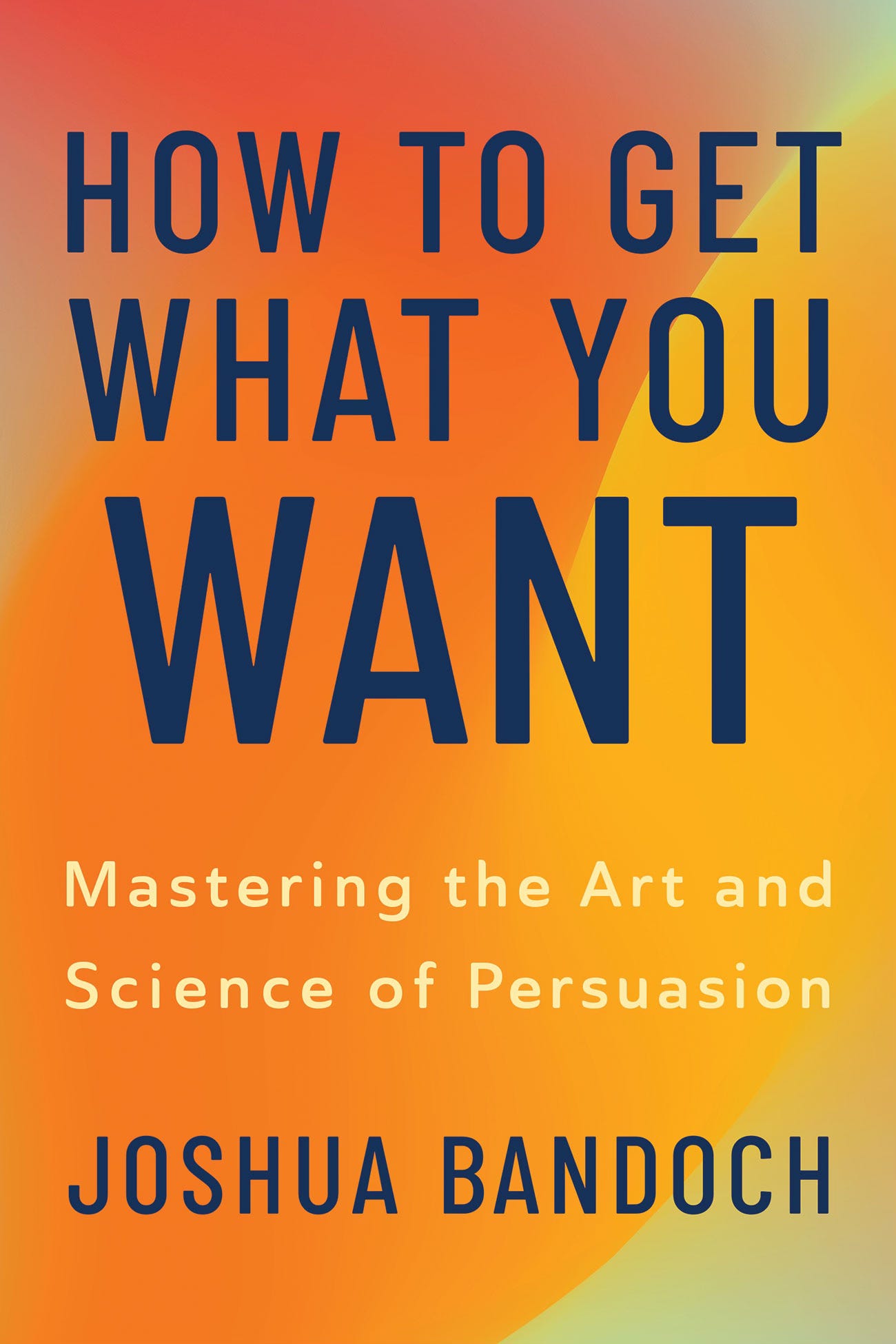
That story sits near the start of Joshua Bandoch’s book How to Get What You Want, and it captures a concept that spans across chapters. Most of us, when we want to change someone’s mind, reach for rational arguments. We marshal our facts and fire. Davis did almost the opposite: he asked, and he listened.
Bandoch leads policy at the Illinois Policy Institute, and his book is an extended argument that persuasion is best understood as shared action rather than as winning. The implications are surprisingly far-reaching, and worth pulling out.
The questions we ask reveal what we want
One of Bandoch’s recurring observations is that most people enter conversations wanting to be right, and the questions they ask betray that. A persuader’s mindset, as the book describes it, requires a different starting position: genuine curiosity about what the other person actually thinks, and why. This sounds obvious until you try it. Bandoch describes his own long struggle with it. He spent years as an academic and a journal editor, in a culture where the goal was to demonstrate that you were right and your opponent was wrong. When he left that world, he embraced the discipline of asking a question and actually wanting to hear the answer, even when that answer was uncomfortable or contradicted his own view.
A practical test he offers, drawn from his experience, is this: when someone disagrees with you, can you summarise their position back to them in a way they would recognise as fair and robust?
Not a strawman, but a “steel man” version of the argument. Most of us discover, the first time we try this seriously, that we have been arguing with our own mental cartoon of the other side rather than with anything they would recognise.
The corollary is that, early in a conversation, the questions you ask should be of a very specific kind: ask things you do not already know the answer to, and ask the other person to explain not just what they think but why it matters to them. And then, before you respond, summarise back what you heard and ask whether you got it right (this is not a twisted form of ‘active listening,’ but genuine listening). The number of arguments that resolve themselves at this stage, simply because the other person feels heard, is one of the more underrated facts about human conversation.
Feelings before facts
Bandoch leans on neuroscience to make the point that people decide with their emotions and justify with their reasons. If you skip the emotional layer and go straight to the substantive disagreement, you are arguing with someone whose mind has already been made up by feelings you have not even acknowledged.
The practical lesson is to ask about how someone feels about a situation before you ask what they think should be done. “What’s been the hardest part of this for you?” earns more than “What’s your position on the policy?” Even when you eventually need to get to the policy, the order changes everything, because the policy conversation now happens with someone who feels you understand why the issue matters to them.
This applies in much higher-stakes settings too. He notes that in his own fundraising work, the difference between an investor who gives once and an investor who gives every year for a decade often comes down to whether the fundraiser asked, early on, what mattered to them and why, and then actually used the answer. The recommended formula is, indeed, to split the time in the conversation like so: 99 percent about the investor, 1 percent about the organisation and zero percent about the fundraiser or salesperson.
The Art of Asking Questions is a reader-supported publication. To support my work, please consider becoming a paid subscriber.
The morals you cannot change
The chapter that has stayed with me longest is the one on moral foundations, where Bandoch draws on the work of the social psychologist Jonathan Haidt. The argument runs roughly like this: just as our tongues have a small set of physical taste receptors that determine which foods we find delicious, our moral minds have a set of moral receptors that determine which arguments we find compelling. The book lists seven of these types of argument: care, equality, proportionality, loyalty, authority, purity, and possibly liberty.
The implication for conversations across divides is significant. If the person you’re speaking to finds loyalty a profound moral matter and you find it a slightly suspect tribal instinct, you are not going to argue them out of their loyalty receptor. It is wired into them at roughly the same depth as their preference for sweet over bitter. The same applies to all of these types of argument. The book posits that we inherit a moral palate, life teaches us how to apply it, and that is what we have to work with.
The book is clear about what happens when we don’t engage with people’s moral tastes. We end up doing the conversational equivalent of force-feeding them food they find disgusting. Telling a vegetarian that they really should try this nice piece of veal will not work. The other person digs in, and you confirm what they already suspected about people like you.
What does work, in Bandoch's account, is the discipline of asking which of these flavours your audience has a taste for, and then making your case on that ground.
What stops people from saying yes
A key question in the book comes from the chapter on negotiation. When Bandoch is making an ask of someone, particularly one he suspects might be hard for them to grant, he does not push.
The phrasing here is important. A question framed as “Why won’t you?” is accusatory, and the other person hears it as such. A question framed as “What would stop us from making this work?” treats the obstacle as something the two of you might solve together, and it invites the other person to be honest about constraints they might otherwise keep hidden (like a budget cap, a competing priority, a stakeholder you did not know about, a previous bad experience with someone in your role). None of these will surface if you spend your time arguing for the merits of your request.
In a similar vein, Bandoch borrows the counterintuitive idea of going for “no” rather than for “yes”. People feel safe saying no, whereas they feel cornered into saying yes. If you frame a question so that “no” is the easy answer (Would it be unreasonable to consider this? Have you given up on the project?), you are inviting a refusal that is in fact progress. The other person feels in control, and in feeling so, they tend to explain their reasoning. That reasoning is the information you actually need. By contrast, yes-pressure questions tend to produce polite agreement that means nothing and survives no longer than the meeting it was offered in.
A further point that runs through several chapters, is that good questions are usually the ones that make the other person comfortable enough to tell you the truth.
Most negotiation failures are failures of trust, and the questions you ask are the main instrument by which trust is either built or eroded.
The questions we (should) ask ourselves
The book closes with what Bandoch calls the granny test: if your grandmother could not understand what you are trying to say, you haven’t communicated clearly enough, and that’s your fault.
He describes teaching a political science course at Notre Dame and finding that fully a third of his students wrote papers with no thesis at all. They could summarise a text but could not say what they thought about it. The same pattern, he says, recurred at Brown, at Wisconsin-Madison, with interns from Chicago and Duke, and with recent Harvard graduates. The students could describe what a text said; they had never been pushed to say what they themselves thought, and held to it until the answer was clean.
This is, in the end, a questioning problem turned inward. The clearest writing comes from people who have asked themselves that hard question and held themselves to it. The same applies to the questions we ask other people. A muddled question produces a muddled answer. A question that has not been thought through gives the other person nothing to grip. A clean, specific, honest question gives them something they can actually respond to, and it tells them you have done your share of the work before showing up.
Bandoch’s formula for his students is to finish the sentence: “In this paper I will argue that…” The same discipline applied to a high-stakes conversation might look like making yourself finish two sentences before you walk in: what I most need to know from this person is… and what I am actually asking them to do is…
If you can’t finish those sentences cleanly, you haven’t yet done the thinking the conversation requires, and no amount of charm in the room will rescue it.
Enjoyed this piece? Become a paid member and get my Consulting with AI prompt library, the full Asking Questions Like a Pro course ($199 standalone), practical templates from a decade of fieldwork, and discounts on many other resources. 🔗 See everything included in the paid tier.
Thank you for this extract….
Thank you all for sharing that too Andrea. Just fyi, there's important unprosecuted crimes and information any remaining unaware people need to learn about and share if they live, work, or visit in America. Please see/share our information from Dr. Neumann, Uaifo Ojo, Dr. Paul Craig Roberts, Tatjana Romig, Manuel Garcia, Нація підприємців, Dr. Hare, Audrey Hatfield, Professor Tony Martin, Dr. Newman, Eugene Earnshaw and others. https://old.bitchute.com/video/jsHTV8JdIlAt
🐈
also here
https://odysee.com/@tidbitsfortruth:2?view=content
and here
https://old.bitchute.com/channel/NBu3vOs8kXFY/
🍂
It's all a science thing.
🦣
Thank you.
https://michaelatkinson.substack.com/
🦖 👀