
Almost Human: Blending Synthetic and Real Voices for Better Decisions
The rise of the pretend people


This article is a collaboration with Alex Pawlowski. His publication, The Strategy Stack delivers curated tech trends, enterprise use cases, and actionable frameworks to help you lead through disruption.
If Medium is your go-to reading spot, you can catch this post there too! Just click here.
Your next “customer insight” might come from someone who doesn’t exist - and that could be your smartest move, or your biggest mistake.
Not a dodgy survey respondent or a bot farm, but an AI-generated persona, built from patterns in millions of real voices. These synthetic participants are faster, cheaper and endlessly customisable. They can tell you what “people like them” think about your new product, campaign or price change… without you ever speaking to a human.
The appeal is obvious. In the same way we use wind-tunnel models to test cars or flight simulators to train pilots, synthetic respondents promise a safe, fast way to test ideas before they ever touch the real world.
The danger is equally clear: the model might be smooth, but it’s still a simulation. And when your decisions carry weight - things like budgets, reputations, livelihoods - the wrong answer from the wrong source can do more damage than no answer at all.
Why Synthetic Personas Are on the Rise
In market research, time and money have always been friction points. Recruiting the right participants takes weeks. Incentives and fieldwork add up quickly. And the more specialised your audience - CFOs in fintech, parents of newborn twins, early adopters in a specific city - the harder and more expensive it is to find them.
Synthetic personas can sidestep much of this. With a few lines of description (“35-year-old London-based parent, tech-savvy, shops at mid-tier supermarkets, works in finance”), the best platforms will spin up a custom virtual panel in a matter of minutes. They will answer surveys, take part in simulated focus groups or walk through a concept test without ever asking for an incentive or rescheduling because of the school run.
There are some reasons why the idea is spreading fast:
Speed: Instant “responses” from hundreds or thousands of simulated participants.
Scale: Cover entire market segments or micro-groups overnight.
Cost-efficiency: No panel fees, no travel, no per-respondent incentives.
Customisation: Personas tailored to match very specific behaviours, attitudes and contexts.
It’s a seductive list. And it’s exactly why teams under time or budget pressure may be tempted to skip the human stage altogether. That’s where the risk creeps in.
But let’s be real. The gains are not only theoretical:
Evidenza created a synthetic audience of senior decision-makers and ran surveys in parallel to a global brand study run by EY. Synthetic and human survey results aligned within 95%, but the AI approach delivered results much more quickly and more cost-effectively. This was particularly valuable for gaining insights about audiences (like senior executives) who are usually hard to reach.
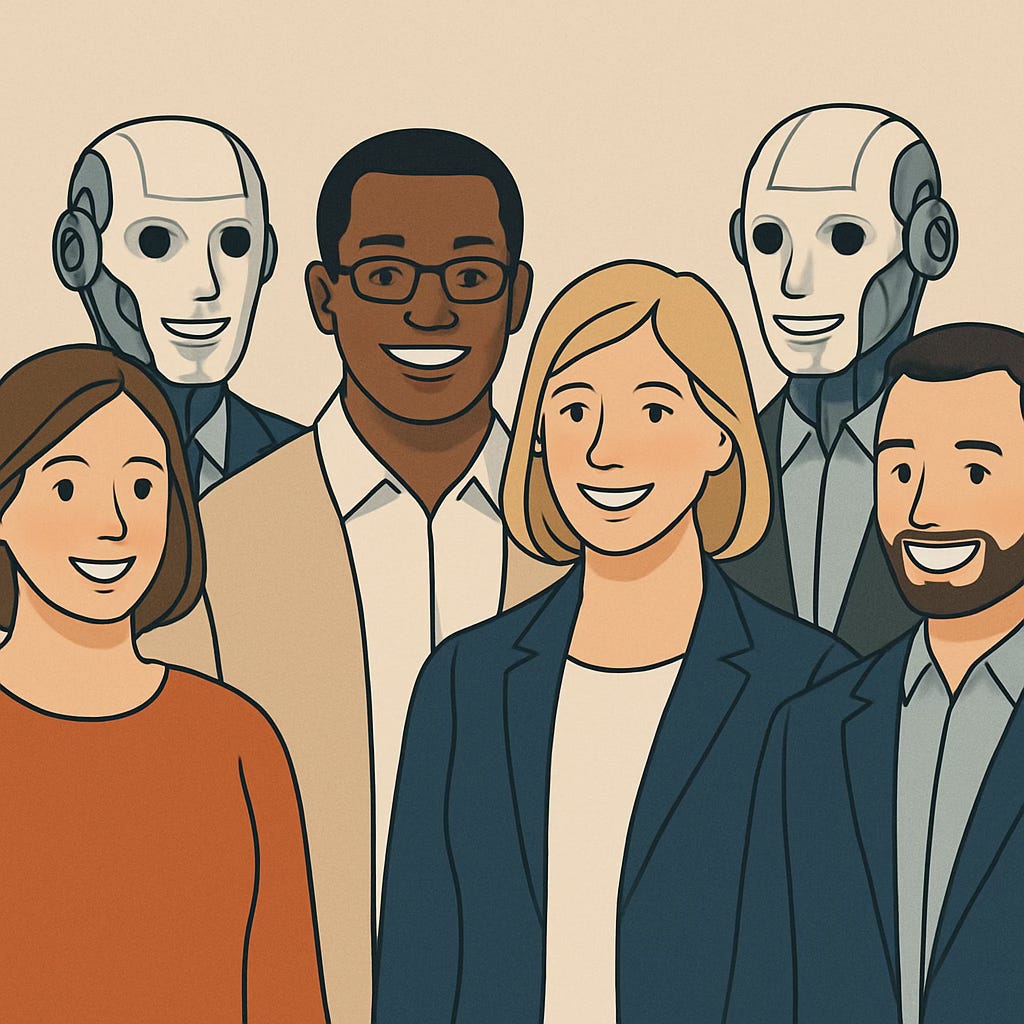
When “Almost Human” Is More Than Enough
Synthetic participants are best thought of as directional tools. They won’t give you the final truth (at least, not yet!), but they can quickly map out the terrain so you know where to dig deeper.
Here are some areas where they can be very effective:
1. Early-Stage Concept Screening
In the messy early stages, you’re often faced with more ideas than you can possibly test live. Synthetic personas act like an always-on idea filter. Feed them your list of concepts, and they can flag the ones that resonate on paper and the ones that obviously miss the target. This stops you spending weeks recruiting real participants to test a dud.
2. Message and Creative Tuning
Messaging and communications work often lives or dies on tone and clarity. Synthetic personas can provide a quick read on how different audience segments interpret a headline or campaign hook. While their judgement isn’t flawless, it’s enough to highlight language that may confuse, alienate or underwhelm before you pay for the wrong message.
3. “What-If” Scenario Modelling
Need to understand how your market might react to a price rise, a feature cut or a sudden competitor move? You can model this in synthetic form first. It’s not a substitute for live customer sentiment, but it’s a low-risk way to explore potential reactions and prepare scenarios for boardroom discussion.
4. Piloting Research Instruments
This is something I am very familiar with - I have seen lots of research instruments like survey questionnaires that were ambiguous or completely missed the mark. Running your questionnaire past synthetic participants first can surface these problems instantly. They’ll expose unclear wording, illogical sequencing or missing prompts before you invest in the real fieldwork.
As you have probably guessed, in all these cases, the point isn’t to replace live participants. The goal is to get to the real work faster and better prepared. They will be your reconnaissance scouts: they give you a lay of the land, but you still need boots on the ground.
Always label synthetic insights as such. Stakeholders should know what’s modelled and what’s lived. This keeps trust high and prevents over-reliance on simulations.
The Blind Spots of Pretend People
Synthetic personas are “almost human”, and that “almost” matters.
First, they have no lived experience. Every “story” they tell you is an amalgam of existing data. They have never walked through a supermarket, wrestled with a clunky app or been swayed by a friend’s offhand comment. This matters because so much of decision-making, in customers and companies alike, is shaped by context, our emotions and the messiness of real life.
Second, they are only as good as the data they’ve been fed. If the model’s training data leans towards certain demographics or cultural perspectives those biases will be reflected back to you.
Third, they tend to over-please. Ask an AI persona whether your product idea is good, and the answer is often an enthusiastic “yes”, backed by plausible but generic reasoning. This agreeableness bias can make weak ideas look stronger than they are.
Finally, they lack depth. They can list pain points or preferences, but they struggle to prioritise them or draw unexpected connections. You will get a neatly packaged list of “important factors”, often the same ones you’d find in a generic industry report, without the off-script insight that makes research truly valuable.
This is why relying solely on synthetic voices is risky. They don’t lie, but they don’t live either. That’s quite the gap!
🚦 Quick field test: if a synthetic persona’s answer feels oddly polished, universally positive or suspiciously aligned with your expectations, treat it as a signal to dig deeper - not a green light!
Humans Still Do What Humans Do Best
When you bring in real participants, the dynamic changes. Humans will usually:
Bring emotion into the room: Their excitement, scepticism and frustration are an enormous asset. The micro-pauses and raised eyebrows that reveal more than the words themselves.
Tell stories: They don’t use bullet points, and share their experiences in rich, specific detail that connects behaviour to context.
Surprise you: They reveal a greater range of unexpected workarounds informed by their lived experiences, unmet needs or left-field interpretations you hadn’t considered.
Carry weight: A direct quote from a real customer has more power in an executive meeting than a model’s prediction ever will. And it’s also more likely to land better with customers and users.
Of course, this isn’t nostalgia for “the old ways”! It’s just an acknowledgement that some types of decisions require the unpredictability and credibility of human voices.
The smartest approach blends synthetic speed with human depth. Let synthetic insight explore and pressure-test ideas, then use human voices to ground and enrich what you’ve learned.
Almost Human, Fully Useful
Synthetic personas can’t replace human participants, but they can extend our reach.
Used with care, they accelerate learning, stretch budgets and help us broaden exploration. Used carelessly, they risk delivering a polished echo of the past instead of the messy truth of the present.
The smartest decision-makers will treat them as scouts, not stand-ins. Let synthetic voices map the terrain, but send human researchers in to walk it. That way, you make decisions that are faster, cheaper and more accurate. They will also resonate more with the people you work with.
In an age of “almost human” insights, the leaders who win will be those who blend speed with substance, prediction with proof - and never forget the irreplaceable value of the human voice.
Before your next research cycle, run one small test combining synthetic and human participants. Compare results side by side. You might find the best of both worlds.
This article is a collaboration with Alex Pawlowski. His publication,The Strategy Stack delivers curated tech trends, enterprise use cases, and actionable frameworks to help you lead through disruption.
I'm Andrea, a management consultant with over a decade of experience across industry and academia. I work with commercial, non-profit, academic and government organisations worldwide, helping them capture meaningful insights through mixed methods research.
I write about practical frameworks to help you discover what others miss. My main goal is to translate complex concepts into techniques that readers can use immediately.
 | A guest post by
|
Love this, thanks for the collaboration !