8 AI Prompts for Leaders Who Can’t Afford to Wait for Certainty
A lightweight protocol for using AI as a decision red team

Most leaders have access to more advice than they can use.
They can ask a colleague, consult a mentor, review a case study, skim a framework, read a thread, listen to a podcast or ask their GPT of choice for “the recommended approach”. Often, the result is a feeling of being pulled in multiple directions, with the added pressure that somewhere in the pile there must be a strong answer they are failing to spot.
In practice, hard decisions are hard because they are made with incomplete evidence, under real constraints, with outcomes that depend on other people. And a decision can be reasonable and still produce a messy result or unpredictable reactions; whereas another decision can be poorly reasoned and still “work” thanks to luck, timing or a strong team compensating at the last minute.
In my experience, if you judge decisions only by outcomes you are training yourself to learn the wrong lessons. The art of decision-making is learning how to act with disciplined reasoning when certainty is simply not an option. It is the ability to commit without pretending you knew more than you did, and to design decisions so they remain understandable later, when it’s tempting to rewrite the story.
This post gives you a way to use AI around decisions without letting it create premature certainty. In ten to fifteen minutes, you can turn a set of messy ideas into a concise brief you can share and debate with peers and colleagues: the choice, the options, what “good” means, the uncertainty that matters and the triggers that tell you when to revisit the call.
What Good Decision-Making Looks Like in Practice
Good decision-making is a set of habits that protect judgement in predictable failure conditions. Based on my experience, as well as on the work of leading thinkers in this space, a well-made decision has a few recognisable features.
First, a well-made decision starts with a clear decision statement: the actual choice between alternatives, including constraints and a deadline. Leaders get stuck when a discussion feels productive but nobody can say what is being decided. “We need a strategy” or “We need to fix engagement” are aims, not decisions. The discipline Richard Rumelt brings to strategy, diagnosis before action, applies here too: you have to identify the choice in concrete terms before you start solving.
Next, a well-made decision defines what “good” means before debating options. Conflict in leadership settings often comes from people optimising for different outcomes without acknowledging it. When criteria are explicit, disagreement becomes useful because it forces the trade-offs into the open. Ralph Keeney is a useful reference here: clarify the values and criteria you care about first, because alternatives become easier to judge once you know what “good” is meant to optimise for.
A well-made decision also makes uncertainty explicit. That does not mean waiting for perfect information; it means identifying the few unknowns that could genuinely flip the decision, then either testing them quickly or designing the choice so it can be revised without drama. Daniel Kahneman offers a good reminder that uncertainty is an input you manage by stating what you don’t know, so you can examine how similar uncertainties tend to behave in comparable situations.
Then, a well-made decision respects reversibility. Many strategic decisions are treated as irreversible when they do not need to be. A strong leader builds options into the decision itself: staged commitments, guardrails, triggers, review points. Jeff Bezos popularised the one-way/two-way door distinction: the practical takeaway is that when you can keep a decision reversible, while still staying honest about what you have not yet proven.
Finally, a well-made decision produces a record. Not a long document, and not an essay. A decision record is a compact artefact that captures the reasoning, assumptions, constraints and what would make you revisit the call. Annie Duke argues for documenting decisions to reduce outcome bias, because a record of your reasoning and assumptions lets you evaluate the quality of the decision process later, even in cases where the result was influenced by luck or timing.
Why Leaders Get Pulled Into Advice Overload
Advice overload is what happens when gathering more perspectives feels like the only responsible thing you can do. The problem is that perspectives do not automatically add up to clarity. Without a structure for turning inputs into a pragmatic choice, more advice is just a weight you carry around.
Part of what keeps people stuck is the expectation that a good decision should feel obvious once you have “enough” information. In strategy, that moment often never arrives. Data matters, but it rarely resolves the central question on its own because the central question is usually a trade-off: which risks you accept, which outcomes you privilege, what you are willing to sacrifice to protect speed, stability, learning, trust or capacity.
Leadership decisions are also rarely yours alone, even when you technically own the call. Consequences ripple through incentives, power dynamics, precedents and relationships. Different stakeholders interpret the same situation through different lenses, and those lenses are tied to real payoffs.
Advice multiplies because there is no single objective answer, only different distributions of downside and upside across the system. If you do not explicitly decide how you will weigh those payoffs, you keep collecting them indefinitely.
Advice overload is also what decision-making feels like when the process is trying to do too much at once. You might be clarifying the problem, generating options, evaluating trade-offs, anticipating reactions, managing your own emotions and preparing a justification in the same mental breath. That kind of cognitive load is exactly where bias thrives: it really is tempting to confuse movement with progress, because movement relieves discomfort.
Why I Don’t Think You Should Build an AI Decision-Maker
When I started writing this, I thought the next step would be to build an AI decision-maker: a structured partner that would keep you honest about trade-offs, uncertainty and follow-through.
So I built an early version and tried it on the kinds of decisions leaders face, including decisions I was facing myself. The failure mode was really sneaky: the model did not give obviously bad advice, but it did give coherent advice too early. It smoothed the mess into a neat narrative and filled gaps with assumptions that were hard to notice unless you were actively watching for them.
That is why I no longer think it is responsible to ship a tool that behaves like a “decision partner”: discernment remains a rare, complex asset. A model can support it, but it cannot supply it on demand. Anastasia | ModernMomPlaybook puts it brilliantly here:
A Safer, More Useful Role for AI: The Red Team
Based on this learning, what I think is worth building is a set of AI-assisted moves that strengthen your judgement. These are narrower tasks where the model’s strengths help, and the risks can be managed.
AI can help you surface blind spots and missing options by challenging the frame you brought to the decision, including the unglamorous options people forget such as deferring with a trigger or running a reversible pilot. It can stress-test assumptions once you state them explicitly, asking what would have to be true for them to hold and what evidence would change your mind. It can support pre-mortems by simulating sceptical viewpoints, so you can rehearse where your reasoning may be thin before a real meeting exposes it. It can also help with documenting decisions once you have actually decided, turning your notes into a readable brief while you stay disciplined about what is fact, what is assumption and what is judgement.
The key design choice is constraint. Large language models are excellent at expanding your view and weak at knowing when expansion should stop.
A Quick Demo: What a Decision Red Team Produces
Here is an example of a type of decision I have seen leaders face (a longer version is under the paywall, including a full description of the decision and the full prompt chain in action):
You own a firm based in London and are deciding whether to open a Manchester branch. Options range from opening a small physical office with early hires, to a “virtual branch” test, to partnerships, to delaying and investing the same budget elsewhere. The constraints are non-negotiable: protect delivery quality, avoid locking in fixed costs without runway, avoid overloading the senior team, protect culture and cohesion. The uncertainty is not abstract: real demand versus “interest noise”, hiring reality in the new location, whether location changes win rates, management overhead and near-term policy volatility. “Good” means resilience, stable quality, leadership capacity, talent strength and keeping pathways open.
A red-team pass on that decision typically surfaces points like these:
It might show missing options that sit between “open” and “don’t open”, which we might miss simply because we haven’t come across them before (for example, a staged commitment that tests demand first, sets an explicit trigger for hiring or leasing and makes the default “stop” unless the signal is real).
It surfaces constraints that are easy to underweight, including the coordination tax of a second location and the precedent it sets internally about growth versus consolidation.
It forces one or two assumptions into the open, such as treating “Manchester demand” as one thing when it may be segmented by buyer type, procurement route or, as is often the case, relationship networks.
It highlights second-order effects, including what a new location signals to current staff about career paths and how it changes how clients interpret continuity.
It also produces a review trigger that makes the decision safer, such as a time-bound test with explicit signals for whether the new branch is converting into repeatable pipeline.
In this type of interaction, you are not asking AI what to do. You are using it to pressure-test the decision you are already responsible for making, then documenting your thinking in a form others can respond to.
The Decision Red Team Pack
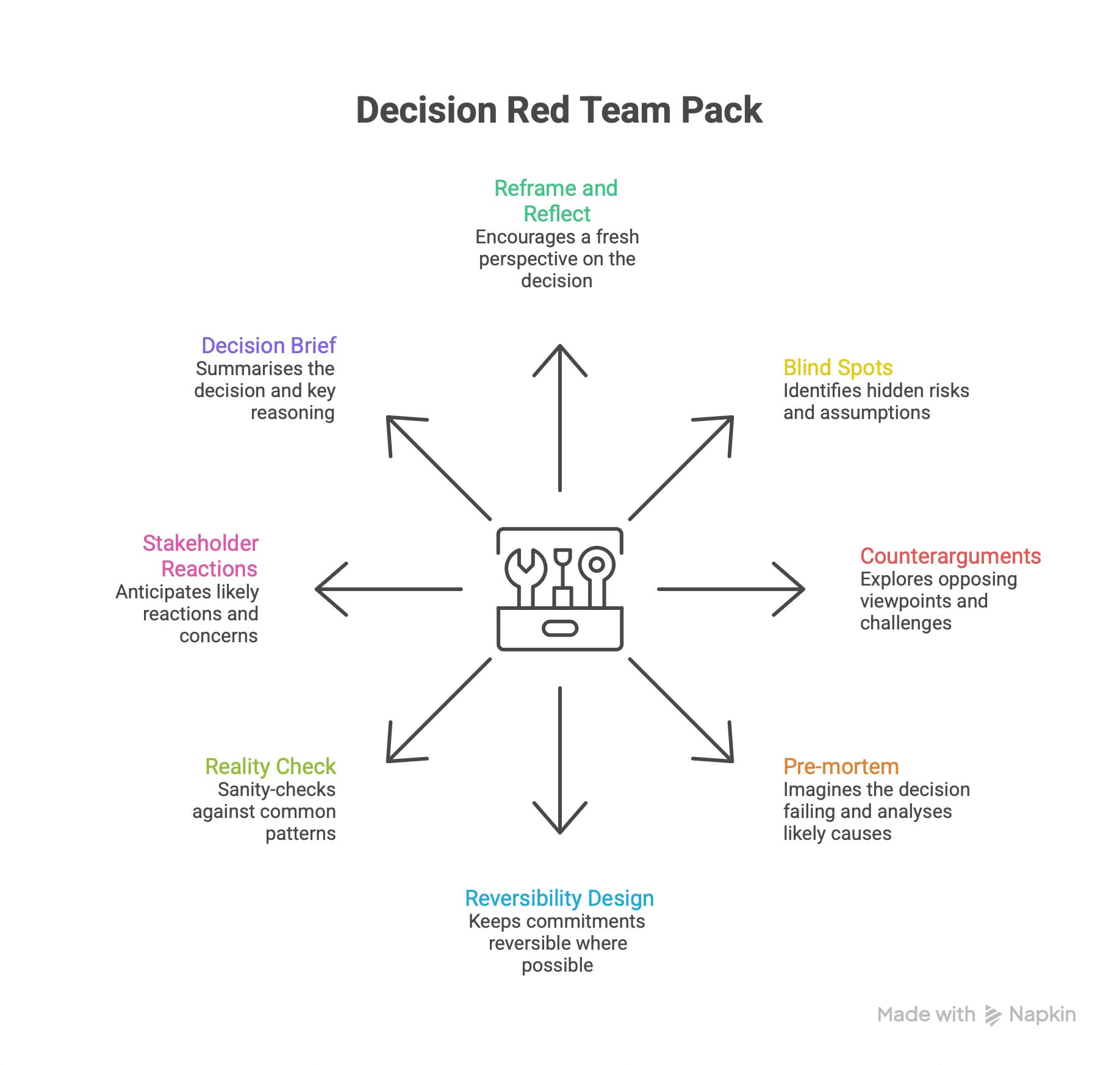
If you want to use AI around decisions, I recommend keeping it in a constrained role. The Decision Red Team Pack is a lightweight protocol designed for situations where you are busy, emotionally loaded, politically constrained or working with incomplete information - but you still want disciplined reasoning rather than a comforting narrative.
Continue reading after the banner below to access my Decision Red Team Pack, including eight prompts (see infographic), the protocol for using them without overloading yourself and a worked example end-to-end.
🔒 What follows is for paid subscribers.