
16 Leadership Lessons from 50+ Successful AI Deployments
What Stanford researchers found when they studied the companies that actually made AI work


This article is a collaboration with Diego Bonifacino. He writes Creatism and has spent 15 years helping leaders across Europe, Asia and Latin America navigate AI adoption, cultural disruption, and the human dynamics that make or break change.
A recent study from Stanford’s Digital Economy Lab examined 51 enterprise AI deployments across 41 organisations, 9 industries and 7 countries. Every case had moved beyond the pilot stage and was delivering measurable business value. The researchers spent five months conducting structured interviews with the executives and project leaders who ran these implementations, then supplemented those conversations with internal metrics, project reviews and financial data.
The headline finding won’t surprise anyone who’s tried this: the technology was consistently described as the easiest part. What follows are the patterns that separated success from failure, split into four thematic sections, alongside case studies from the research.
Let’s dive in.
What you’re actually paying for
1. Your first AI project will probably fail, and you should budget for it anyway.
Across the sample, 61% of successful AI deployments had at least one significant prior failure. Those failed experiments represent sunk costs that never appear in the “successful” project’s ROI but were often essential to it. The failures shared a pattern: teams treated AI as a technology project rather than a process and change management project.
A translation services company tried AI-powered recruiting and failed at first. Their initial attempt didn’t account for bias in screening algorithms, and the team assumed AI would fix broken processes without anyone redesigning them. The second attempt, led by the CEO rather than the CTO, started by mapping the entire recruitment workflow and identifying real pain points before touching any technology. That second attempt took one month and delivered an 83% improvement in intake efficiency.
The implication for budgeting is uncomfortable, but practical: the true cost of a successful AI deployment usually includes the cost of the one that didn’t work.
This is what Andrea introduced in his article on the “Client Zero” principle: the organisations most capable of deploying AI effectively are the ones that tested it on themselves first, absorbing the friction, the failed assumptions and the process gaps internally before applying any of it to clients or customers. The internal failure is the organisational literacy that makes future attempts work. You can’t buy that literacy, and you have to earn it by staying in the problem.
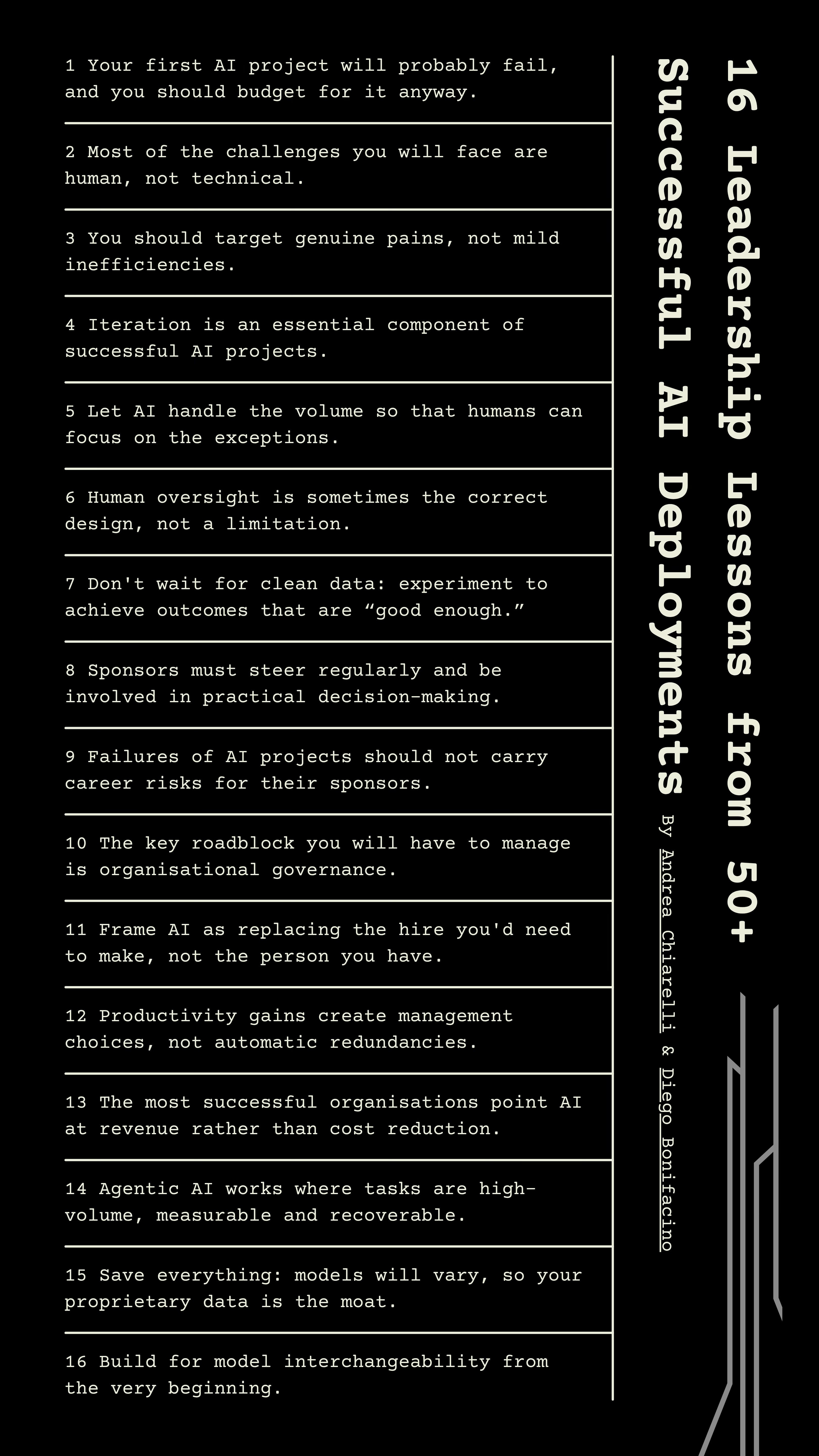

2. Most of the challenges you will face are human, not technical.
When the researchers asked practitioners what was hardest to fix, the answers clustered around change management, data quality and process redesign — not model performance or compute infrastructure. These are costs that rarely appear in vendor proposals or board presentations.
A billion-dollar logistics company processing over 100,000 invoices annually illustrates what this looks like in practice. Before any AI could work on their invoices, the team discovered that a large number of accumulated templates were redundant and inconsistent. Nobody had ever reviewed them. As a result, subject matter experts had to validate AI outputs on top of their daily work to train the model.
To support the initiative, the company’s president ran weekly check-ins to clear bottlenecks. Two junior IT staff were also embedded from day one so the company could operate the system independently.
The AI itself? “A lot of open-source and off-the-shelf stuff,” as a contributor put it. The invisible work was the actual project: process simplification, data annotation, knowledge transfer and executive attention.
3. You should target genuine pains, not mild inefficiencies.
Projects where end users were desperate for relief had near-zero adoption friction. When physicians in hospital systems were asked to adopt AI transcription tools, nobody needed convincing. After full days of patient care, doctors were spending hours documenting their activities. The technology’s ROI hadn’t even been clearly established, but hospital systems were willing to try it because their physicians were burning out.
In a case like this, AI adoption is a painkiller. Projects that solve a problem people are actively suffering from essentially adopt themselves. Projects that offer modest convenience improvements fight for attention.
How to build it
4. Iteration is an essential component of successful AI projects.
Of the cases where the researchers could identify the development methodology, 100% used an iterative approach. The pattern was consistent: start small, learn, expand. Waterfall-style delivery is simply not fit-for-purpose.
A food delivery company serving millions of monthly orders described it plainly: roughly 90% of their pilots and tests failed, but they iterated on those until they found what worked, and then it grew. They built their AI customer support in layers, eventually reaching 90–95% full automation for common issues like missing deliveries or incorrect orders. A logistics company used the same philosophy: build one process, document it, add a layer, then the next feature on top. The compound effect of these small iterations was far more reliable than any attempt to design the complete system upfront.
The Art of Asking Questions is a reader-supported publication. To support my work, please consider becoming a paid subscriber.
5. Let AI handle the volume so that humans can focus on the exceptions.
The researchers classified each case by its level of human oversight and found a striking difference. Escalation-based models, where AI handles 80% or more of work autonomously and humans review only the exceptions, delivered a median productivity gain of 71%. Approval models, where a human checks every output, delivered 30%. This partly reflects task selection (escalation models tend to be applied to high-volume, recoverable tasks), but the gap is large enough to matter strategically.
A financial services company put this into practice with marketing content. Campaign production went from seven weeks to six hours using an 80/20 split: AI generates the content, humans refine and approve it. Click-through rates doubled. The company maintained zero error tolerance on customer-facing content while achieving a 97.6% reduction in time to market. The 20% human layer served brand protection, caught edge cases and fed patterns back into the AI to improve future outputs.
6. Human oversight is sometimes the correct design, not a limitation.
That same financial services company viewed their 20% human component as transitional, expecting to reduce it as AI matures. But the researchers found four contexts where human involvement creates clear, lasting value: zero error tolerance (where a single mistake costs more than thousands of correct outputs), regulatory requirements (where human review is legally mandated regardless of AI capability), enterprise risk management (where perceived risk of autonomous AI outweighs efficiency gains) and continuous improvement (where human reviewers identify error patterns that feed back into model training).
In clinical documentation, for instance, physicians must approve every AI-generated note because these are legal documents. The point isn't whether the AI can do the work on its own: regulators wouldn't accept that regardless.
7. Don’t wait for clean data: experiment to achieve outcomes that are “good enough.”
Only 6% of implementations had data that was fully ready for AI. That’s worth repeating: in 94% of cases, the data wasn’t in good shape when the project started.
Yet in the majority of those cases, LLMs were part of the solution, processing voice transcripts, scanned documents, legacy code and scattered knowledge bases that no prior technology could handle at the required accuracy and scale.
A construction services company faced data quality issues on both sides of their procurement problem. The extraction from unstructured sources (paper forms, emails, spreadsheets submitted by field technicians) was poor, and the structured catalogue they were matching to was also inconsistent. Their solution was a four-stage pipeline: extract with Python when OCR failed, cleanse with generative AI, fuzzy-match to the catalogue despite imperfect reference data, and use human-in-the-loop review for exceptions rather than demanding 100% accuracy.
Each stage added value even with imperfect input from the previous stage. The company’s appreciation that “good enough” was the right bar to set for their purposes made all the difference.
Leading the change
8. Sponsors must steer regularly and be involved in practical decision-making.
The researchers classified sponsor engagement on a four-point scale, from passive approval through to strategic integration. Active steering with weekly check-ins, proactive blocker removal and involvement in decisions was the most common pattern among successful projects (58% of cases). But the seven cases that achieved organisation-wide transformation all reached the highest level: strategic integration, where AI adoption was embedded in corporate OKRs and tied to incentives.
A semiconductor manufacturer’s AI leader recognised that departmental sponsorship wasn’t enough after earlier initiatives stalled. He escalated to the CEO through three specific actions: placing AI champions in every department (not just engineering and IT, but Legal, HR and other non-technical functions), making AI adoption a corporate OKR, and creating demo days where the CEO gave recognition and prizes to teams driving adoption. The signal was unmistakable: AI was a strategic priority, not an IT experiment.
9. Failures of AI projects should not carry career risks for their sponsors.
This finding is narrow but consequential. In every case where the researchers could identify whether the same executive sponsored both the failed and successful attempts, the answer was yes. At the above semiconductor company, the AI leader who oversaw the initial stalled initiatives personally drove the second wave to production.
When sponsors change after failure, institutional memory leaves with them: what not to do, which stakeholders to involve, where the real bottlenecks are. And, critically, replacing a sponsor after a failed project sends a message to everyone else that failure is a career risk.
Across all 51 cases, no one was punished for a failed AI initiative. That fact alone probably explains more than any technical decision.
10. The key roadblock you will have to manage is organisational governance.
The conventional wisdom focuses on end-user resistance and the fear of job loss. The data tells a different story. Staff functions like Legal, HR, Risk and compliance were the most frequent source of resistance at 35%, ahead of internal end users at 23%. Frontline replacement fear appeared in only two cases.
Each group resisted for different reasons and required different solutions. Legal worried about liability. HR worried about change management. Risk and compliance teams worried about regulatory exposure. These functions have the organisational authority to slow or stop projects regardless of executive support.
At a large bank, past regulatory issues had created a deeply risk-averse culture. One executive described spending almost all of their time on risk and controls “where everyone is very afraid to do anything.” The solution that worked across these cases was a mandate: when AI adoption was embedded in corporate OKRs, and when staff functions were given a governance role rather than simply told to approve, there was a shift from blocking to actively supporting deployment.
Here’s Diego’s experience on this very subject:
The Stanford data shows who resists and what triggers it. But there’s another question worth considering: why does resistance sometimes survive even mandates, governance roles and pressure from OKRs?
In my experience running AI adoption workshops across banking and construction teams, the resistance that’s hardest to move is about identity. Staff functions like Legal and HR have built their organisational authority on being the humans who catch what machines miss. When AI enters, they fear losing their answer to the question “what do I do here that only I can do?”
I run a diagnostic workshop called Picture AI with leadership teams. In one session with a 50-person banking HR team, I asked participants to draw how they see themselves in a world shaped by AI. One participant drew themselves without a face. They weren’t resisting AI, but mourning a version of themselves that hadn’t been replaced yet.
11. Frame AI as replacing the hire you’d need to make, not the person you have.
Fear of replacement dissolves when the path forward is concrete: what work disappears, what remains, what new work emerges. A technology services company with a six-person Security Operations Centre processing 1,500 alerts per month deployed AI to automate alert triage. The team was already drowning: they could only investigate high-priority alerts thoroughly, and lower-priority alerts received minimal coverage.
The sponsor framed freed capacity as a path up: AI took the mechanical triage (classification, false-positive filtering, routine escalation), whereas analysts kept the judgment-intensive investigation that required their expertise. As one executive put it: “AI is not replacing the person you have. AI is replacing the person you don’t need to hire. The person you have can now do two or three or four people’s work.”
Capacity jumped from 1,500 to 40,000 alerts per month. No one was laid off. The 4.5 FTEs of freed capacity moved to threat hunting, security architecture and capability development.
12. Productivity gains create management choices, not automatic redundancies.
Headcount reduction was the largest single outcome across the sample at 45%, but alternatives like avoided hires, redeployment and maintaining headcount accounted for 55%. Technology doesn’t dictate this type of decision. Strategic context does.
An education technology company illustrates the tension. With documented productivity gains of 20–30% in engineering and millions in content production savings, the leadership team faced a decision. The CEO and COO, under private equity pressure, leaned towards cost reduction. The CTO argued for acceleration: the company had a large product backlog, and shipping features faster would generate more revenue than cutting the team that worked on those features.
For engineering, the company chose acceleration. For content production, the savings were captured and reinvested in AI development. The same gains that could have justified headcount cuts instead justified accelerating the roadmap. Both were rational choices and, importantly, it was the leadership team that made the decision, not the technology.
A forward-looking caveat from the researchers: the 45% reduction rate they observed may represent a floor, not a ceiling. As models improve and cost pressures mount, the calculus will likely shift.
Where the real value is
13. The most successful organisations point AI at revenue rather than cost reduction.
Most implementations in the sample were measured as productivity improvements or cost reductions. But the highest returns came from companies that pointed AI at revenue: personalising offers for individual customers rather than segments, closing deals in hours instead of weeks and packaging internal tools as products sold to clients.
A traditional call centre services company was facing an existential threat: AI-native startups could offer intelligent routing and automated resolution from day one, and the underlying seat-based pricing model was eroding. Instead of using AI to make human agents faster, the management team embedded agentic AI directly into their product, redesigning the service so that AI could resolve tickets end to end.
The result was a repositioning. The company won 20+ new deals attributed to AI capabilities, was ranked among the top four for AI in customer experience (the other three were AI-native companies) and began shifting from selling seats to selling outcomes.
14. Agentic AI works where tasks are high-volume, measurable and recoverable.
Agentic implementations where AI takes autonomous actions and completes multi-step tasks end-to-end represented only 20% of the sample but delivered 71% median productivity gains versus 40% for high-automation approaches. The successful cases shared four characteristics: high volume (thousands of alerts, hundreds of procurement decisions), clear success criteria (the AI can evaluate its own outputs), recoverable errors (mistakes are costly but not catastrophic) and data access across multiple systems.
A regional supermarket chain with roughly two dozen stores deployed an AI system that replaced the human procurement function entirely. The system makes calls on what to buy, when and from which supplier, optimising thousands of decisions across every store simultaneously. A human buyer making the same decisions couldn’t work at that scale.
Waste fell 40%. Stockouts fell 80%. EBITDA margin doubled. For a small retailer competing against chains with massive procurement power, agentic AI made a genuine difference.
15. Save everything: models will vary, so your proprietary data is the moat.
Every frontier lab is training on every piece of public data it can access. Organisations can’t compete on that axis. But 75% of implementations cited proprietary data as a key factor in their AI strategy, and 47% described their accumulated data as a competitive moat.
An HR technology company built their differentiation on 13 years of accumulated data: “Our differentiator, the reason why people buy from us, is because we created this knowledge graph. We have over 20 billion data points.”
The pattern was consistent across industries: the organisations generating the most value from AI were those that had been storing data (even imperfect data) long before they knew how they’d use it.
As open-source models close the performance gap with proprietary ones, the differentiator shifts from which model you use to what data you feed it. The cost of storing data is negligible compared to the cost of not having it when the right use case arrives.
16. Build for model interchangeability from the very beginning.
For 42% of implementations, model choice was fully commodity: any frontier model would have delivered similar results. The commodity boundary tracked with task complexity: routine tasks were four times more likely to be interchangeable than advanced reasoning tasks. The highest-performing organisations built abstraction layers that allowed model switching without rearchitecting the system.
A communications technology company built a multi-LLM gateway that routes each customer support query to the optimal model based on cost, latency, relevance and accuracy. They use Claude, ChatGPT, Llama, and other solutions interchangeably. The results included 82% ticket deflection, 71% resolution rate and 40%+ agent productivity improvement: they were driven by the orchestration layer, not by any single model. The gateway avoids vendor dependency and optimises cost per query rather than making a single global model choice. It also absorbs improvements from any provider automatically.
The durable advantage, across the full sample, was consistently in what organisations built around the model, not in the model itself.
The pattern beneath the patterns
Across all 16 lessons, one finding is especially consistent: the difference was almost never the AI model. It was always the organisation.
The same use case took weeks at one company and years at another. The same technology delivered very significant efficiency gains on its second attempt after failing completely on its first. The same productivity improvements led to headcount cuts at one firm and accelerated growth at another. But, in 42% of cases, the model itself was fully interchangeable: any frontier option would have produced similar results.
What separated the organisations that captured value from those still running pilots was a set of distinctly human capabilities:
Sponsors who stayed through failures.
Teams given permission to experiment.
Processes redesigned before technology was applied.
Resistance met with organisational commitment and governance rather than PowerPoint decks.
It’s not just better leadership that we need today, but a different kind. And one that most organisations aren’t selecting for or developing.
The leaders in these success stories succeeded because they could tolerate not knowing. They could hold the question “where does AI actually belong in how we work?” without rushing to an answer, and then build the organisational conditions for others to find it.
The “Client Zero“ principle captures one dimension of this: the willingness to make yourself the first test case. To absorb the friction and the broken processes internally before you deploy any of it outward. That requires a specific kind of intellectual honesty that many leadership teams avoid.
The leaders in Stanford’s 51 success stories had something else too: what we would call ‘structural imagination.’ They were able to see their own organisation’s processes as redesignable, and to search beyond the familiar for where AI creates real value, not just where it’s convenient to apply. The skill here is to hold what exists and what could exist in the same frame, without collapsing the tension too early.
The Stanford researchers close their report with an observation that’s hard to ignore: the window for experimentation is narrowing. The question today is whether organisations will evolve fast enough to capture the value that AI can deliver, and whether leaders will treat the transition as something they owe to their people, not just their shareholders.
95% of generative AI pilots fail to produce measurable financial impact, according to MIT’s NANDA initiative. The 51 cases in this study sit in the minority that didn’t. What they have in common is better leadership — and a specific, learnable kind of it.
👇 Steal My Toolkit
The newsletter covers ideas, frameworks and honest takes on consulting practice. The paid tier is where those ideas become usable: you get templates you can open in a project, prompts you can run today, and research tools built from over a decade of fieldwork.
Paid members get instant access to:
Consulting with AI Series: the custom AI prompts I use in my own management consulting work, explained and ready to adapt.
Full Course: Asking Questions Like a Pro - A Practitioner’s Guide to Mixed Methods Research ($199 value): practical research techniques refined across 10+ years of consulting engagements, covering design, facilitation and analysis.
Practical Guides, Handbooks, Workbooks and Templates: premium resources from paid posts or 70% off discounts for my Gumroad assets.
Cozora discount (up to $360 off): up to 50% off a Cozora subscription to learn AI from practitioners who use it in real work.
Free subscribers aren’t left out either.
Leader Tools Cards: 10% off with code ANDREA10 at leadertools.co/ANDREA10
Cozora welcome discount: 10% off via https://cozora.substack.com/andre10
Demystifying Academic Research - A practical guide for navigating academic research without a PhD: Available for free (pay what you can, $0+) via Gumroad
Disclosure: I earn a referral fee if you purchase through my links, at no extra cost to you.
 |
|